
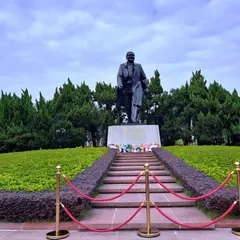
Park and lookout
Lianhuashan Park
Hillside park in central Shenzhen: Kite Square, the bronze statue of Deng Xiaoping on the summit, the wall with his 1984 inscription and the lookout over Futian's skyscrapers.
Shenzhen, China
Walk the city born of reform with 32 audio stops narrated by experts. From Nantou's Ming wall to the lookout on the 116th floor, every place explains how a county of fishermen and rural markets became the factory and laboratory of modern China.
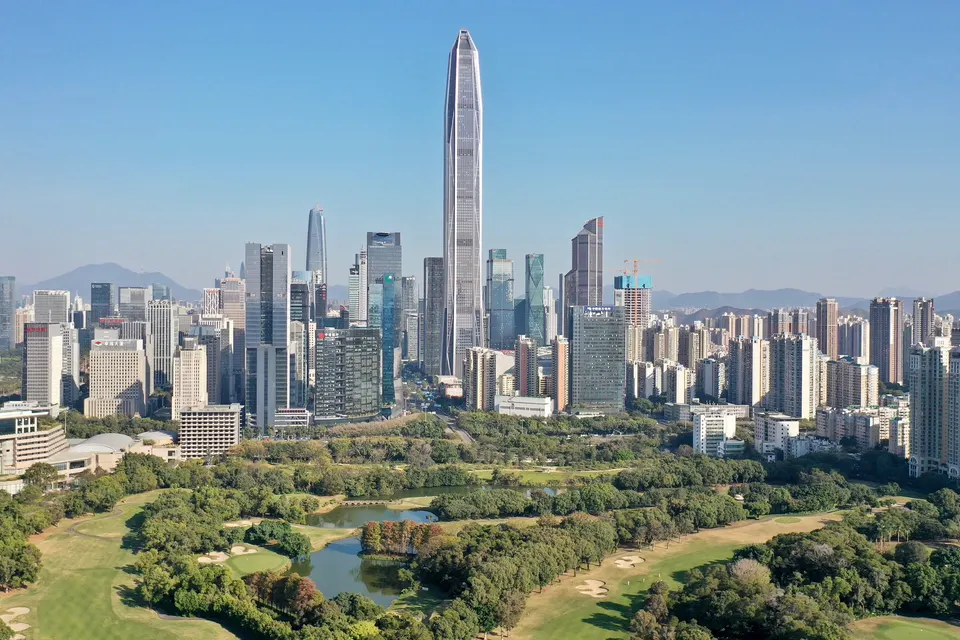
Photo: Charlie fong, CC BY-SA 4.0
Park and lookout
Hillside park in central Shenzhen: Kite Square, the bronze statue of Deng Xiaoping on the summit, the wall with his 1984 inscription and the lookout over Futian's skyscrapers.
Skyscraper and lookout
Nearly 600-metre skyscraper in Futian, Shenzhen: stainless-steel facade, the antenna dropped in 2015, the glass floor of the Free Sky lookout and the views over Hong Kong.

Stranded ocean liner
Former French liner turned hotel and stranded ashore in Shekou: the Minghua ship, Deng Xiaoping's calligraphy, the statue of Nüwa and the Sea World Culture and Arts Center.
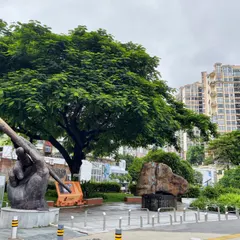
Village of painters
Oil-painting village in Shenzhen: the entrance sign, the gallery street with Van Gogh copies, the studios of the back alleys and the Dafen Art Museum.

Ming walled city
Ming walled city of 1394 in Shenzhen, former capital of Xin'an county: the South Gate, the Dongguan Guild Hall, Baode Square, the Wen ancestral temple and the wall in Zhongshan Park.

Electronics market
Shenzhen's electronics district: the Electronics Building, SEG Plaza and its component market, the pedestrian street of market towers and the Huaqiangbei Museum.

Historic market
Pedestrian streets of the old Shenzhen Xu, the market that named the city: the Siyue Academy, Ye Ting's headquarters, mainland China's first McDonald's and the bronze relief of the old market.
Shenzhen Audio Guide
Shenzhen is read in two times. The first is old: the walled city of Nantou, raised in 1394 as the seat of Xin'an county, from which Shenzhen and Hong Kong emerged, and the old rural market of Shenzhen Xu, today the Dongmen pedestrian street, which lent its name to the metropolis. The second begins with reform: in 1983 the liner Minghua was stranded on the beach at Shekou as a hotel for China's first reform zone; the military factories moved in 1979 gave way to the electronics market towers of Huaqiangbei, and the Hakka village of Dafen became the world's largest oil-painting factory. In Futian, the bronze of Deng Xiaoping on the summit of Lianhuashan Park looks straight at the new centre, where the Ping An Finance Center raises 599 metres of stainless steel with a lookout on the 116th floor.
With the EarGuide Shenzhen audio guide, every place reveals its history through professional narration prepared by guides who know the city and reform-era China inside out. Unlike a free walking tour or a conventional guided visit, you set the pace, the order and the stops. No groups, no timetables, no internet connection.
No internet needed
Download the routes before you head out and explore without using data.
Smart geolocation
The narration starts by itself when you reach the point of interest.
Frequently asked questions
The EarGuide app is free. The Shenzhen audio guide includes 7 independent routes with a little over seven hours of professional narration spread across 7 sites and 32 audio stops, and it is found inside the app itself.
No. EarGuide works entirely offline. Download the routes over WiFi before you set out and you can use the audio guide with no connection and no data use throughout your walk around Shenzhen. The map shows your GPS position in real time even without coverage.
The Shenzhen audio guide is available in Spanish and English, with professional narration prepared by guides and experts in the history of Shenzhen and of reform-era China.
The audio guide brings together 7 independent routes with a little over seven hours of narration in total, from 45 to 75 minutes per route. They are designed to be spread over two or three days: you can do them separately or string together the ones that are close by in a single walk.
They are different experiences. The EarGuide audio guide lets you walk Shenzhen without timetables or groups, pause and resume whenever you like, and replay any explanation as often as you need. It suits independent travellers, families and anyone who prefers to understand the city at their own pace, with no prior knowledge of China.
The Shenzhen audio guide covers 7 main sites: Lianhuashan Park and the statue of Deng Xiaoping, the Ping An Finance Center, Shekou Sea World and the Minghua ship, the Dafen Oil Painting Village, the Nantou Ancient City, Huaqiangbei and Dongmen Pedestrian Street, with stops that range from Nantou's Ming wall to the lookout on the 116th floor.
By area. Lianhuashan Park, the Ping An Finance Center and Huaqiangbei are in Futian, a few kilometres from one another, and Dongmen lies somewhat farther east, in Luohu. Shekou Sea World and the Nantou Ancient City are in Nanshan, to the west, and the village of Dafen, in Longgang, to the northeast, so it is best to reach them by metro.
Yes. Purchases belong to your EarGuide account, not to one app or one phone. A city unlocked in the EarGuide app is also unlocked in that city's own app, and the other way round, on both iPhone and Android. Just sign in with the same account on the other device. The store's “restore purchases” button only covers the app the purchase was made in, so signing in is what carries it across.
The Shenzhen audio guide is inside the EarGuide app, free and ready to use offline. Carry it in your pocket and explore the city at your own pace.
Coming soonMore destinations
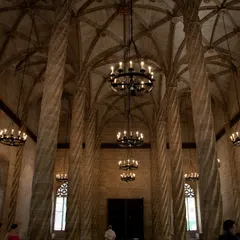
From the City of Arts and Sciences to the Carmen neighbourhood. Discover 2,000 years of Valencian history with audio guides.

From the Plaza Mayor that inspired Madrid to the house where Cervantes wrote Don Quixote. Discover the former capital of the court of Philip III with audio guides.

From the sacred mountain of Doi Suthep to the market built over the royal cemetery. Explore the old capital of the Lanna kingdom with audio guides.

From the Art Nouveau town reborn out of the 1904 fire to a wooden lighthouse on the edge of the Atlantic. Explore Ålesund and its islands with audio guides.

From the Templar castle where a pope refused to stop being one to the range this coast deliberately left wild. Explore the walled town of the Papa Luna with audio guides.

From a half-moon pond over a spring to the gilded mansion of a salt merchant. Explore the Wang clan's village, shaped by water, with audio guides.
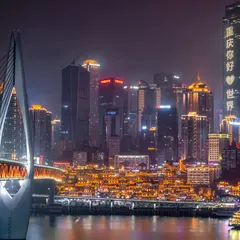
From the stilt houses of Hongyadong to the train that crosses a building at Liziba. Explore the mountain city of the Yangtze and the Jialing with audio guides.

From the stone archway the clan nearly turned into lime to the corner a prefect gave up to the street. Explore the Hu clan's village, in Huizhou, with audio guides.
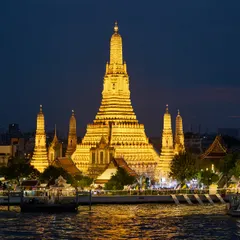
From the Emerald Buddha dressed in gold for each season to the solid gold Buddha hidden beneath stucco. Walk old Bangkok, from Rattanakosin to Chinatown and Thonburi, with audio guides.
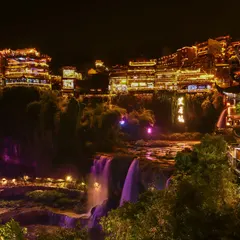
From the waterfall that splits the town in two to the bronze pillar that sealed a peace in 940. Explore old Wangcun, hanging over the You River, with audio guides.

From the Ming wall that still closes the city to the clay soldiers farmers found digging a well in 1974. Old Chang'an, with audio guides.
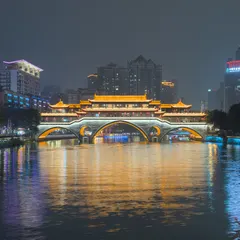
From the tomb mound of Liu Bei that nobody has opened to the nurseries of the giant pandas. Explore the capital of Sichuan, its temples and its teahouses, with audio guides.

From the throne of the Forbidden City to the battlements of Mutianyu and the hill where the last Ming emperor hanged himself. Six centuries of imperial capital, with audio guides.
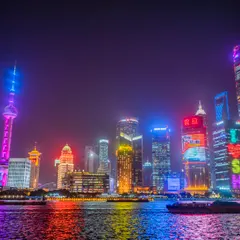
From the waterfront of banks and customs house raised by the foreign concessions to the eleven-sphere tower that founded Pudong. Shanghai district by district, with audio guides.

Timber stilt houses hanging over the Tuo River, a red sandstone wall and a bridge from 1670 that was market, road and market again. Old Fenghuang, with audio guides.
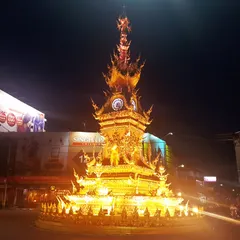
From the white temple a painter rebuilds at his own expense to the bank where Thailand, Myanmar and Laos face one another. Chiang Rai and its artists, with audio guides.

From the chapel of the kings of Siam to the Buddha head trapped in a fig tree and the temple-mountain by the river. The old capital, with audio guides.

From the Li River of the 20-yuan note to the arch of Moon Hill and the stone bridges of the Yulong. The karst of southern China, with audio guides.
We are working to bring EarGuide to more cities. Where do you want to discover culture?