Skyscraper and lookout
Ping An Finance Center Audio Guide (Ping'an Jinrong Zhongxin)
Almost 600 metres of stainless steel in the heart of Futian: the tower that gave up its antenna to leave room for aircraft and that, from the Free Sky lookout on the 116th floor, looks out at once over Shenzhen's planned centre and the hills of Hong Kong.
- 60 min of audio
- Lookout on the 116th floor
In 2007 the insurer Ping An paid just over 1,656 million yuan for plot no. 1 of Futian's central district, and on it, from 2008, Kohn Pedersen Fox designed a tower shaped like a steel cable stretched between sky and ground. Work began in 2009, overtook the KK100 as Shenzhen's tallest building in 2014 and was considered finished in 2017, when the CTBUH confirmed its completion. It was raised as a symbol of a city that grew from some 300,000 inhabitants to nearly 10 million in the 35 years since it became China's first Special Economic Zone.
The great contrast lies at the top. The project foresaw a 60-metre antenna, up to about 660 metres, to surpass the Shanghai Tower; in February 2015 it was dropped because it could interfere with flight routes, and the tower stayed under 600 metres. What it lost in height it gained in outlook: on the 116th floor, the Free Sky lookout holds the cantilevered glass-floor platform that Guinness recognised in 2019 as the highest in the world, at 547.60 metres.
Highlights
- Stainless-steel facade — 1,700 tonnes of 316L steel against the salty air, the largest in the world when completed
- Supercolumns — Eight pilasters rising up the shaft and converging toward the crown like taut cables
- Free Sky elevator — From floor B1 to the 116th in about a minute, at 10 metres per second
- Glass floor — The world's highest cantilevered platform according to Guinness, at 547.60 metres
- 116th-floor windows — The Hong Kong border to the south and the axis of Futian Civic Centre to the north
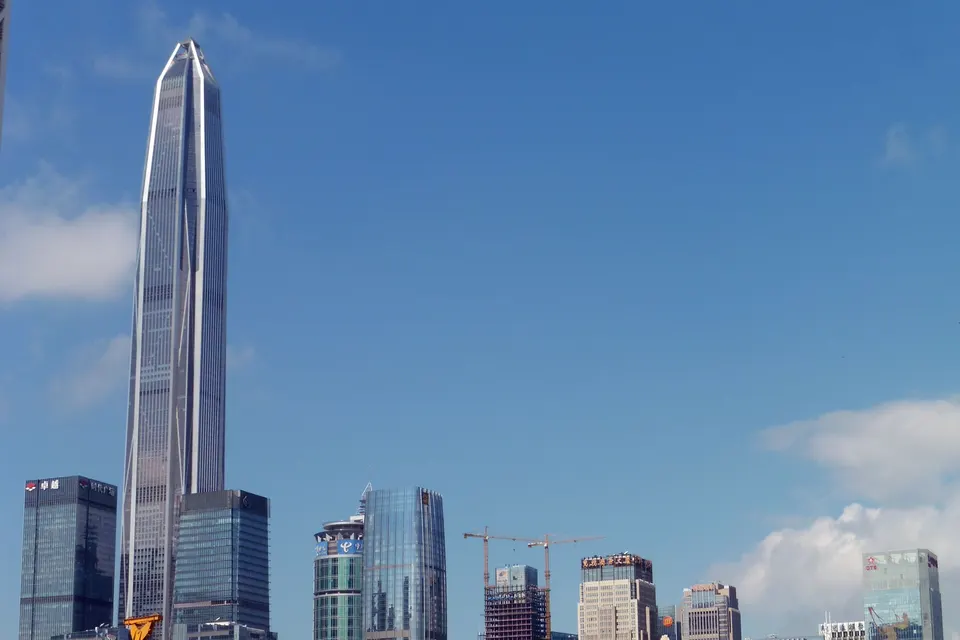
In Futian’s central district rises the Ping An Finance Center (平安金融中心), the tower that on 15 July 2014 overtook the KK100 as Shenzhen’s tallest building. Its architectural height is around 599 metres, though the figures vary: when the main structure was topped out, 592.1 was given. It is the headquarters of the insurance group Ping An, which gives it its name and occupies at least six tenths of its floor area, with floors 47-48 and 109-112 as corporate headquarters. And on its 116th floor it holds the Free Sky lookout, opened in 2018, from which the city and the Hong Kong border read like a map.
The history of the Ping An Finance Center is made of twists. The first stone was laid on 29 August 2009, and in 2013 work was even halted over a suspicion about the concrete. In January 2015 the Malaysian photographer Keow Wee Loong climbed the tower under construction, and on 19 February, in the middle of Chinese New Year, the urban explorers Vadim Makhorov and Vitaly Raskalov climbed to a crane above its summit and shared photos and video. That same February the antenna that would have made it the tallest in China was dropped, and the main structure was topped out on 30 April 2015. The exterior lighting was first switched on at dusk on 16 December 2016, with the crown in red, and the tower was officially lit on the night of 28 March 2017, when the CTBUH confirmed its completion.
Its architecture resists round figures. The CTBUH counts 115 floors above ground and other sources 118, while the lookout is placed on the 116th; the height of the Free Sky is published as 541 metres from the ground, 547.6 in the Guinness record or 562 as observatory height. At its foot, the shopping mall joins it to the South Tower, of some 290 metres, with the Park Hyatt hotel and offices. It has not always been full: in the second quarter of 2019 almost 30% of its offices were still empty. Its facade, on the other hand, has served as a screen. On New Year’s Eve 2023, the light show “龙腾CBD”, the dragon rising over the financial district, bathed it in blues, cyans and purples until bursting into yellow with dragon motifs to welcome the Year of the Dragon, and for the first time projected messages written by Shenzhen residents, among them a joke about piling up money on the bank card and not calories on the body.
To know what to see at the Ping An Finance Center beyond the view, the audio guide covers it in four stops and one hour of narration: from the plaza at the foot of the tower to the elevators on floor B1, the glass floor on the 116th and the windows facing Hong Kong and Futian. The thread is a single one: a tower dressed in steel against salt air and typhoons that gave up being the tallest in China.
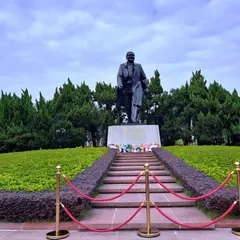
To the north, at the other end of Futian’s axis, rises the hill of Lianhuashan Park, where Deng’s bronze looks south, and to the east lies Huaqiangbei, the electronics market where the city learned to manufacture.
A steel cable against the salt air
Ping An Finance Center
Summary of this stop
From the plaza at the foot of the tower, the first impression is of just another skyscraper. The supercolumns correct it: eight large composite pilasters stand out from the envelope and run up the shaft from bottom to top, converging toward the crown. Kohn Pedersen Fox, who designed the tower from 2008, conceived it as a steel cable stretched between sky and ground, and that sharpened silhouette reduces reference wind loads by 35%. Above, the facades narrow into a faceted pyramidal crown that dominates Futian’s skyline at night.
The skin is not like its neighbours’ either. Against the glass curtain wall of the surrounding skyscrapers, the facade is clad in vertical bands of matte-finish stainless steel: 1,700 tonnes of 316L steel, the largest stainless-steel facade in the world when completed, chosen for its resistance to the corrosion of Shenzhen’s salty coastal air. It is Outokumpu Supra 316L with an embossed finish, Deco Linen, chosen to give the sun a soft, diffuse gleam instead of a mirror reflection and to limit light pollution.
Corrosion was also the great suspicion of the works. In March 2013, with work under way since 2009, the Shenzhen Housing and Construction Bureau ordered a halt on suspicion that concrete made with untreated sea sand, rich in chlorides that corrode steel, was being used; after drilling cores to a depth of 12 centimetres, work resumed that same month. On the plaza, the audio guide tells why the sea marked the history of this steel tower as much as the sky.
The 60-metre antenna that never went up
Free Sky elevators on floor B1
Summary of this stop
Access to the lookout is not at the top but underground: on floor B1 of the shopping mall, connected to the Shopping Park metro station on lines 1 and 3. There, before going up, the tower recounts its own vertical career. On 15 July 2014, when a 10-metre steel column was hoisted, it overtook the KK100. The project foresaw crowning it with a 60-metre antenna, up to about 660 metres, to surpass the Shanghai Tower, but in February 2015 it was dropped because it could interfere with flight routes. In January it had already been rumoured, without official confirmation, that the height would drop from 660 to 592.5 metres for the safety of Shenzhen’s airspace; Ping An only stated that it was not seeking to be China’s tallest building. Today the top ends in the crown itself, with no mast.
A direct panoramic elevator, at 10 metres per second, takes visitors to the 116th floor in about a minute. Others make the climb on foot: since 2018 the tower has hosted a vertical marathon of 3,201 steps, 116 floors and about 541 metres of elevation gain, which forces a change of stairwell eight times, with flat stretches of some 60 metres that some use to catch their breath and others hate because they break the rhythm.
On 10 January 2026, with some 1,500 participants, among them Shenzhen firefighters and company teams, the Malaysian Soh Wai Ching won in 19 minutes and 23 seconds and beat by a single second the course record, held by his eternal rival, the Japanese Ryoji Watanabe, second that day. Among women, the Croatian Tea Faber retained the title in 22 minutes and 41 seconds. Beside the elevators, the audio guide sets that one minute of ascent face to face with the under twenty the world’s best runners need.
Glass floor and the Monkey King’s staff
Triangular glass-floor platform
Summary of this stop
On the 116th floor, the floor disappears. The cantilevered triangular glass platform lets visitors walk looking straight into the void, and on 21 October 2019 Guinness recognised it as the world’s highest glass-floor platform, at 547.60 metres: 541 from the ground to the 116th floor, plus 6.6 from the sunken pedestrian entrance at the base. Skyscraper databases give another figure for the observatory, 562.1 or 562.2 metres, depending on the source.
What keeps things calm at that height is very close by. Two hybrid dampers of 500 tonnes each, on the 114th floor according to Ping An engineers cited by the business press (a 2021 local report places them on the 113th), counteract the wind: when a typhoon pushes the tower to one side, the mass moves to the other, guided by computer and motors, like the counterweight of a scale. During Typhoon Mangkhut in 2018, they kept the sway of the top under 30 centimetres, within 50% of the design value, and the tower is calculated for mean winds of 60 m/s and gusts of 80. On the night of 23 September 2025, with Typhoon Ragasa, the upper floors withstood gusts of force 8 to 9.
Shenzhen has given them a legendary name. They are nicknamed “定楼神针”, the divine needle that fixes the building, a play on “定海神针”, the popular name of the magic staff that in Journey to the West the Monkey King, Sun Wukong, pulled from the palace of the Dragon King of the Eastern Sea. At the lookout, beside telescopes and interactive screens, the model of the damper that visitors can handle with their own hands carries another nickname: “镇楼神器”, the wondrous artefact that protects the tower. Above the glass, the audio guide explains how a classic Chinese novel ended up naming a piece of engineering.
Hong Kong to the south, Futian’s axis to the north
Panoramic windows on the 116th floor
Summary of this stop
From the southern windows, the map becomes a border: the strip of the Shenzhen River, the Futian and Huanggang border crossings and, on the other side, Hong Kong’s Northern district, with the ridges between Tai Po and Sha Tin and, to the southwest, the wetlands of the Mai Po reserve. That proximity helps to understand the city: Shenzhen was China’s first Special Economic Zone and in 35 years grew from some 300,000 inhabitants to nearly 10 million. The tower was designed as a symbol of that leap.
To the north, the city appears drawn with a ruler: Shenzhen’s Civic Centre on the central axis of Futian district, to the east the Shenzhen Central Park and to the west the Shenzhen Bay Bridge. In that planned centre, plot no. 1, of some 18,400 m², was auctioned on 6 November 2007 and Ping An won it for just over 1,656 million yuan, with a 40-year land-use right expiring on 5 November 2047.
The tower’s staircase also had its festival. In 2020 the vertical marathon was held on 25 October, the day of the Chongyang festival, the Double Ninth, whose age-old custom is “climbing high to look far” (登高望远): some 300 athletes were called to climb the 3,201 steps to the Free Sky in a race dedicated to the 40th anniversary of the Shenzhen Special Economic Zone. That year, the old tradition of climbing a hill in autumn moved to the city’s tallest skyscraper. In front of the windows, the audio guide’s last stop reads at a glance the history of a city pressed against the border.