Stranded ocean liner
Shekou Sea World Audio Guide (Shekou Haishang Shijie)
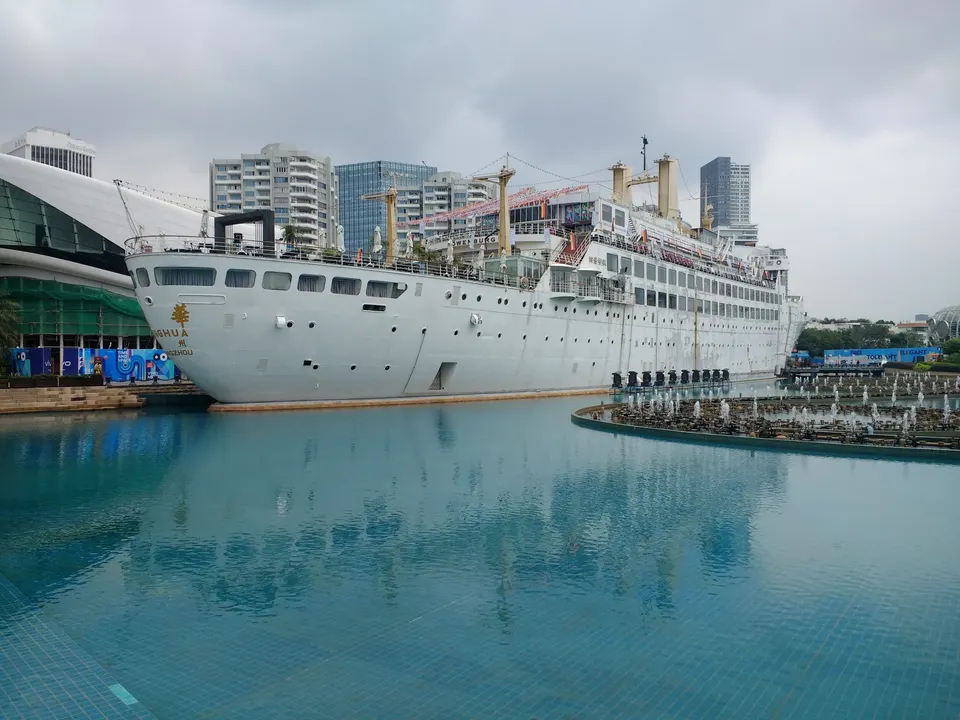
A French liner launched by De Gaulle in 1962 and beached in 1983 on a Shekou shore to house China's first reform zone: today the Minghua is a 168-metre ship without a drop of water around it.
- 60 min of audio
- Reform and opening-up
When in 1979 Shekou became the Industrial Zone that the China Merchants group developed under the direction of Yuan Geng, even before the Shenzhen Special Economic Zone existed, the most basic thing was missing: somewhere to sleep. The solution came by sea. In 1983 the zone bought the Minghua, the former liner Ancerville, and left it stranded in Liuwan Bay as a fixed building. In January 1984 Deng Xiaoping went aboard and wrote four characters, 海上世界, “World on the Sea”, which gave their name to the complex, the neighbourhood and even the metro station.
The contrast lies in the ground. The ship ran aground on a beach, but from 1989 more than twenty years of landfill won all its surroundings from the sea, and in the 1990s the hull, of some 14,000 tonnes, ended up entirely on dry land. Today it stands in the middle of a pedestrian plaza ringed by restaurants and towers, and the shore where it was stranded is only an absence beneath the paving.
Highlights
- Minghua ship — A 168-metre liner launched by De Gaulle in 1962 and stranded on dry land
- “海上世界” sign — The calligraphy Deng Xiaoping wrote aboard in 1984 that named the neighbourhood
- Statue of Nüwa — 18 metres, half woman and half serpent, beside a former bathing beach
- Sea World Culture and Arts Center — The Fumihiko Maki building that houses Design Society
- Sea World plaza — Water and light shows at dusk in front of the ship's bow
In Shekou, in Shenzhen, an ocean liner rises in the middle of a pedestrian plaza with no water around it. It is the Minghua, heart of Shekou Sea World (蛇口海上世界, Shekou Haishang Shijie): a French liner launched in 1962, bought by China in 1973 and stranded in 1983 as a hotel for the country’s first reform zone. Its name, 明华, is interpreted sometimes as “spirit of China” and sometimes as “illuminate China”, and both readings suit a ship that ended up as a showcase of an era.
The history of Shekou Sea World begins before Shenzhen was a Special Economic Zone. On 31 January 1979 Shekou officially became an Industrial Zone, developed exclusively by the Hong Kong-based China Merchants group under the direction of Yuan Geng, and on 8 July that year the blasting of Sheshan hill fired the “first shot” of reform and opening-up. Accommodation was lacking, and the answer was a ship that had already lived several lives: the last, in 1978, a mission from Huangpu port, in Guangdong, to evacuate ethnic Chinese from Vietnam that failed and returned it to port without a single evacuee aboard. The date of its arrival in Shekou is disputed (17 or 27 August 1983, depending on the source), as is the extent of Deng Xiaoping’s visit in January 1984: one version speaks of a stay aboard and another reduces it to a lunch on 26 January, the day of the calligraphy. Opened at the Spring Festival of February 1984, it was China’s first tourist resort created from a large cruise ship, and in 1986, according to accounts, the former captain’s lounge hosted a game of go between China and Japan followed by Xu Jiatun, the Communist Party’s top representative in Hong Kong, while the ballroom offered discounts to members of the Communist Youth League.
The architecture of Shekou Sea World is today that of a neighbourhood built around a hull. The ship closed in 1998 after a fire and management problems; a 70-million-yuan refurbishment remade it between 2001 and 2005, and in December 2013 China Merchants launched the new Sea World, a retail and hotel complex that the firm Callison designed over three years around the Minghua, which today houses a 110-room hotel. Toward the sea rises the Sea World Culture and Arts Center, by Fumihiko Maki and opened in 2017: a sculptural plinth from which three cantilevered volumes emerge, home to Design Society in partnership with the V&A.
To know what to see at Shekou Sea World beyond the shops, the audio guide covers it in five stops and one hour of narration: the plaza in front of the bow, the side of the hull, the sign with Deng’s calligraphy, the statue of Nüwa and the Culture Center by the sea. The thread is a single one: a ship without water that showed all of China what reform could be, until the city won the sea from around it.
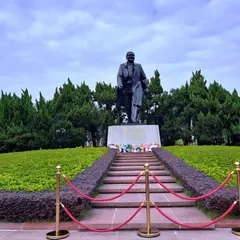
The name Sea World was given by Deng Xiaoping, the same man whose statue crowns Lianhuashan Park; a few kilometres away, in the same Nanshan district, the Nantou Ancient City holds the county capital that preceded Shenzhen.
An ocean liner aground in the middle of the plaza
Sea World
Summary of this stop
In front of the bow, on Sea World’s central plaza, the scene has something of a scale error: a 168-metre ship resting on paved ground, with no dock or water to justify it. That strangeness is the best key to understanding the place. The Shekou Industrial Zone, born in 1979 at the hands of China Merchants and Yuan Geng, needed first of all somewhere to lodge people, and in August 1983, after its last voyage between Yokohama and Shanghai, the Minghua was sold to it.
The ship reached Shekou at the end of August, and the Fourth Naval Engineering Bureau of the Ministry of Communications took three and a half months to drag it to Liuwan Bay, where it was left stranded like any other building. Turning a liner into a hotel required a trade that nobody in Shekou had. According to accounts from the time, Wang Chaoliang, appointed manager in 1983 with no hospitality experience, brought more than ten professionals from Hong Kong on high salaries, from the head of housekeeping to the master chef, and paid a Hong Kong hotel manager more than thirty times his own monthly salary. In front of the bow, the audio guide tells how people learned to look after a tourist in the country’s first floating hotel.
The lives of the Ancerville before Shekou
Minghua hull
Summary of this stop
Along the side, the motionless hull keeps a deep-sea biography. It was born as the Ancerville, built at the Chantiers de l’Atlantique shipyards and launched on 5 April 1962 by President Charles de Gaulle. There is a notion that it was the French president’s yacht or exclusive ship, but it was a scheduled liner of the Compagnie de Navigation Paquet: it served the Marseille–Dakar route, six days each way, with 171 first-class, 342 second-class and 243 third-class berths. De Gaulle merely launched it.
In July 1970, near the Canary Islands, the Ancerville rescued all the passengers and crew of the Fulvia, a liner that was burning and sinking. On 7 April 1973 the Guangzhou Maritime Transport Company bought it and renamed it Minghua, and from 1973 to 1978 it carried Chinese aid personnel to Tanzania and other countries, among them workers on the Tanzania–Zambia railway.
There was still one more life, documented in diplomatic chronicles: in May 1979, four years before being stranded, the Minghua toured Japan as the “Sino-Japanese friendship ship”, with a delegation of 600 “friendship envoys” led by Liao Chengzhi, born in Tokyo and president of the China-Japan Friendship Association; aboard travelled the widow and daughter of Marshal He Long. Beside the hull, the narration follows this ship across three continents before it stopped moving.
The calligraphy Deng wrote aboard
Minghua “海上世界” sign
Summary of this stop
Above the ship, four characters shine in illuminated letters, 海上世界 (Haishang Shijie, “World on the Sea”). Their origin is a lunch. Around Christmas 1983, Wang Chaoliang, first manager of the converted Minghua and a former aeronautical engineer in the military industry, was ordered to prepare the visit of a senior leader fond of spicy food: Deng Xiaoping. On 26 January 1984, during his inspection of Shekou, Deng boarded the newly refurbished ship; at lunch, Wang Chaoliang and Zhao Yanhua asked him for a piece of calligraphy, and what he wrote ended up naming the whole complex.
The hotel opened to the public at the Spring Festival of February 1984: more than 200 rooms in six categories, more than 600 beds, air conditioning in every room, rare at the time, and artificial turf on the bow and stern decks. According to documented tradition, on 8 March 1984, Women’s Day, organised groups from neighbouring cities came en masse, and there were so many visitors aboard that the hull, already settled on the beach, even tilted, though the combined ticket cost more than 100 yuan, a luxury for the time. In front of the sign, the audio guide reconstructs the day a flood of the curious made an engineless ship list.
Nüwa mends the sky where the sea used to be
Nüwa Statue (女娲补天像)
Summary of this stop
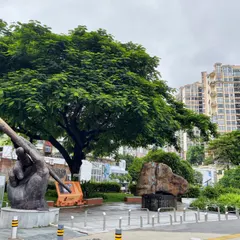
South of the ship, in the Nüwa coastal park, stands an 18-metre figure, half woman and half serpent, holding in her arms a great five-coloured stone: Nüwa Mending the Sky. Yuan Geng commissioned it in 1986 from Professor Fu Tianchou of the Central Academy of Fine Arts, and it was raised in 1989 beside a bathing beach. Today it is listed as a cultural heritage site of reform and opening-up.
The statue forces one to measure an absence. Where the Minghua ran aground in 1983 there was beach and water; the sea began to retreat with the “first shot” of 8 July 1979, the blasting on Sheshan hill to gain land and build Shekou port. From 1989 Sea World grew south with more than twenty years of landfill, and in the 1990s the area around the berth was won from the sea for a golf course, leaving the hull entirely on dry land. Beside Nüwa, the narration follows the line of a coast that no longer exists.
From Yuan Geng’s slogan to the ship that paraded in Tiananmen
Sea World Culture and Arts Center (海上世界文化艺术中心)
Summary of this stop
In front of the Sea World Culture and Arts Center, the story of Shekou as a laboratory comes to a close. Yuan Geng coined, in 1981 or 1982 depending on the source, on returning from a business trip to Hong Kong, the slogan “Time is money, efficiency is life”, which was mounted on a sign beside the road to the Shekou ferry pier so that Hong Kong investors would see that efficiency was valued there. In the 1984 National Day parade in Tiananmen Square, a float shaped like a scale Minghua carried that same slogan, and Sea World became a name known all over China.
Then came the fire and closure of 1998, the refurbishment of 2001–2005 and, in December 2013, the ship’s rebirth as the centrepiece of China Merchants’ retail and hotel complex. Fumihiko Maki’s building, opened on 2 December 2017, completes the ensemble, and the neighbourhood’s metro station bears the name Haishang Shijie, inherited from the calligraphy written aboard. At the last stop, the audio guide tells how a stranded ship ended up naming a piece of the city.