Electronics market
Huaqiangbei Audio Guide
Shenzhen's great electronics market: a street of market towers north of Shennan Avenue, born from three military factories brought down from the mountains in 1979, where one-metre counters still move chips, cables and phones to half the world.
- 60 min of audio
- Electronics and trade
In September 1979, Guangdong province moved three military factories hidden in the mountains of Shaoguan, Hongquan, Dongfanghong and Xianfeng Machinery, to Shenzhen and merged them into a single company: Huaqiang. Its name christened the street that crosses Shennan Avenue, and the strip to the north became Huaqiangbei, “North Huaqiang”. In the early 1980s the city laid out the Shangbu industrial estate here, occupied by electronics firms with the prefix “Hua”, and in January 1981 construction began on the Electronics Building, Shenzhen's first tall building. In 1988 the SEG group opened its component market on a ground floor, and the district has never stopped growing.
Today, in 1.45 km², 35 specialised electronics markets are concentrated that in 2025 moved more than 480 billion yuan, and more than 100 listed companies have emerged from the district. The scale contrasts with the basic unit of the business: a one-metre counter, rented by newcomers mostly from the Chaoshan region, where urgent deals are sealed by word of mouth. In 2017 the former American programmer Scotty Allen assembled a fully working iPhone 6s here, Touch ID included, buying every part at the spare-parts stalls.
Highlights
- Electronics Building — Shenzhen's first tall building, 20 floors begun in 1981 and now dwarfed by its neighbours
- SEG Plaza — 292 metres, ten floors of market and tremors without an earthquake in May 2021
- SEG Electronics Market — More than 3,000 stalls and the one-metre counters of the Chaoshan traders
- Huaqiangbei pedestrian street — About 900 metres of market towers, reopened in 2017 after four years of hoardings
- Huaqiangbei Museum — A wall of 330 circuit boards that blink and a neon city hung upside down
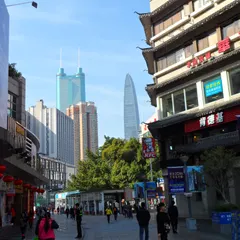
North of Shennan Avenue, in Futian district, stretches Huaqiangbei (华强北), Shenzhen’s great electronics market: a pedestrian street flanked by market towers where chips, connectors, cables and phones are sold by the tray. Its origin lies far from here. In September 1979, Guangdong moved three military factories from the mountains of Shaoguan to Shenzhen and merged them into a single company, Huaqiang, which would end up naming a street and, by extension, the whole district.
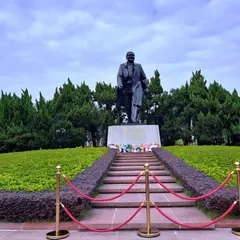
The history of Huaqiangbei advances in dates. In the early 1980s Shenzhen’s urban planning committee laid out the Shangbu industrial estate here, and it was occupied by electronics companies sharing the prefix “Hua”: Aihua, Jinghua, Huafa, Huaqiang and Hualianfa. In 1984 Deng Xiaoping came specifically to see it on his first visit to the city; in 1988 the SEG group opened its component market; in 2000 SEG Plaza was completed, and in 2017 the street reopened as a pedestrian one after four years of metro works. Today, in 1.45 km² of commercial area (the administrative subdistrict of Huaqiangbei, a different scope, measures 2.9 km², and the two figures are often confused), 35 specialised electronics markets are concentrated that in 2025 moved more than 480 billion yuan. More than 100 listed companies have come out of the district.
Its architecture is that of a market that grew upward: office towers whose ground floors are mazes of tiny stalls. Among them the district has produced episodes of every kind. In 2017 the former American programmer Scotty Allen assembled a fully working 16 GB iPhone 6s, with the Touch ID reader operational, buying every part at the spare-parts markets; the phone ended up with about 300 dollars in parts, although between broken spares, surplus parts and tools he spent more than 1,000. And around the corner, on Aihua Street, the so-called “ghost market” (guishi) has been operating for more than ten years: the stalls go up around eleven-thirty at night and by four-thirty in the morning they are gone. Second-hand phones, motherboards, salvaged batteries and cables are sold wholesale, and by local custom the knowledgeable buyer states his price first and examines the goods with a torch.
To know what to see in Huaqiangbei without getting lost among floors and aisles, the audio guide covers it in five stops and one hour of narration: from Shenzhen’s first tall building to SEG Plaza and its market, the pedestrian street and, at the end, the museum that tells the district’s history. The thread is a single one: this maze of counters was for decades the workshop where Shenzhen learned to manufacture, to copy and to invent.
The same culture of mass copying filled the Dafen painting village with paintings; the other great shopping street of the centre is Dongmen Pedestrian Street, and to the west rises the Ping An Finance Center.
Shenzhen’s first skyscraper, a dwarf today
Electronics Building (电子大厦)
Summary of this stop
At 2070 Shennan Avenue, beside SEG Plaza, stands the Electronics Building, a 20-floor, 70-metre building that today passes almost unnoticed among its neighbours. Construction began in January 1981 and it was Shenzhen’s first tall building; the date of its completion varies by source, August 1982 in some and August 1983 in others. In its modesty fits the start of the whole district.
In front runs Shennan Avenue, which is also the border of the name. Huaqiang Street, christened by the company born from the three military factories of Hongquan, Dongfanghong and Xianfeng Machinery, crosses the avenue, and the strip to the north came to be called Huaqiangbei, “North Huaqiang”: a name that, at bottom, is merely an address.
In January 1984, on his first visit to Shenzhen, Deng Xiaoping came specifically to Huaqiangbei, then the emerging core of Chinese electronics. In front of the building, the audio guide opens the route by telling how factories hidden in the mountains ended up raising the first vertical profile of a city that was only beginning.
The SEG tower that shook without an earthquake
SEG Plaza (赛格广场)
Summary of this stop
At the corner of Shennan Avenue and Huaqiangbei Street rises SEG Plaza, completed in 2000: 71 floors and 292 metres to the roof. Its first ten floors are occupied by the SEG electronics market, with street-level entrance, which after five expansions totals almost 60,000 m² and more than 3,000 stalls. It all began in a much smaller corner: on 28 March 1988, a date considered auspicious, part of the ground floor of the SEG Industrial Development Building was partitioned off and became the SEG component market. This is how Huaqiangbei’s electronics market was born.
The tower also bears an unsettling mark. On 18 May 2021 it began to shake with no earthquake and was evacuated; the tremors repeated over the next two days. The cause has been explained in two ways: wind making the rooftop mast vibrate or, according to the initial investigation, a combination of wind, metro traffic beneath the building and temperature. Afterwards the tower lost the antenna that raised it to 356 metres. At its feet, the narration compares that ground-floor corner with today’s ten floors of market and explains what is missing at the top.
One-metre counters that copied Akihabara
SEG Electronics Market (赛格电子市场)
Summary of this stop
Inside the SEG market, rows of tiny stalls follow one after another with display cases and trays of chips, connectors and modules. The idea had a declared model: in 1986 the SEG group proposed opening a market specialised in electronic components here with the Akihabara district in Tokyo as its reference. The label “China’s first electronic components market” is repeated as the group’s own slogan, without independent verification, and the figures for its beginnings do not add up either: the same chronicle speaks of 1,400 m² and, further down, of 900 m² with 43 shops.
The basic unit of the business is the one-metre counter. Between 70 and 80% of Huaqiangbei’s traders come from the Chaoshan region, in eastern Guangdong; newcomers start by renting that metre of display case, and urgent deals are sealed by word of mouth.
In 2007 the American engineer Andrew “bunnie” Huang walked these floors and published a text titled “Akihabara, Eat Your Heart Out”. He described floors crammed with reels and trays of resistors, capacitors, relays and memory chips, and called it the ultimate flea market of electronic components. Among the aisles, the audio guide tells how the pupil ended up, in an engineer’s eyes, dwarfing its model.
Four years of hoardings and express copies
Huaqiang Electronics World (华强电子世界)
Summary of this stop
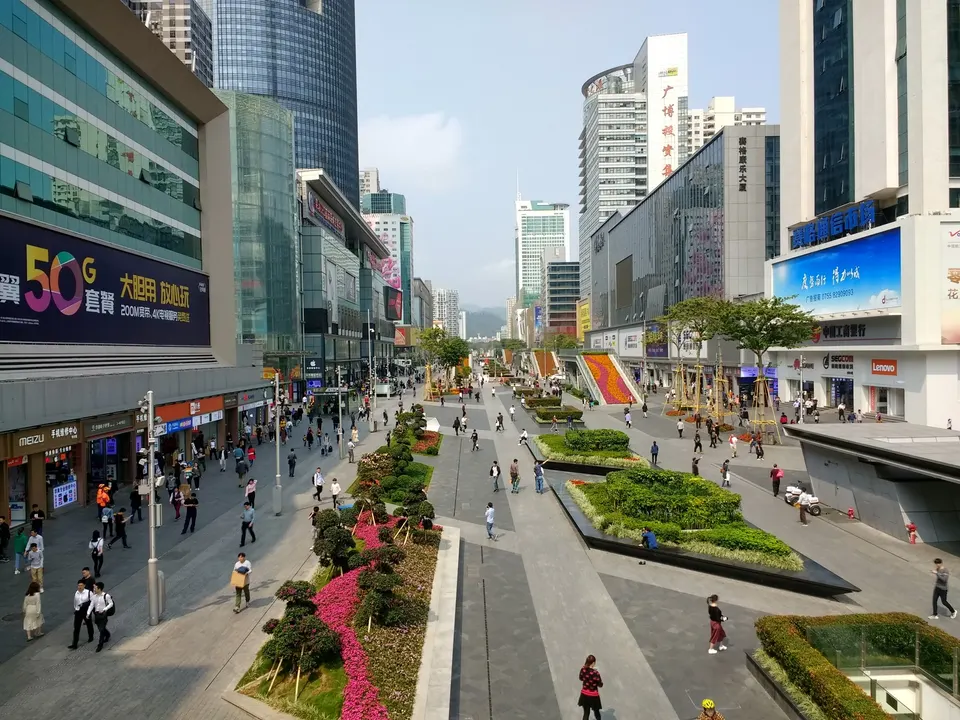
In front of the Huaqiang Electronics World, another large market building with entire floors of components and consumer electronics, the pedestrian street of some 900 metres between Hongli and Shennan seems to have always been this way. It has not. From 27 February 2013, works on metro line 7 closed Huaqiangbei Street, and for four years the markets could only be entered through narrow passages beside the hoardings. It reopened as a pedestrian street on 14 January 2017, and beneath it an underground shopping street linking the Huaqiang North and Huaxin stations opened on 18 July 2018.
Before the hoardings there was another cut. In 2012, after a crackdown campaign on illegal trade, 3,575 traders in Huaqiangbei’s phone market abandoned their stalls, and the district turned toward official brands.
The fame of copying, however, did not disappear. According to what circulated in April 2021, months before Apple presented its third-generation AirPods, imitations from Huaqiangbei with the look of the leaked designs were already appearing in videos: a product that officially did not exist already had a copy. That pace is called “Huaqiangbei speed”. In the middle of the street, the narration reviews the less confessable side of the gleaming pedestrian avenue.
A museum of boards that never stop blinking
Huaqiangbei Museum (华强北博物馆)
Summary of this stop
The route ends at height: on the fifth floor of the Guangbo Modern Window building (1058 Huaqiangbei Street), reached by panoramic elevator, the Huaqiangbei Museum, Futian district’s first state museum, opened on 30 December 2020. Inside await a wall of 330 circuit boards that blink nonstop and a neon model of the city hung upside down from the ceiling.
The museum turns the district into memory without it ceasing to be a workshop: the figures of its 35 markets keep growing and the list of listed companies that came out of these counters exceeds a hundred. One of the most famous stories began a few steps away. As its protagonists remember, in 1998 Tencent started in an office in the SEG technology park, in a borrowed ballroom with a disco ball on the ceiling; a veteran employee recalls that, seeing that decor on the day of his interview, he thought it was a shell company. In front of the wall of boards, the audio guide’s last stop tells who handled the complaints of the first users back then.