Contemporary temple
Blue Temple Audio Guide (Wat Rong Suea Ten)
An abandoned village temple beside the Kok River, brought back to life by its neighbours and dressed in sky blue and gold by Sala Nok, the disciple of the creator of the White Temple who wanted to speak in his own voice.
- 40 min of audio
- Contemporary Buddhist art
A Buddhist temple in Chiang Rai born of the determination of the residents of Ban Rong Suea Ten, who in 1996 decided to reclaim an abandoned plot with remains of old brick. Its blue vihara, 13 by 48 metres, was raised between 2005 and 2016 under the hand of Phuttha Kabkaew, Sala Nok, who trained alongside Chalermchai Kositpipat at Wat Rong Khun. Inside waits a seated pearl-white Buddha of 6.5 metres; behind it, a standing Buddha as tall as the vihara itself and a 20-metre stupa with relics in its finial.
Sala Nok took the undulating scrolls from his master, but swapped the white and mirrors of the White Temple for sky blue, the colour of the dhamma. Nor did he think himself able to match Chalermchai's finest ornament, so he worked the reliefs in incised strokes, scored by hand so that the lines seem to ripple. Even the fangs of the nagas on the staircase are a loan: they derive from the horns and tusks of Thawan Duchanee, the artist of the Black House, though here they are sharper still.
Highlights
- Blue and gold vihara — A 13-by-48-metre hall raised by Sala Nok between 2005 and 2016
- Main Buddha — Seated, pearl-white, 6.5 metres tall, with relics of the Buddha in its head
- Staircase of the nagas — Curved fangs inherited from Thawan Duchanee, the artist of the Black House
- Standing white Buddha — In the Pang Ham Yat posture, as tall as the vihara itself
- Phra That Ket Kaew Chulamani stupa — 20 metres, with relics of the Buddha in its finial
Beside the Kok River, in Chiang Rai, the Blue Temple (วัดร่องเสือเต้น, Wat Rong Suea Ten) raises a vihara of sky blue with gilded reliefs that looks fresh from the workshop. To a large extent it is: the hall was begun on 27 October 2005 and finished on 22 January 2016. But the place is older than its colour. On the plot stood an abandoned village temple, of which only remains of old brick survived and whose foundation has no documented date.
The history of the Blue Temple begins in 1996, when the residents of Ban Rong Suea Ten gathered to reclaim that plot: they had nowhere to make merit and each family went to a different temple. Some sources speak of the restoration of the abandoned temple and others of the building of a new one, and both readings coexist. The official foundation permit came on 21 August 2015, five months before the vihara was finished, and the merit ceremony for the new building was held from 19 to 22 January 2016.
The architecture of the Blue Temple carries the signature of Phuttha Kabkaew, known as Sala Nok, who trained alongside Chalermchai Kositpipat at Wat Rong Khun, the White Temple. From the master he took the undulating scrolls; the white and the mirrors he replaced with blue and sky blue, which here represent the dhamma, the Buddha’s teaching, against the gold of the reliefs. Inside waits a seated pearl-white Buddha of 6.5 metres; behind it, a standing Buddha as tall as the vihara itself and a 20-metre stupa with relics in its finial. Most sources call the blue building a vihara, although one or two describe it as an ubosot, the ordination hall.
To know what to see at Wat Rong Suea Ten, the audio guide walks it in five stops and 40 minutes, from the fountain in the entrance courtyard to the great standing Buddha that rises behind the vihara. A single thread joins them: this blue is not a decorative whim, but the voice of their own that a village without a temple and a humble disciple found in the shadow of their masters.
Sala Nok’s master is still remaking the White Temple, south of the city, and the fangs of the nagas recall the Black House of Thawan Duchanee. About 5 km away, Wat Huay Pla Kang raises its 69-metre white Guanyin.
Blue fish in the courtyard of the tigers
Wat Rong Suea Ten
Summary of this stop
The route starts in the entrance courtyard, at the fountain of Phra Upakhut: a pearl-white figure seated in the middle of the water beneath a lotus, ringed by blue fish from the mythical forest of Himmaphan. It is the first announcement of the colour that dominates the whole complex and, too, the door to the story of the place’s name.
Rong Suea Ten means “the ditch where the tiger dances”. According to the tradition kept by the village elders, when the area was forest with few houses, tigers leapt across the ditch; the name passed from the place to the village, Ban Rong Suea Ten, and from the village to the temple. Those same neighbours were the ones who in 1996 came together to reclaim the abandoned plot, because each family went to a different temple, and on 21 August 2015 the temple received its official foundation permit.
The courtyard ended up fulfilling that vocation as a meeting point. By about 2023 the temple had turned it into a kad mua khrua laeng, the Lanna late-afternoon market: the residents of Rong Suea Ten sold crafts, OTOP products of the district and local food, while on the stage there followed one another Lanna dances, klong sabat chai drums and a light and sound show titled “The Naga Offers Lotus Flowers to the Buddha”. Beside the fountain, the narration tells how a temple born of the lack of a common place ended up as the village square.
A blue so as not to be the White Temple
Blue and gold façade of the vihara
Summary of this stop
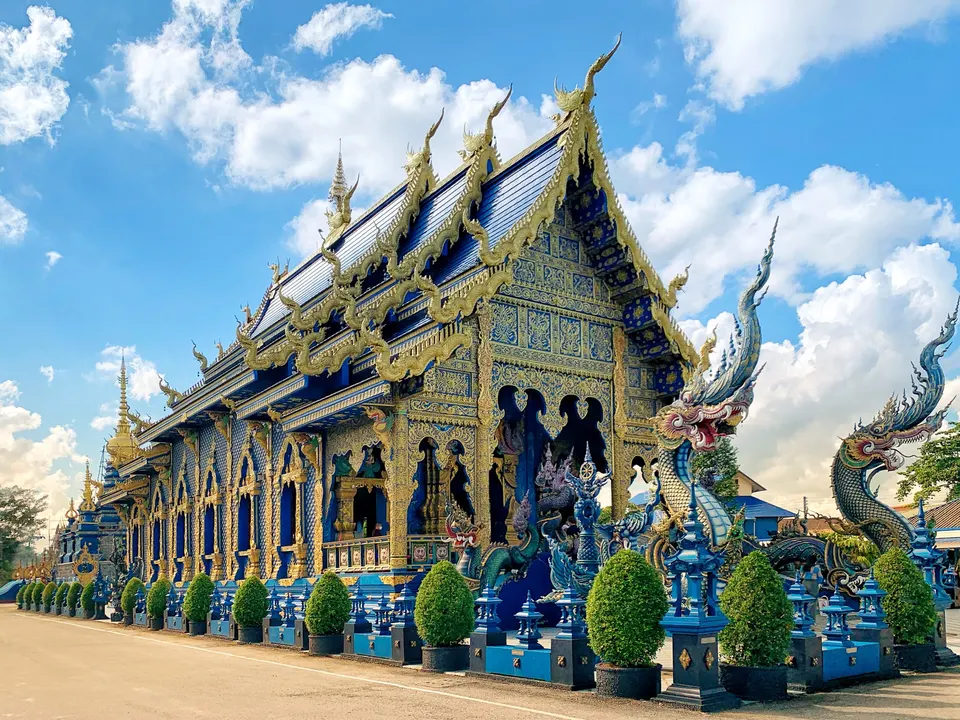
Facing the façade, the 13-by-48-metre hall unfolds its sky blue beneath gables and stepped roofs, with stucco reliefs in gold and white with undulating lines. The scrolls have a family air with Wat Rong Khun, and not by chance: their author, Phuttha Kabkaew, Sala Nok, studied art education at Rajabhat University in Chiang Rai, and Chalermchai Kositpipat called him to work at the White Temple before he graduated. In 2001 he was still there; in 2003 he set up on his own.
According to the story told of that meeting, it all began with a student sculpture that Sala Nok took to the exhibition for the university’s 25th anniversary. Chalermchai, the creator of the White Temple, noticed it, and that glance opened the door to Wat Rong Khun for him. From the master he brought a maxim that he repeated: to work for Buddhism one has to be more diligent, more careful and more imaginative than others.
The façade is at once inheritance and emancipation. Sala Nok kept the undulating scrolls but swapped the white and the mirrors for blue and sky blue to give the temple an identity of its own: the sky blue represents the dhamma, set against the gold of the reliefs. He conceived the vihara together with the abbot, Phra Thanongsak Katasaro, as praise of the Buddha and as a tribute to Chalermchai. Before the façade, the audio guide tells how a disciple turned a tribute to his master into a voice of his own.
Borrowed fangs and hand-scored furrows
Staircase of the two nagas
Summary of this stop
At the foot of the staircase wait the two great nagas, paired on either side, with blue scales flashing green and curved, sharp fangs. Those fangs have a genealogy: they derive from the horns and tusks of Thawan Duchanee, the artist of the Black House (Baan Dam), another of the great signatures of Chiang Rai. Sala Nok made them sharper still.
Up close, the reliefs reveal another decision. Sala Nok did not think himself able to match Chalermchai, who at Wat Rong Khun achieved the finest ornament on enormous volumes, and he worked the stucco of the vihara in incised strokes, scored by hand so that the lines seem to ripple. It was long work: it began on 27 October 2005 and ended on 22 January 2016, after some eleven years, with the team racing against the clock in late 2015 to have everything ready for the merit ceremony in January.
That stucco has also been through water. In 2024, the biggest flood in Chiang Rai in 50 years put more than a metre of water into the temple; by November of that year the reliefs no longer bore the waterline or the red mud. Beside the nagas, the narration shows how to read in those furrows a disciple’s solution, not a master’s copy.
A white Buddha above 88,000 amulets
Pearl-white main Buddha
Summary of this stop
Inside the vihara, the blue interior is arranged around a stroke of light: Phra Phuttha Ratchamongkhon Bodi Trilokanat, a seated Buddha in the Phra Singh 1 style, pearl-white, 6.5 metres high and 5 across the lap. On the walls, murals in intense colours narrate episodes from the life of the Buddha beneath a lavishly ornamented ceiling.
The image’s name was bestowed by the Supreme Patriarch Somdet Phra Yanasangwon and means “the auspicious Buddha, lord of royal dignity, refuge of the three worlds”. From the same patriarch come the relics of the Buddha held in the statue’s head.
The most striking thing is not in view. Beneath the main Buddha are buried Phra Rod Lamphun amulets along with silver and gold rings and other valuables. Most sources put the amulets at 88,000; one or two speak of 84,000, a number with symbolic resonance in Buddhism, that of its 84,000 teachings. Before the image, the audio guide completes the portrait of what this figure keeps within and beneath.
The giant who calms behind the temple
Standing white Buddha
Summary of this stop
The route leaves the vihara and goes around it. Behind, Sala Nok raised a great standing white Buddha, as tall as the vihara itself, in the Pang Ham Yat posture, that of calming one’s relatives: the hand raised in a gesture of appeasing, standing out against the blue and gold of the roofs.
A few steps away rises the 20-metre Phra That Ket Kaew Chulamani Ha Phra Ong stupa, which keeps in its finial relics of the Buddha donated by the Supreme Patriarch Somdet Phra Yanasangwon. The two vertical figures crown a complex that began on a plot of old bricks and with neighbours lacking a temple of their own. Behind the vihara, the last stop of the audio guide returns to the calming gesture of the white giant to close the story of a village and a disciple.