Author's Temple
White Temple Audio Guide (Wat Rong Khun)
The old village temple of Chiang Rai, born beside a muddy stream, which a local painter has been rebuilding at his own expense since 1997 in white plaster and mirrors, with a hell of pop icons hidden inside.
- 90 min of audio
- Contemporary Buddhist art
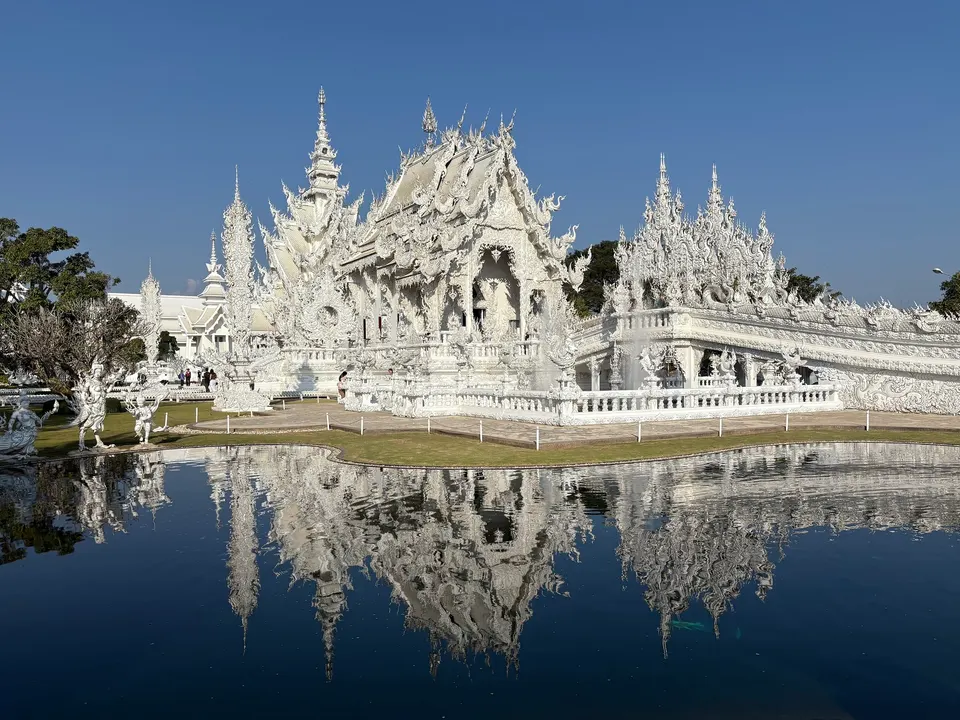
Wat Rong Khun takes its name from the village of Ban Rong Khun, founded around 1887 by a few families beside a muddy stream. Its first ubosot, from 1964, was pulled down in ruins in 1995, and work on the new one stalled halfway with the Thai economic crisis. In 1997 the painter Chalermchai Kositpipat, born in the village itself, offered to finish it with his own money and to his own taste: an entirely white hall, studded with fragments of mirror, with a three-tiered roof and a profusion of naga serpents.
Facing the white of the ubosot, which represents the mind, stands a gilded, highly ornate building that represents the body and attachment to money. It houses the toilets. And it was precisely that toilet block that in 2015 led the artist to ban all Chinese tourists, a ban he lifted in little more than a day and which ended with him admitting that the one who was not ready was himself.
Highlights
- Bridge of hands — Hundreds of stucco hands symbolising desire before the Gate of Heaven
- White ubosot — Plaster and mirror fragments under a three-tiered roof crowded with nagas
- Pop hell murals — Michael Jackson, Neo and Freddy Krueger amid orange flames
- Golden building — The compound's toilets, an allegory of the body and money set against the white mind
- 2016 bell tower — A near-black gold bell beside the bodhi tree
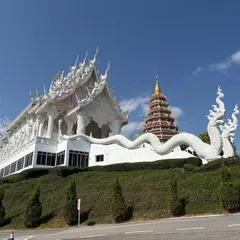
On the outskirts of Chiang Rai, the White Temple (วัดร่องขุ่น, Wat Rong Khun) dazzles from afar: an ordination hall entirely white, flecked with fragments of mirror that throw back the sun, ringed by naga serpents, demon figures and a pond. It looks like a postcard, but it is a living work, unfinished and controversial. It has been raised since 1997 by a son of the village, the painter Chalermchai Kositpipat, with his own money, his own plans and a temperament that has more than once reached the newspapers.
The history of Wat Rong Khun begins long before the plaster and the mirrors. Around 1887, year 2430 of the Buddhist Era, a few families settled to farm beside a small muddy stream that drains into the Mae Lao river; that muddy stream gives its name to the village, Ban Rong Khun, and to the temple. The first ubosot was built in 1964 by the abbot Phra Sawai Chakharo; by 1995 it was so ruinous that it could no longer serve for rites, and it was pulled down. Work on the new one began in February 1996 and stopped almost at once, for lack of funds, when the Thai economic bubble burst. That is why some sources date the start to 1996 and others to 1997, the year the painter took over the project: the two dates tell different parts of the same story.
The architecture of Wat Rong Khun reads like a sermon in stone and stucco. The path to the ubosot crosses a bridge over the pond, before a sea of outstretched hands that symbolise unbridled desire; the white ubosot represents the mind, and the golden building that counterbalances it, the body and attachment to money. Inside, the white gives way to orange flames and demon faces, among which figures from film and current events peer out. That mixture of Buddhist iconography and pop culture has been called sacrilegious by some, and the temple receives no state funding, unlike other Thai temples. Chalermchai, who has invested more than 40 million baht, limits each donation to 10,000 baht so that no large donor can influence the work.
The artist defends the temple with the same stubbornness with which he builds it. In February 2017, when boxes of China-made chocolates bearing the image of the temple appeared in airports and supermarkets across Thailand, he called the press to proclaim that Wat Rong Khun belongs to the citizens of Thailand and that not even his own family may make business from it. The company ended up apologising, and he accepted on condition that it withdraw the boxes and donate 500,000 baht to a school for the blind in Chiang Rai. Two years earlier, in September 2015, one of the photos from a shoot with a Chinese model angered him so much, as disrespectful to religion, that the painter himself ended up posing before the cameras to show how it should be done.
At the back of the compound, past the abbot’s residence, a white arch with the sign “wishing well” leads to a pond with a multi-tiered lotus in the centre. Visitors make a silent wish and toss coins so that they stay on the highest tier, though they almost never manage it, and the bottom is carpeted with baht coins. From the nearby branches a gallery of white papier-mâché heads of film villains, from Freddy Krueger to Hellboy, watches them.
To know what to see at Wat Rong Khun, the audio guide walks it in five stops and 90 minutes: the entrance esplanade, the kinnaree pond, the bridge of hands, the interior of the murals and the golden building. Nobody gives a firm date for the end of the work: 2070 is used as a horizon and, in 2017, there was still talk of at least another fifty years. It is a temple that is visited while it is being built.
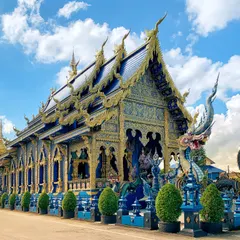
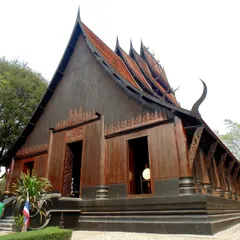
The saying that sets Chalermchai’s heaven against Thawan’s hell is completed north of the city, at the Black House. The Blue Temple is the work of Sala Nok, who trained alongside Chalermchai at this very temple, and Wat Huay Pla Kang is another recent white temple raised on the ruins of an earlier one.
A white temple named for muddy water
Wat Rong Khun
Summary of this stop
The route starts on the entrance esplanade, facing the ubosot. From here the building is seen whole, blinding, with its three-tiered roof and several images of the meditating Buddha before it. It is hard to link that image to the name it bears: Rong Khun refers to the small muddy stream beside which, around 1887, a few families settled to farm, a step from the Mae Lao river.
The temple of that village had a modest life. The abbot Phra Sawai Chakharo, in charge since 1956, raised the first ubosot in 1964. Thirty years later it was so decayed that it was useless for rites and a large colony of bats occupied it; it was pulled down on 3 June 1995. On 3 February 1996 work on the new one began, but only the structure of the central body was completed before the Thai economic crisis left the temple without money.
That is where Chalermchai Kositpipat enters, born in Ban Rong Khun itself. In 1997, aged 42, he offered to finish the ubosot out of his own pocket, changed the plans to his taste and opened the compound to visitors. Before the façade, the audio guide tells how a ruined village temple became the work of a lifetime.
The façade its maker wanted to tear down
Kinnaree pond
Summary of this stop
On the edge of the pond, before the ubosot, stand two kinnaree, half-woman, half-bird figures from Buddhist mythology. From this point the façade looks perfect, and that is why it is surprising how fragile it once proved. On 5 May 2014 a magnitude 6.3 earthquake with its epicentre in Mae Lao flaked the walls of the ubosot, made tiles fall, split the spire of the reliquary and damaged the paintings. The temple closed from the next day. The real extent of the damage is still told in different ways: some versions speak of paintings entirely lost; the engineers’ assessment, of partial damage.
On 6 May Chalermchai announced that he would demolish the temple and not rebuild it. The next day, after a team of engineers certified that the structure was sound, he promised to restore it within two years, and the compound reopened on 8 May. What lay behind that announcement is a disputed story: according to one version, the artist himself admitted that same 7 May that it had been a publicity stunt to test whether the Government cared about the temple and the surrounding villages, and that day he received promises of help from the Government, from companies, from the Chiang Rai army and from several universities.
Two months later, on 19 July 2014, the province of Chiang Rai held here a sueb chata mueang, the northern rite to lengthen the destiny of the city, with a procession and nine monks chanting, to restore the spirits of the population. Beside the pond, the narration dwells on the days when the White Temple seemed doomed.
Hands that beg before the bridge
Hands beneath the bridge
Summary of this stop
The ubosot is not reached in a straight line: the approach crosses a white bridge over the pond, and the path is conceived as a story that is walked with the body. Before the bridge, hundreds of stucco hands sprout from the ground, stretching towards whoever passes; they symbolise unbridled desire and suffering. At the start of the bridge wait the jaws of Mara, the king of demons, a figure of the passions of the heart that must be left behind.
The bridge represents the passage from the cycle of rebirths to the land of the Buddha, and figures of asuras peer from its railings. On the other side, the Gate of Heaven is guarded by two giant figures representing Death and Rahu, the one who decides the fate of the dead.
To cross this stretch is to pass from desire to the mind, from the world of begging hands to the white of the ubosot. At the entrance to the bridge, the audio guide unpicks the meaning of each figure along the way.
Neo and Michael Jackson amid the flames
Ubosot murals
Summary of this stop
Inside the ubosot the white ends. The murals burst into orange flames and demon faces, and among them familiar faces appear: Michael Jackson, Neo from The Matrix, Freddy Krueger and a Terminator T-800, beside the attack on the World Trade Center. The hell of this temple is populated by the contemporary world. Photography is not allowed inside, so these paintings can be seen only in person.
The mixture has not pleased everyone: some consider it sacrilegious. And it is not the first time Chalermchai’s work has provoked that debate. Between 1988 and 1992 he painted the murals of the Buddhapadipa Thai temple in London, criticised from their inauguration by those who held that this was not authentic Thai art.
Before the murals, the audio guide explains why a painter accused of not making Thai art decided to fill the heart of a Buddhist temple with pop icons.
The gold that guards the toilets
Golden toilet building
Summary of this stop
The route ends before a gilded, highly ornate building, the great counterpoint to the ubosot. If white represents the mind, gold represents the body and attachment to money. Inside are the toilets. And money, here, has its own rules: Chalermchai pays for the work out of his pocket, with more than 40 million baht, and limits each donation to 10,000 baht. For its first 19 years the visit was free; since 1 October 2016 foreigners pay admission, 50 baht then and 200 since 1 January 2026, with the cave exhibition included, while Thais still enter free.
That toilet block starred in one of the temple’s most talked-about episodes. In early February 2015 a Thai visitor complained about the state in which he had found it, and the artist, furious, banned all Chinese tourists: whole coachloads had to make do with photographing the temple from the car park. He planned to close for three days, but lifted the ban in little more than a day on seeing that it was unfair to those who behaved well. He warned that, if it happened again, the guides would clean with their own hands. A year later he summed it up in a blunt phrase: the one who was not ready was himself. He renovated the toilets with an investment of some 10 million baht and hired Chinese-speaking staff.
Towards the back gardens, beside the bodhi tree, stands the bell tower inaugurated in October 2016 before more than 2,000 people dressed in white: a two-pillar golden arch with a great bell of a dark, almost black gold, which was meant to have a twin for Cambodia that was never made. It was blessed by the abbot Phra Khru Chakhariyanuyut, the same monk Sawai who had raised the ubosot of 1964. Facing the gold of the toilets, the last stop of the audio guide closes the circle of a temple that began, and remains, the village’s own affair.