Art museum
Black House Audio Guide (Baan Dam Museum)
Some forty blackened timber pavilions on the outskirts of Chiang Rai, where the painter Thawan Duchanee spent from 1975 to 2014 turning horns, skins and bones into a meditation on death.
- 75 min of audio
- Lanna architecture
Estate-museum of the painter Thawan Duchanee, National Artist of Thailand, in the tambon of Nang Lae, on the outskirts of Chiang Rai. He began building it in 1975 and never stopped extending and transforming it until his death in 2014: more than 100 rai, some 160,000 m², and more than 40 buildings of northern Thai vernacular architecture, from the great Mahawihan hall to the triangular Tri Phum house, where he lived and painted.
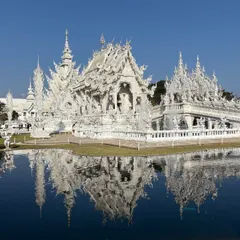
A saying circulates in Thailand that sums up Chiang Rai in two artists: “Chalerm sawan, Thawan narok”, Chalermchai the heaven, Thawan the hell. Against the white paradise of Chalermchai Kositpipat, the Black House is the dark world of passions and sin of Thawan Duchanee, with temple roofs that shelter no worship and tables ringed by chairs of buffalo horn.
Highlights
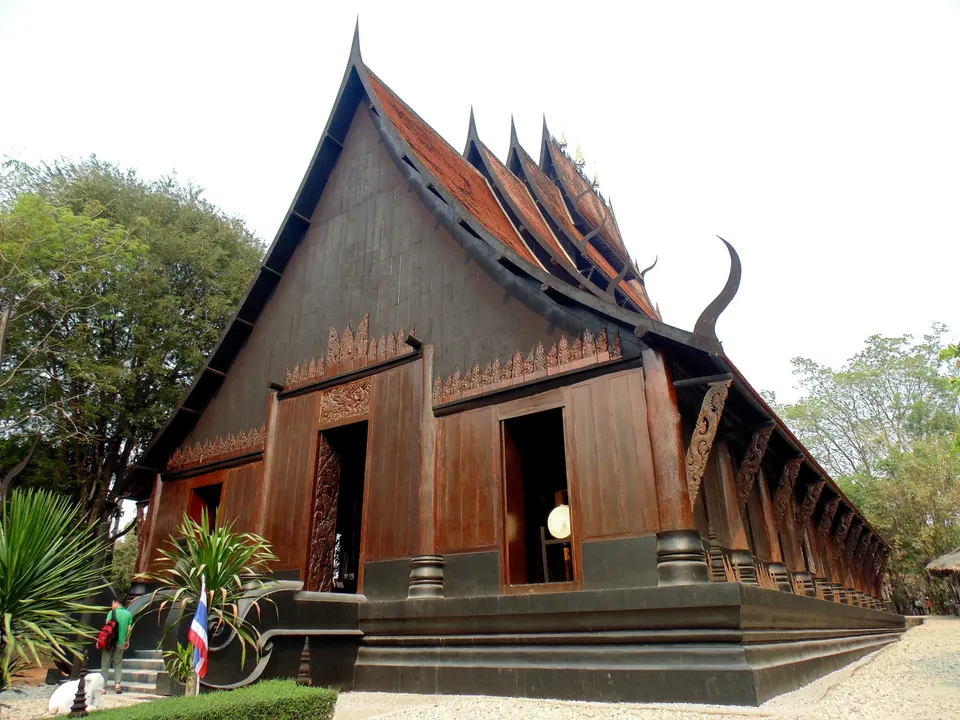
- Mahawihan — The great black hall, 44 metres long, on 44 timber pillars and beneath a four-tiered Lanna roof
- Horn tables — Long black tables with buffalo-horn chairs and crocodile skins as decorative motif
- Tri Phum — The triangular house of the Three Worlds, studio and home of Thawan Duchanee, destroyed three times by storms
- Small temple — A Buddha carved in wood in the Phra Ubosot Lek of 1992, on six pillars
- Elephant skeleton — A whole elephant displayed beneath a black pavilion on stilts
On the outskirts of Chiang Rai, in the tambon of Nang Lae, a path between trees links dozens of black timber houses with sharp northern Thai temple roofs. It is the Black House (พิพิธภัณฑ์บ้านดำ, Baan Dam Museum), the estate that the painter Thawan Duchanee began to build in 1975 and kept extending and transforming until his death in 2014. Locals call it Baan Dam Nang Lae, the Black House of Nang Lae, and today it is a private art museum of more than 100 rai, some 160,000 m², with more than 40 buildings of northern Thai vernacular architecture.
The history of the Black House is that of its author. Thawan Duchanee studied at the Rijksakademie in Amsterdam from 1963 to 1969; on his return, some students slashed several of his large paintings as offensive to Buddhism, and he stopped exhibiting in Thailand for years. In 2001 he was named National Artist of Thailand in Visual Arts. He died on 3 September 2014, aged 74, and since then the museum has been run by his son, Doytibet Duchanee. The black that gives the place its name symbolised for him suffering and death, the themes to which he returned again and again.
It is often called the “Black Temple”, but it is not a temple or a place of worship: it is a museum whose buildings imitate Lanna religious architecture. That is the key to the architecture of the Black House: stepped clay-tile roofs, timber pillars and sanctuary stairways in the service of a personal universe made of horns, skins, bones and canvases in red, black and white. Some houses are known by their shape, such as the one that reproduces, idealised, the head of a great hornbill, or the one that, with glass bull’s-eye windows, looks like a submarine half sunk in the ground; tradition does not agree on which of the two the artist slept in.
Not even his death closed the story. In September 2021 a painter who had been his student told on television that he kept ash from the bones of one of Thawan’s fingers and wanted to venerate it and use it to create work; his son protested publicly, the ash was returned to him and on 17 September 2021 the painter apologised to the family. To know what to see at Baan Dam Museum, the audio guide walks the grounds in five stops and 75 minutes, from the great hall at the entrance to the studio-house and the garden of scattered pavilions, with a single thread: this Black House is not a macabre whim, but the lifetime’s work of a man who looked suffering and death in the face.
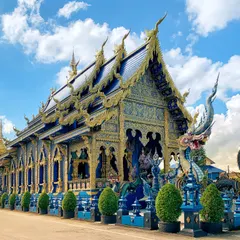
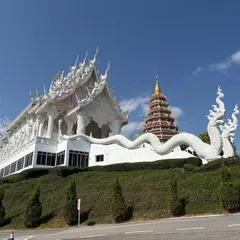
The heaven of the saying lies south of the city, at the White Temple of Chalermchai Kositpipat, and Thawan’s mark reappears in the fangs of the nagas of the Blue Temple. Further north, in the Chiang Saen district, the Golden Triangle looks out over the confluence of the Ruak and the Mekong.
A black hall of 44 metres
Baan Dam Museum
Summary of this stop
The route starts facing the Mahawihan, the great exhibition hall that rises beside the entrance. It was built between 1999 and 2009: it measures 20.30 metres wide and 44 long, rests on 44 great timber pillars and stands 2.8 metres above a brick plinth, with stairs rising to the east and west doors. It is crowned by a four-tiered Lanna roof of unglazed clay tiles, finished with swan tails (hang hong) and baralee.
That first look dismantles the nickname “Black Temple”. The dark, sharp silhouette is that of a northern Thai sanctuary, but it crowns no place of worship: it is the gateway to a painter’s estate, at number 333 in the village of Mae Pu Kha. Behind it spreads the rest of the grounds, more than 100 rai dotted with more than 40 buildings.
Before the façade, the audio guide explains why an artist decided to give his home the form of a temple that is not one.
The hell table of horns
Long table of the Mahawihan
Summary of this stop
Inside the Mahawihan, once the eyes adjust to the gloom, a long table of dark wood appears on the axis of the hall, covered in skins and flanked by chairs made of buffalo horn, among the 44 pillars. It is an image that repeats in the interiors of Baan Dam: long black tables ringed by chairs of buffalo and other animal horn, and crocodile skins arranged as a decorative motif. From the beams hang more skins and horns, beside canvases by Thawan in red, black and white.
The dominant black is the key to the place: for Thawan Duchanee it symbolised suffering and death. Hence the saying that circulates in Thailand, “Chalerm sawan, Thawan narok” (Chalermchai the heaven, Thawan the hell), which sets the white paradise of Chalermchai Kositpipat, a younger artist also from Chiang Rai, against the dark world of passions and sin of Thawan.
Death was not for him merely a studio theme. He told how at the age of 37 he had built his own coffin, of delicately worked wood. At his cremation in 2014, at Wat Thepsirin in Bangkok, the coffin was red and gold, designed by himself and covered in deep red flowers, and young artists dressed in black danced before it. Beside the table, the narration tells how that last gesture closed the work of a lifetime.
A Buddha for the censored painter
Small temple Phra Ubosot Lek
Summary of this stop
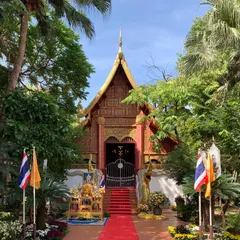
The small temple, Phra Ubosot Lek, is a timber building of 1992 on six pillars, 9.34 metres high with a stepped clay-tile roof. Inside it keeps a Buddha carved in wood beneath an arch of Thai and Burmese style, and in the grounds it serves as a transitional piece towards the Mahawihan.
Its presence has something of a reply. After his studies at the Rijksakademie in Amsterdam, between 1963 and 1969, Thawan returned to Thailand and saw students slash several of his large paintings as offensive to Buddhism; for years he stopped exhibiting in his own country. Decades later, in 2001, the Office of the National Culture Commission named him National Artist of Thailand in Visual Arts.
The painter accused of profaning the sacred ended up building, in his own way, the religious architecture he was reproached for. Facing the small temple, the audio guide reveals that twist.
Tri Phum, the house that fell three times
Tri Phum, the triangular house
Summary of this stop
Here it all began. Tri Phum is a triangular-plan house raised on 25 timber pillars, some 1.80 metres off the ground, with terraces on both sides. Its name alludes to the Three Worlds of Buddhist cosmology. It was built in 1976–1977, barely a year after Thawan began to create Baan Dam in 1975, and storms destroyed it three times: building and restoring it took seven years in all.
It was the artist’s studio and home. From this house came the paintings of his that now hang in museums around the world, while around it the grounds grew and changed without ever being considered finished.
The black house also has a living ritual. Every 27 September, the day Thawan was born in 1939, Baan Dam celebrates Thawan Duchanee Day: in 2023, on his 84th anniversary, the day began with an offering of food to 27 monks and a merit ceremony, and went on with scholarships, the Thawan Duchanee Prize for Art and Culture and an art market on the grounds. In 2024 the event turned ten. Before the triangular house, the narration reconstructs how it withstood the storms.
The elephant beneath the black pavilion
Elephant skeleton
Summary of this stop
At the back of the grounds, among trees and black timber houses, a pavilion on stilts shelters a whole elephant skeleton. Completing the osteological collection are wood carvings with buffalo horns, deer antlers and elephant bones, and in another of the garden pavilions a high-ceilinged bathroom lets carved wooden birds hang down. Many of the houses show their interiors only through the windows.
In front of the bones the uncomfortable question arises: where did all this come from. Among those who tour Baan Dam a reassuring explanation passes by word of mouth: according to popular belief, all the animals whose remains fill the houses are said to have died of natural causes and not to have been hunted for the collection. Nobody has been able to confirm it fully.
The painter’s private universe lives on. Since 2014 it has been run by his son, Doytibet Duchanee; in August 2018 Baan Dam brought together several National Artists to teach painting, sculpture and other arts to students. Attendance depends greatly on the season: in January 2017 there was talk of at least 15,000 visitors a day, mostly Chinese, on long public holidays. Beneath the elephant pavilion, the last stop of the audio guide ties up the loose ends of this timber hell.