Chan Buddhist monastery
Jade Buddha Temple Audio Guide (Yufo Chan Si)
Two Burmese white-stone Buddhas that a monk left behind while passing through Shanghai in 1899 and a monastery that moved three times to house them, until in 2017 its Great Hall was pushed thirty metres without taking the statues out.
- 45 min of audio
- Burmese Buddhas of 1899
The history of the Jade Buddha Temple begins far from Shanghai. Huigen, a monk from Mount Putuo, was returning from a pilgrimage on foot through Wutai, Emei, Tibet and India when, in Burma, with donations from the overseas Chinese merchant Chen Junpu, he had five white marble Buddhas carved. In 1899 he stopped over in the city on his way to Putuo, and the faithful asked him to leave one: a seated Buddha and a reclining one stayed. Then came a straw hut in Zhanghuabang, a first temple in Jiangwan in 1900, a rented house on Maigen Road and, at last, the monastery on Anyuan Road that Abbot Kecheng took ten years to build, from 1918 to 1928, now wedged between apartment blocks in Jing'an district.
The jade of the name is, in fact, marble: in Chinese, white stone is popularly classed as jade, yu, and that is how the temple got its name. And its main building is no longer where it was built. Between 2 and 16 September 2017, the Great Hall of brick and timber, of some 2,000 tonnes, was moved 30.66 metres north on rails with its original Buddhas inside, and then raised 1.05 metres. The gap it left is today the courtyard where the incense burns.
Highlights
- Seated Jade Buddha — 195 cm of white Burmese marble in a single block, with inlaid jadeite and agate
- Reclining Buddha Hall — The small 96 cm original of 1899 beside a 4 m giant brought from Singapore
- Great Hall Daxiong Baodian — 2,000 tonnes moved 30.66 m in 2017 without taking out its Buddhas
- Gate-hall of the Heavenly Kings — Gate and first hall in a single building, with Maitreya and Weituo
- Relief of the Island Guanyin — Guanyin on a dragon-fish and eighteen arhats at the back of the Great Hall
In the middle of the housing fabric of Jing’an district, at pavement level on Anyuan Road, the Jade Buddha Temple (玉佛禅寺, Yufo Chan Si) is still active: a Buddhist monastery of the Linji Chan school that keeps two white-stone Buddhas carved in Burma. They reached Shanghai in 1899 almost by chance, in the luggage of a monk who was heading elsewhere, and since then the city has not stopped making room for them: a straw hut, a lost temple, a rented house and, finally, the present monastery, completed in 1928. Some two million visitors a year now crowd its courtyard with incense.
The history of the Jade Buddha Temple is full of ups and downs. The temple takes 1882 as its founding year, although that date does not quite fit the chronology of the Buddhas: the temple’s own pages place it in different ways and the press of the time dates the Buddha’s arrival to May 1899. In 1947 Taixu, the great reformer of Chinese Buddhism, who had been based at the temple since the previous year, died here, in the Zhizhi Xuan pavilion. The Cultural Revolution, begun in 1966, hit the monastery, but the two Buddhas and many of its pieces came through intact, and the temple reopened in 1978. It is said that the monks then pasted portraits of Mao Zedong on the outer walls so that the Red Guards could not pull it down, although the episode comes from a travel account and the official history does not mention it.
The architecture of the Jade Buddha Temple is understood from the street. In front of the gate, across Anyuan Road, a carved-brick screen wall unfolds in five panels a dragon spitting water, phoenixes turning their heads and white elephants. Inside, the double-eaved Great Hall, with grey tiles and yellow walls, coexists with new teak-wood buildings in the style of the Ming and Qing halls of the south Yangtze, raised after its move. And the temple does not live on its past alone: every August, before the Mid-Autumn Festival, the abbot and senior monks bless with water the oven for its strictly vegetarian mooncakes, a custom born as a gesture for the elderly of the neighbourhood that in 2019 came to some seventy thousand cakes a day.
To know what to see at the Jade Buddha Temple, the audio guide walks it in four stops and 45 minutes: from the pavement of Anyuan Road, through the incense courtyard before the Great Hall, to the reclining Buddhas and the seated Jade Buddha on the upper floor. There is a single thread: this temple is not a fixed place, but a pilgrimage that has not yet ended.
Another group of traditional Chinese architecture, the Yu Garden, lies in the old walled city, near the Huangpu; to the south, in the former French Concession, stands the Wukang Mansion.
The gate that is also a hall
Jade Buddha Temple
Summary of this stop
The monastery has no vestibule. At street level rises the Hall of the Heavenly Kings, which doubles as the main gate: three openings, the central one dedicated to Emptiness and the side ones to the Formless and the Non-doing. Inside, Maitreya looks toward the pavement and, behind him, Weituo, in golden armour and holding a mace, watches over the interior. That fusion of gate and first hall is peculiar to this temple, and has an explanation: the narrowness of the plot.
That plot was the Buddhas’ third home. First they were under a straw hut on waste ground in Zhanghuabang, beside the Songhu railway; in 1900 a temple of 33 mu was finished near Jiangwan station, with four courtyards in a row and 72 rooms, the first to bear the name Jade Buddha Temple. In 1918 the fourth abbot, Kecheng, obtained the land on Anyuan Road, donated by the family of Sheng Xuanhuai, and since he was a master of the Linji Chan school the temple was renamed Yufo Chan Si, Chan Temple of the Jade Buddha.
This same pavement has its own winter ritual. Since 2009, on Laba day, the eighth day of the twelfth lunar month and a date associated with the Buddha’s enlightenment, the temple hands out free porridge. In 2018 three thousand bowls were served with grains, lotus seeds, longan, ginkgo, dates, chestnuts and walnuts; the first worshippers, almost all elderly, had been waiting at the door since four in the morning, and the queue doubled back as far as Jiangning Road and Xinhui Road. In 2022 the mass handout was replaced by three thousand bowls taken to neighbours and care homes. At this gate, the audio guide opens the route with the story of a monastery that had to squeeze itself to fit.
A hall that walked thirty metres
Great Hall Daxiong Baodian
Summary of this stop
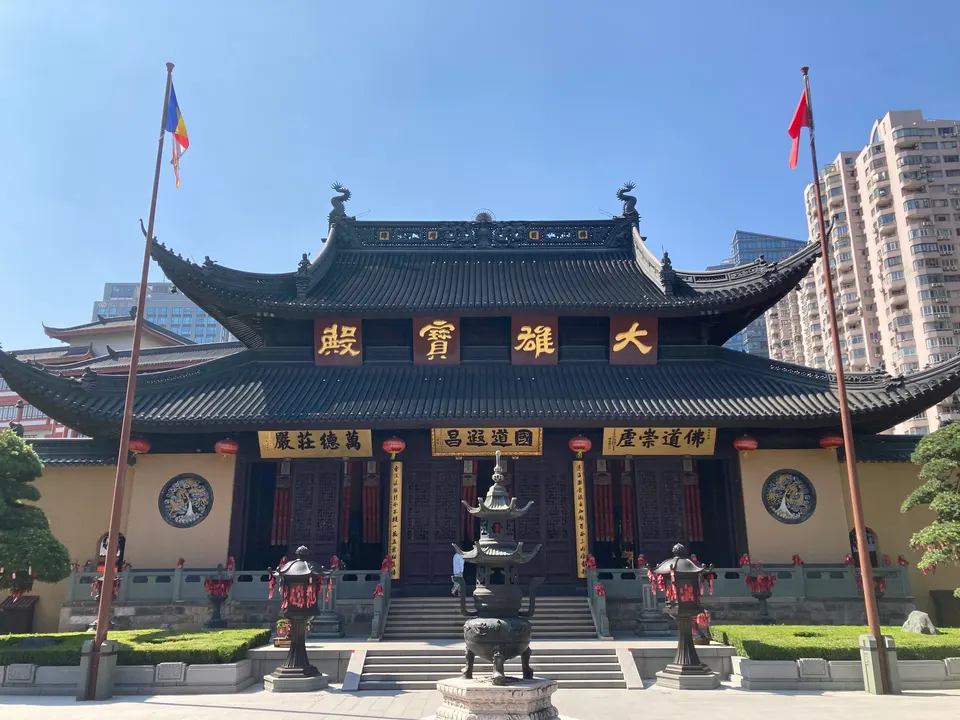
Behind the gate-hall opens an esplanade wrapped in smoke, with the incense burners and people crowded before the Great Hall, the Daxiong Baodian. That emptiness is the hall’s own former floor. Between 2 and 16 September 2017, the brick-and-timber building, raised between 1918 and 1928 and weighing some 2,000 tonnes, was moved 30.66 metres north on rails without taking out its original Buddhas, and then raised 1.05 metres. The courtyard almost doubled its area.
The hall keeps its double eaves, its hip-and-gable roof, its grey tiles and its yellow walls. Inside sit three golden Buddhas, Sakyamuni with the Dharma wheel in the centre, Bhaisajyaguru to the east and Amitabha to the west, flanked by twenty guardian devas; above the door hangs the plaque “Fo Dao Chong Xu”, placed in 1992. On the back face, a large painted relief shows Guanyin standing on a dragon-fish in the sea, the young Sudhana on his 53 visits, the ascetic Buddha in the Snowy Mountains with a monkey and a deer offering him fruit and flowers, and eighteen arhats at the base.
In front, the Guanyin Hall and the bell and drum towers, of freshly worked teak, were raised after the move; the first holds a Ming-era bronze Guanyin with strings of beads. In the courtyard, the narration reveals what the contrast between the new wood and the century-old hall says.
The small Buddha that ended up in a park
Reclining Buddha Hall
Summary of this stop
In the Reclining Buddha Hall rest two recumbent Buddhas in the lion’s posture, heads supported on the right hand. The one that catches the eye first is the large one, 4 metres of white marble in a single piece, brought from Singapore by Zhenchan, tenth abbot of the temple between 1979 and 1995. But the one that matters is the small one: Huigen’s original, 96 centimetres, carved from a single piece of Burmese stone and arrived in 1899.
That small Buddha lived the temple’s pilgrimage. During the 1911 revolution, troops occupied the Jiangwan temple and the Buddhas ended up abandoned in a park; the third abbot, Hongfa, later took them to a rented house on Maigen Road, today Huai’an Road, turned into a provisional temple. The Jiangwan site stopped working as a temple and ended up destroyed by the bombings of 1932, in the first Battle of Shanghai against Japan. Sources do not quite agree on the dates of that destruction and of the rebuilding, and one speaks of warlords in 1917.
According to the temple’s documented tradition, the second abbot, Benzhao, a disciple of Huigen, had travelled to the capital and come back with a complete set of the Longzang, the Buddhist canon printed by the Qing court, which is still kept in the scripture pavilion. He later saw the Buddhas out in the open and died without managing to recover them. Before the two statues, the audio guide tells why the smaller one is the one that holds the temple’s memory.
The Burmese marble Buddha called jade
Seated Jade Buddha
Summary of this stop
On the upper floor of the northern section, the Jade Buddha Hall keeps the piece that gives its name to everything: a seated Buddha of 195 centimetres, carved from a single block of white stone, with a serene face and half-closed eyes. It represents Sakyamuni at the moment of enlightenment, with the right hand touching the earth, and stones such as jadeite and agate are inlaid in the hem of the robe and the bracelet on the right arm.
Its journey began with Huigen’s pilgrimage on foot through Wutai, Emei, Tibet and India. On his return, in Burma, with Chen Junpu’s donations, he had stone quarried and five Buddhas of different sizes carved. On the stopover in Shanghai the faithful asked to keep one, and this was one of the two that did not continue to Putuo. It is a Burmese carving in Mandalay style in white marble: the temple describes it as jade, and Chinese popular tradition classes it so, while a 2023 academic study identifies it as Burmese marble; a photo published in 1912 in a Chinese Buddhist magazine even attributed it to “India-Ceylon”.
According to the documented tradition, in the first lunar month of 1953 the Chan master Xuyun, a hundred and fourteen years old by the traditional count, led a two-week meditation retreat here; his talks to the meditators were later published, and that same spring he presided over the consecration of the jade Buddha. Before the statue, the last stop of the audio guide brings together the whole journey and the episode of that blessing.