Television tower
Oriental Pearl Tower Audio Guide (Dongfang Mingzhu)
A 468-metre television tower born because Shanghai got poor TV reception: planted on top of some warehouses at the tip of Lujiazui, paid for with the first loan from Chinese banks in Pudong, and the first landmark of the new district facing the Bund.
- 90 min of audio
- Pudong icon
Proposed in 1983 by the Shanghai Broadcasting Bureau and designed by chief engineer Jiang Huancheng, the tower was topped out in December 1993 after 27 months of construction, 105 days ahead of schedule. It began commercial operation on 18 November 1994 and since 1 May 1995 has broadcast 5 television channels and 5 FM radio channels over a radius of some 80 kilometres that covers all of Shanghai. Three slanted legs hold up eleven spheres of steel mesh, and a 110-metre antenna mast, hoisted over 11 days, takes it to 468 metres. It was the tallest structure in China from 1994 to 2007.
Its origin is almost domestic: in the 1980s the new skyscrapers blocked the signal of the old television tower, and some families made outdoor antennas from Coca-Cola and Sprite cans. Its financing was an act of faith: the banks calculated the loan repayment on tickets of 5, 8 or 12 yuan, and almost no one believed the public would pay 12. The debt was settled early, around the year 2000, and in 2020 a ticket cost between 120 and 220 yuan.
Highlights
- Three slanted legs — 108-metre pillars, 7 metres in diameter, holding up the lower sphere
- Eleven steel spheres — Five 12-metre balls with hotel rooms between 118 and 210 metres
- Glass walkway — A transparent floor at 259 metres facing Jin Mao, the SWFC and the Shanghai Tower
- Space Module — The 16-metre sphere at the top of the shaft, the tower's highest viewing point
- Old Shanghai wax museum — More than a thousand pieces and more than a hundred figures up to 1949
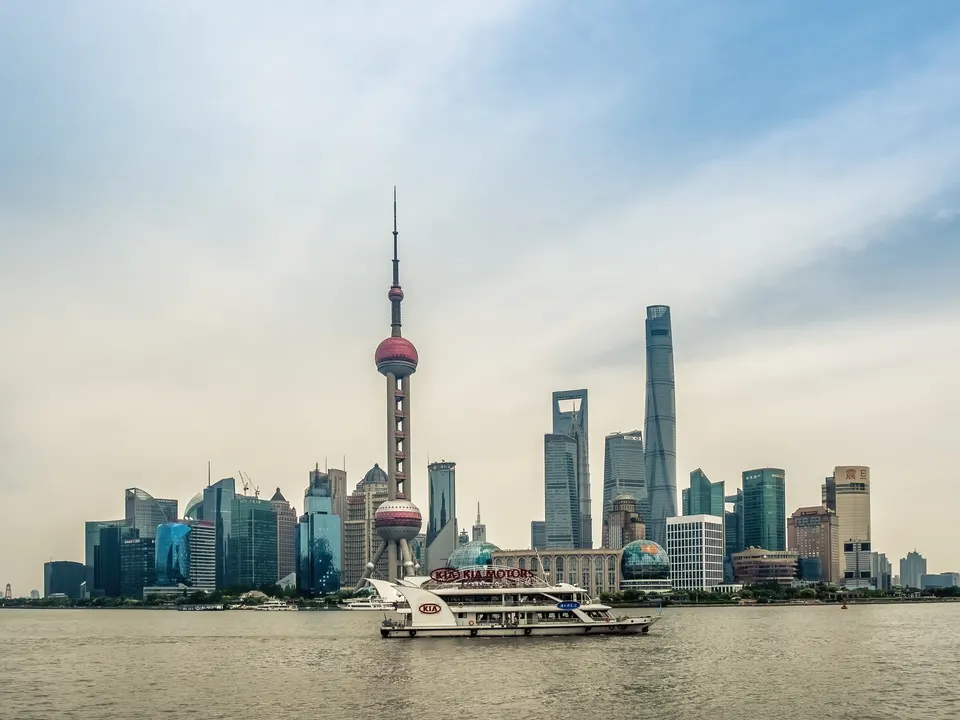
At the tip of Lujiazui, where the Huangpu bends east right across from the Bund, rises the Oriental Pearl Tower (东方明珠广播电视塔, Dongfang Mingzhu). It is a radio and television tower 468 metres tall, built between 1991 and 1994, held up by three slanted legs and strung with eleven spheres of steel mesh. It was the tallest structure in China from 1994 to 2007, when the neighbouring Shanghai World Financial Center overtook it, and the first landmark of the new district of Pudong on a bank that until then had only warehouses.
The history of the Oriental Pearl Tower begins with an antenna problem. On 25 August 1983 the Shanghai Broadcasting Bureau proposed a new tower because skyscrapers were blocking the signal of the old one; the site was set in 1985 and the design came out of a competition of 12 proposals. When in 1989 Canada withdrew a soft loan of 50 million dollars, the work was paid for with a loan from 44 Chinese financial institutions. The 350-metre structure was topped out in December 1993, the antenna mast, 110 metres and 450 tonnes, was installed on 1 May 1994, and the tower began commercial operation on 18 November 1994.
Its architecture was summed up by chief engineer Jiang Huancheng in a formula: “three legs, a bowl and an umbrella”. The tower is also associated with the line “big and small pearls fall on a jade plate” from Bai Juyi’s poem “Pipa xing”, often presented as the source of the design; another version credits the first use of that image to the jury experts Feng Jizhong and Wu Liangyong, and authorship remains disputed. What is not disputed is the silhouette: three vertical shafts with the lifts inside, a great lower sphere 50 metres in diameter, an upper one with viewing floors above 250 metres and, at the top of the shaft, the small Space Module, the tower’s highest observation point, above 350 metres.
The tower also has a life of its own. Since 1 January 1996, every New Year’s Day at 9 in the morning, a stair-climbing race organised by the Shanghai Sports Bureau sets off from its plaza. And in the summer of 2025 it became a meme: Chinese social media filled with AI-generated images in which the Pearl was a video-game “defence tower” firing laser beams at anyone strolling with a cup of Mixue, the cheap milk-tea chain. The tower itself played along from its official account: “I’m not hiding it any more, yes, I am a defence tower”.
To know what to see at the Oriental Pearl Tower, the audio guide walks it in four stops and 90 minutes: the plaza at its feet, the space beneath the slanted legs, the glass walkway at 259 metres and the urban history room in the base. There is a single thread: the most photographed tower in Pudong was not born as a futuristic whim, but as the answer of a city that could not get good television reception.
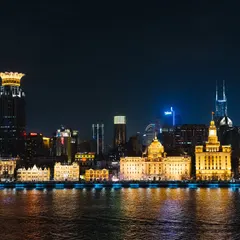
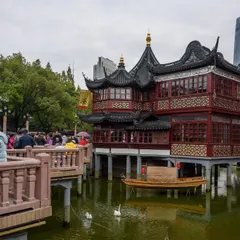
Facing the tower, on the other bank of the Huangpu, the Bund lines up; on that same bank lie the Yu Garden, in the old Chinese city, and, farther north, in Hongkou, the Shanghai Jewish Refugees Museum.
Tin-can antennas and warehouses by the river
Oriental Pearl Tower
Summary of this stop
The plaza at the foot of the tower opens the route, with the tower overhead and the Bund across the river. Its origin is more domestic than the silhouette suggests: in the 1980s, the new skyscrapers of more than 100 metres blocked the signal of the old 210-metre television tower on West Nanjing Road. Even in the Nanyang Road area, two stops from that tower, there were families making outdoor antennas from red Coca-Cola and green Sprite cans.
On 25 August 1983 the Shanghai Broadcasting Bureau proposed a new tower. Its director, Zou Fanyang, looked for land in Lujiazui, where at the time there were only a few warehouses at the tip of the bend, and in June 1985 permit 219 of the Planning Commission fixed the site on the former textile raw-material and Navy warehouses.
The shape was still missing. In May 1988 three design institutes presented 12 projects and three with very different names reached the final: “Eternity”, “Flying Saucer” and “Oriental Pearl”, the last from the East China Architectural Design Institute. The final choice was made by an enlarged meeting of the municipal Party committee. On the plaza, the audio guide begins by telling how a bank of warehouses ended up crowned by a pearl and not by a flying saucer.
Three legs, a bowl and an umbrella
Slanted legs of the tower
Summary of this stop
Beneath the legs, the scale changes. Three concrete pillars 108 metres tall and 7 metres in diameter come out of the ground diagonally and hold up the great lower sphere, 50 metres in diameter; up the axis of the tower climb three vertical shafts 9 metres wide that carry the lifts inside. Chief engineer Jiang Huancheng wanted to break with the “chimney with a candied-fruit skewer” model of tower and described his design as “three legs, a bowl and an umbrella”.
The silhouette has more calculation than it seems. The design was corrected twice before it was built: the lower sphere rose from 58 to 68 metres above the ground so that the trunk would look taller, and the small sphere at the top went from 13.8 to 16 metres in diameter to harmonise with the two large ones. Between those two large ones, five 12-metre balls are staggered which, between 118 and 210 metres, hide hotel rooms.
Following the eye up to the spire appears the tower’s darkest episode. According to the documented tradition, in the early hours of 13 April 2010, with Shanghai under a storm of rain and wind, lightning struck the highest part at about 2:20 and set fire next to the great antenna. Firefighters brought the flames under control in under an hour, with no casualties or damage to the structure, and neither broadcasts nor visits were interrupted. Less than three weeks remained before the 2010 World Expo. Beneath the legs, the narration reconstructs the night the tower burned like a candle.
Twelve yuan and three giant neighbours
259-metre glass walkway
Summary of this stop
At 259 metres, the floor turns transparent. The glass walkway circles the upper sphere, with the main viewing deck at 263 metres and the revolving restaurant at 267. Work began in October 2008 and it opened on 1 May 2009, when the tower was no longer the tallest in China: it had been from 1994 until the Shanghai World Financial Center overtook it in 2007. From here Jin Mao, the SWFC and the Shanghai Tower can be seen lined up, three skyscrapers of more than 420 metres.
This height had an unusual financing. In 1989 Canada withdrew a soft loan of 50 million dollars, and the tower went ahead with a syndicated loan from 44 Chinese financial institutions, signed on 10 April 1991 at the Yinhe Hotel: the first of the development of Pudong and the first in the country in foreign currency and yuan with Chinese banks alone. The banks calculated repayment on tickets of 5, 8 or 12 yuan, and almost no one believed the public would pay 12. The debt was settled early, around the year 2000.
From the top there is also a popular reading of the landscape. Legend has it that the Yangpu Bridge, to the northeast, and the Nanpu Bridge, to the southwest, the two great inner-ring bridges over the Huangpu, are two dragons fighting over a pearl: the tower itself, in the old Chinese motif of “two dragons playing with a pearl”. It is not a declared intention of the designers, but an image that Shanghainese apply to the ensemble. Over the glass, the audio guide draws that map of dragons, banks and skyscrapers.
Old Shanghai in wax beneath the new tower
Shanghai urban history room
Summary of this stop
The route ends back at the base, in the Shanghai Urban History Exhibition Hall, known as the “old Shanghai wax museum”. It gathers more than a thousand pieces and more than a hundred wax figures that run through the city from the late Yuan and early Ming to 1949: the old city, the open port and the era of the concessions.
The contrast is strong: the Shanghai before 1949, recreated at the foot of the symbol of the new city. On 29 September 2024 the tower welcomed its 100 millionth visitor, the German Peter Baur, a retired physics teacher aged 66, on his first visit to Shanghai and on the day of his 35th wedding anniversary.
Around those days, a French tourist who had travelled to China some thirty years earlier summed up the change on the riverbank in one sentence: “Back then, looking from the Bund toward Pudong, there was only the Oriental Pearl”. Among the wax figures, the last stop of the audio guide joins the city that was with the bank that came afterwards.