Tang Buddhist pagoda
Big Wild Goose Pagoda Audio Guide (Dayanta)
The brick tower that the monk Xuanzang had built in 652 to keep the sutras brought from India: rebuilt by Wu Zetian, cased by the Ming, signed for centuries by those who passed the imperial examination and still leaning to the northwest.
- 75 min of audio
- Tang dynasty
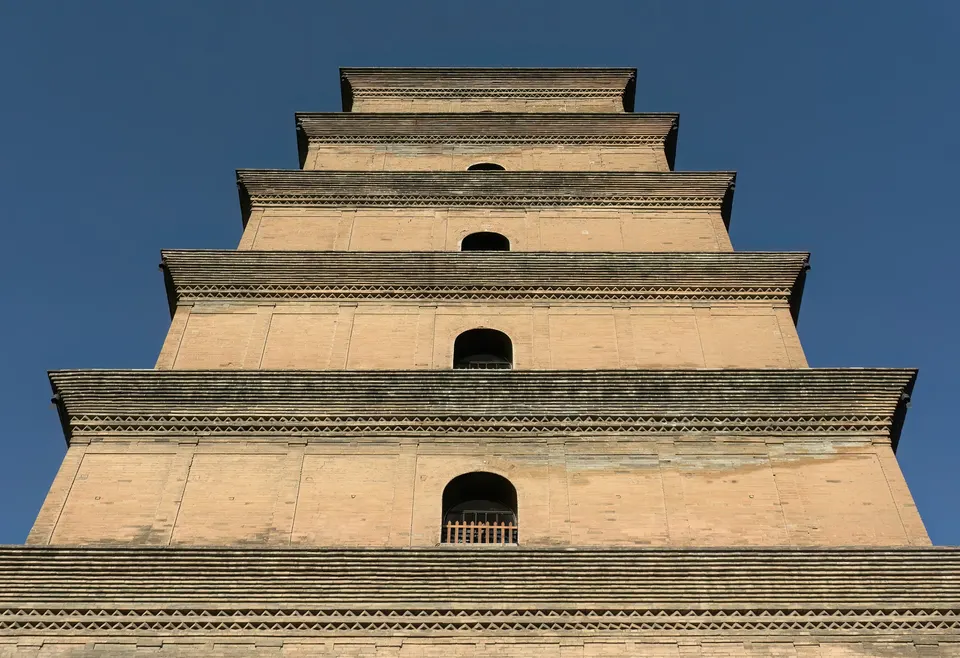
In 648 Crown Prince Li Zhi, the future Emperor Gaozong, enlarged an old Sui-era temple in memory of his mother, Empress Wende, and called it Da Ci'en, “great maternal grace”. It was an imperial temple and a sutra-translation workshop directed by Xuanzang, the monk who had returned from India with several hundred Sanskrit texts. To keep them, in 652 a tower in the style of the Western Regions was raised in the west courtyard: Xuanzang wanted it in stone, but the emperor ordered it built of brick and paid for it with the clothing of the dead of seven palaces. The present tower, of seven storeys and about 64 metres, is the one rebuilt by Wu Zetian in the early eighth century, wrapped in 1604 in a Ming brick jacket.
The contrast lies in the ground. In 1719 the pagoda leaned 198 millimetres to the west-northwest; with the overexploitation of Xi'an's groundwater, in 1996 it reached 1,010.5 millimetres. That year the city began to seal the surrounding wells and, since 1997, the tower has stopped leaning and is returning toward the vertical at a rate of one millimetre a year. Today that same city limits the height of buildings around it so that its silhouette, on Xi'an's emblem since 1988, keeps dominating the horizon.
Highlights
- Preface Steles — Two imperial texts dedicated to Xuanzang's sutras, calligraphed by Chu Suiliang at the south door
- West door lintel — A Tang Buddhist hall carved in stone that the architect Liang Sicheng drew as evidence
- Interior staircase — 248 steps up to the arches of the seventh floor that look out over the city
- The leaning tower — It tilted by more than a metre and since 1997 has been returning toward the vertical
- Da Ci'en Temple — One of the four Buddhist temples the Tang capital kept in the purge of 845
In Xi’an, the old Tang Chang’an, stands the Big Wild Goose Pagoda (大雁塔, Dayanta), a seven-storey grey brick tower on the axis of the Da Ci’en temple, a Buddhist monastery still in use. It was born in 652 as an archive: the monk Xuanzang had it built to keep the sutras he had brought from India. The records agree on neither the date nor the size: the tower is dated to 652 and the temple to 648, although some versions move the pagoda back to 648 and the temple to 647, and its height appears as 64.1, 64.5 or 64.7 metres depending on the measurement.
The history of the Big Wild Goose Pagoda is that of a survivor with many skins. The first tower, of five storeys, with a brick skin and an earth core, fell into ruin within a few decades; Wu Zetian replaced it with the seven-storey one, which came through the great Buddhist purge of 845, the ruin of Chang’an in 904, a fire in the eleventh century and the earthquake of the Jiajing era, which brought down its crown. In 1604 the Ming wrapped it in a new layer of brick, the one seen today. Its architecture imitates timber in fired clay: pilasters, lintels and dougong brackets carved in brick, with a number of bays that drops from nine to seven to five as you go up, an arch in the middle of each face of each storey and, at the top, a glazed ceramic finial in the shape of a gourd above the pyramidal roof.
Even the name has its riddle. First it was the pagoda of the Ci’en temple; then the Goose Pagoda, and finally the Big Goose Pagoda, to tell it apart from the Small one of the Jianfu temple. The most repeated explanation refers to a legend that Xuanzang recorded in India; another reading holds that the name was fixed for this tower much later, in the Song period, through the custom of inscribing the names of those who passed the exams. And the monk himself has partly returned to his temple: on 21 November 2000, on the 1,400th anniversary of his birth, the Da Ci’en temple opened a courtyard dedicated to him and deposited there a relic attributed to his skull, while other remains of his are divided among Nara, Taiwan, Nalanda and Chengdu. In that last courtyard, beside the Dabianjue Hall and its bronze statue, the Prajna Hall tells his life in large wooden reliefs.
To know what to see at the Big Wild Goose Pagoda and in the temple that surrounds it, the audio guide covers it in five stops and 75 minutes of narration: from the south square, where the statue of Xuanzang waits, to the bell tower of the first courtyard, the base of the tower with its Tang steles and lintels, the climb inside to the arches of the upper floors and, at the end, the north square. The thread is a single one: a tower that is not a motionless monument but a survivor, to which the same city that made it lean now gives space so as not to hide it.
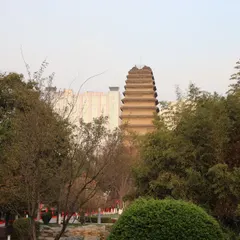
The other Tang pagoda for scriptures brought from India, the Small Wild Goose Pagoda, lies farther northwest, near the wall. And to keep reading history in carved stone, the Forest of Steles gathers beside the south wall the Confucian classics and the calligraphy of the great masters.
A tower paid for with the clothing of the dead
Big Wild Goose Pagoda South Square (大雁塔南广场)
Summary of this stop
The route begins in the south square, opened in 2001 in front of the temple gate, where the statue of Xuanzang greets the visitor. Behind it lies the origin of it all. In 648, Crown Prince Li Zhi, the future Emperor Gaozong, enlarged the old Sui-era Wulou temple in memory of his mother, Empress Wende, and gave it the name Da Ci’en, “great maternal grace”. It was an imperial temple and a workshop where Xuanzang directed the translation of the sutras he had brought from India.
In 652, the third year of the Yonghui era, the monk directed in the west courtyard the building of a tower in the style of the Western Regions to keep those several hundred Sanskrit texts. He had asked for it in stone, 30 zhang tall, before the temple gate. Emperor Gaozong’s answer came through the secretary Li Yifu: the work was too large. He ordered it made of brick and paid for it with the clothing of the deceased of seven palaces, including that of the crown prince.
That leaves the goose. Xuanzang left written in his Records of the Western Regions the story of a monastery in Magadha, on Mount Indrasaila-guha, where one day the monks’ food ran out, a goose fell dead from the sky after a joke and the community, taking it as a sign, raised a stupa over it. It is the most repeated explanation of this tower’s name, but no ancient text links the two pagodas, and Xuanzang never called the one in Chang’an “of the Goose”. In front of the statue, the audio guide reconstructs the whole scene and leaves the doubt open.
One of the four temples spared
Temple spared in 845
Summary of this stop
In the temple’s first courtyard, face to face, stand the bell tower and the drum tower. In the bell tower hangs an iron bell recast in 1548, of nearly a tonne, and its presence here has something of irony. According to the chronicles, in 842 Emperor Wuzong, persuaded by the Taoist Zhao Guizhen, began emptying the monasteries: in Chang’an alone 3,459 monks and nuns returned to lay life, and of the capital’s Buddhist temples four were left, among them the Ci’en. In 845 the final decree came, four temples with ten monks each, and the bronze statues and bells of the demolished temples were melted down to mint coin. There is talk of more than 4,600 temples demolished across the empire and 260,500 religious secularised.
The temple survived the purge, but not neglect. In 904, when Zhu Wen forced Emperor Zhaozong to move the capital to Luoyang, Chang’an was destroyed and the temple was left in ruins. In the Xining era, between 1068 and 1077, a fire started by the wealthy Kang Sheng burned all night and peeled off the pagoda’s outer plaster, leaving the brick exposed.
From the courtyard the most recent wound can be seen. With the Mahavira Hall in front as a vertical reference, the body of the tower is not plumb: it leans to the northwest. In 1719 the measured deviation was 198 millimetres; in 1941, 413; in 1996 it reached its maximum, 1,010.5. Between 1985 and 2004 the ground beneath the tower sank 1,189 millimetres. Beside the bell, the narration tells how the temple narrowly escaped the greatest Buddhist persecution of the Tang.
Tang stone beneath a Ming jacket
Preface steles at the south door
Summary of this stop
At the foot of the pagoda, the tower reveals itself as an onion of eras. The first, of five storeys, had a brick skin and an earth core; in the Chang’an era (701–704) grass grown in the joints had ruined it, and Wu Zetian and the nobles paid for its demolition and replacement with a square seven-storey tower of pavilion type. Whether it always had seven is another matter: Cen Shen’s poem of 752 speaks of seven, while later texts speak of ten, and some believe the tower grew and shrank back after the wars, while others hold that those ten storeys are an exaggeration.
What is seen outside is later. The great earthquake of the Jiajing era brought down the crown, and in 1604 the minister Wen Chun restored the pagoda: he reinstalled the stairs of each storey and wrapped the Tang body in a layer of brick about 60 centimetres thick. Only the doors let you see the original stone. In the brick niches on either side of the south door are the two steles of the Preface to the Sacred Teaching: the one that Emperor Taizong wrote in 648 for the sutras translated by Xuanzang and the one with the record written by Gaozong, both calligraphed by Chu Suiliang, topped with coiled dragons, edges with plant scrolls and a base with celestial musicians and dancers.
The four ground-floor doors keep stone lintels with line engravings of buddhas and heavenly kings, datable to Wu Zetian’s reconstruction. The one on the west door shows Amitabha preaching before a Tang Buddhist hall of five bays, and the architect Liang Sicheng drew it as evidence of what the timber architecture of the time was like. In front of the south door, the audio guide separates, layer by layer, what belongs to each century.
Climbing the tower to sign the pass
Upper-floor arches
Summary of this stop
The pagoda measures 64.1 metres including its base, about 4.2 metres high and 48.8 wide from north to south; the side of the lower body measures 25 metres and the storeys narrow as they rise. Inside, a staircase of 248 steps, renewed in the twentieth century, climbs in half-light to the seventh floor, and on each face of each storey a brick arch looks out over the city. In the autumn of 752, the poet Cen Shen, back from Anxi, climbed it with Gao Shi and other friends and composed the poem that describes it with “seven storeys that brush the firmament”.
From the Shenlong era (705–707), the tower was also the climax of a celebration. The new jinshi doctors toured the Qujiang pond together, attended the imperial banquet at the Apricot Garden and climbed the pagoda to leave their names in the temple: hence the expression “to inscribe one’s name on the Goose Pagoda” for having passed the imperial examination, which Bai Juyi celebrated with the verse “the youngest of the seventeen”. According to tradition, it all began with a whim, that of a new doctor who wrote his name at the foot of the tower and was imitated by the others, and the inscription ended up with its own protocol: name, origin, date of the pass and lineage of the family.
The custom outlived the Tang. Under the Ming, those who passed the provincial examination kept erecting steles here and at the pagoda of the Jianfu temple, and on the ground floor Ming and Qing steles with the names of graduates remain set into the walls, beside the one of Xuanzang carrying the sutras. At the arches of the upper floors, the narration tells what happened in 793, when a list of 32 graduates, with Liu Zongyuan and Liu Yuxi among them, lacked the origin of an absent companion and the wall allowed no corrections.
A crooked tower that is straightening
Big Wild Goose Pagoda North Square (大雁塔北广场)
Summary of this stop
The route ends in the north square, 300 by 450 metres, opened in 2003, with a central pool and scheduled fountain shows. From here the pagoda is seen whole, and with it the final paradox. In 1996 the Xi’an government began sealing the neighbouring institutions’ own wells, more than 400 according to some figures and 500 according to others. Since 1997 the tower has stopped leaning and started to recover toward the vertical at a rate of one millimetre a year: by the end of 2006 it had gained 9.4.
The city that bent it now steps aside so as not to hide it. In 2013 Xi’an set around it a buffer zone with stepped maximum heights from 6 to 60 metres and three visual corridors toward Heping Gate, Hanguang Road and Yannan Fourth Road, so that it remains the dominant landmark of the horizon. Its silhouette has headed the city’s emblem since 1988. In front of the pool, the audio guide’s last stop closes the story of a tower that, thirteen centuries later, is still moving.