Historic quarter
Muslim Quarter Audio Guide (Huimin Jie)
Xi'an's Hui quarter begins at the foot of the Drum Tower along Beiyuanmen Street: blue-stone lanes with lamb and bread inherited from the Silk Road merchants and, at the end of one of them, a Ming mosque built like a Chinese temple that faces Mecca.
- 60 min of audio
- Silk Road
Xi'an's Muslim community goes back to the Tang dynasty, when Muslim merchants arriving along the Silk Road settled in Chang'an, the Xi'an of the time. The quarter grew around its mosques: in the Qing period it took the form of “three mosques and thirteen neighbourhoods”, and with the Central Mosque (1919) and the Western Mosque (1920) it reached the “nine mosques” layout. The Shaanxi-Gansu Muslim revolt (1862–1877) devastated numerous Muslim neighbourhoods in northwest China, but this one came through unscathed thanks to its commercial weight and its position inside the wall. In 2010 about 60,000 people lived there, more than half of them ethnic Hui.
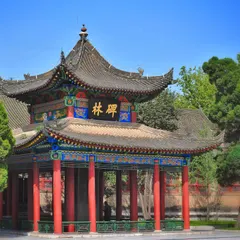
The contrast lies at the end of Huajue Xiang alley. The Great Mosque has paifang arches, steles, a three-storey pavilion and turquoise tiles, like any Chinese temple, but its entire axis runs east to west to point to Mecca, the reverse of Chinese temples, which open north to south. Instead of a minaret there is an octagonal tower that looks like a pagoda. And its prayer hall, built for a thousand worshippers, spent the years of the Cultural Revolution converted into a steel factory.
Highlights
- Beiyuanmen Street — Blue-stone paving and Ming-Qing façades that begin beneath the Drum Tower
- Gao Family Courtyard — A Ming-era residential courtyard with 86 rooms, restored with Norwegian help
- Lao Tong Jia — Cured lamb since the Qianlong era and Empress Cixi's halted sedan chair
- Great Mosque of Huajue Xiang — Courtyards, steles in Chinese and Arabic and an axis oriented toward Mecca
- Shengxin Lou — The Heart-Examining Tower, an octagonal pavilion where you would expect a minaret
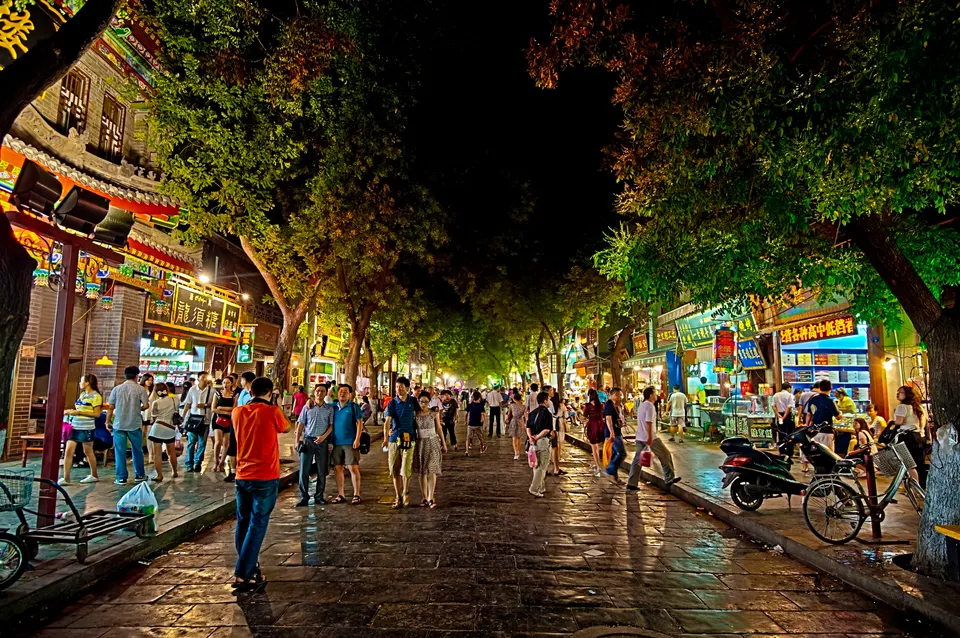
North of Xi’an’s Drum Tower begins the Muslim Quarter (回民街, Huimin Jie), the neighbourhood of the Hui community. What guidebooks call “Muslim Street” is not a street to its residents but a whole district of alleys —Beiyuanmen, Beiguangji, Xiyangshi, Dapiyuan, Huajue Xiang, Sajinqiao— which they call Huifang, “the Hui quarter”, or simply Fangshang, “in the quarter”. Its best-known entrance is Beiyuanmen Street, pedestrianised, paved with blue stone, its Ming and Qing-style façades occupied almost entirely by restaurants and souvenir shops.
The history of the Muslim Quarter begins with the Tang dynasty, when Muslim merchants arriving along the Silk Road settled in Chang’an, today’s Xi’an. Since then the quarter has grown around its mosques, and the most important, the Great Mosque of Huajue Xiang, condenses that history in stone and wood. Tradition places its founding in the year 742, the first year of the Tianbao era, although the exact date is unknown and almost nothing remains of the Tang work. Its present form was essentially built in 1392, under the Hongwu emperor of the Ming dynasty, and the Qing added the front gate, the paifang arches and a public fountain; some argue, however, that the complex did not take its final look until the eighteenth century, after several enlargements.
Another mosque in the quarter, the one on Daxuexi Xiang, preserves a tradition documented in an inscription of 1523, the so-called “Zheng He stele”. It tells that in 1413, while preparing his fourth voyage to the Western Seas, the Muslim admiral Zheng He came to Xi’an looking for trustworthy interpreters and found Hasan, leader of that mosque, who had mastered Arabic and sailed with the fleet. He got him out of trouble more than once and, on his return, asked for no posts or honours: only that his mosque be repaired, and Zheng He directed the work.
To know what to see in the Muslim Quarter without staying on the surface of the food stalls, the audio guide walks it in five stops and one hour of narration: from Beiyuanmen to the Gao house, the Beiguangji arch and, in the silence of Huajue Xiang alley, the courtyards of the Great Mosque as far as its prayer hall. The thread is a single one: this bustle is not a tourist set but the form a community born of the Silk Road found to remain itself inside a Chinese city for more than a thousand years.
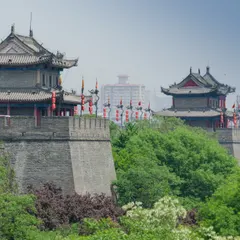
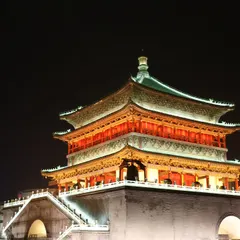
About five hundred metres away, at the city’s central crossing, rises the Bell Tower, and the whole quarter lies within the enclosure of the Xi’an City Wall.
A street born of the Silk Road
Beiyuanmen (北院门)
Summary of this stop
Beiyuanmen Street starts north of the Drum Tower, whose bulk is left behind as soon as you enter it. Ahead opens a blue-stone roadway flanked by Ming and Qing-style buildings, full of counters, smoke and people. Behind that crowd there is a long genealogy: the community that lives here descends from the settlement of the Muslim merchants who reached Chang’an along the Silk Road in Tang times.
The quarter was not organised around a square or a market but around its mosques. In the Qing period it had the shape of “three mosques and thirteen neighbourhoods”, and the Central Mosque, of 1919, and the Western Mosque, of 1920, took it to the “nine mosques” layout. It is still a lived-in quarter: in 2010 about 60,000 people lived there, more than half Hui and the rest Han. Beneath the Drum Tower, the audio guide begins by reading in this street of shops the trace of those merchants.
The Ming house that survived everything
Gao Family Courtyard (高家大院)
Summary of this stop
At number 144 Beiyuanmen, among the shops, a gateway opens onto the Gao family courtyard (Gao Jia Dayuan), a residential compound of brick and timber with three courtyards and four buildings whose core dates from the Chongzhen reign, at the end of the Ming dynasty. It brings together 86 rooms on 2,517 m² of living space, 56 of them open to the public. Inside follow courtyards with the single-pitch side wings typical of Shaanxi, and a second gate with brick reliefs of flowers and bamboo and the characters 平为福. That it has survived to today is no accident: the Shaanxi-Gansu Muslim revolt (1862–1877) devastated many Muslim neighbourhoods in the northwest, but Xi’an’s came through unscathed. In 1999 the house entered, together with the courtyards at Huajue Xiang 125 and Xiyangshi 77, a Chinese-Norwegian conservation project funded by Norway; in 2002 the restoration of Huajue Xiang 125 received an Honourable Mention at the UNESCO Asia-Pacific Awards for Cultural Heritage Conservation.
The street’s name holds another episode. Beiyuanmen means “gate of the North Courtyard”, and in that North Courtyard, the Beiyuan, the dowager empress Cixi settled, having fled Beijing with the Guangxu emperor when the troops of the eight powers took the capital in 1900. According to the documented tradition, she entered Xi’an on 26 October that year, found the provisional palace prepared for her in the South Courtyard too small and moved here: work went on day and night, neighbouring houses were knocked down and the place was remade in the image of the Forbidden City. That year of drought, with some three million people affected in Shaanxi, more than a hundred dishes were served at each meal in her kitchen, and in summer perpetual ice was brought down from the summit of Mount Taibai to cool her sour-plum juice. In front of the Gao gateway, the narration tells how a street of neighbours became an emergency palace.
An arch, a golden sign and the paomo
North Guangji Street (北广济街)
Summary of this stop
At the entrance to Beiguangji Street, an arch bears the characters 回坊, Huifang: the name residents give the quarter. Past the arch, on the west side, a big black sign with golden letters shines: 辇止坡老童家. This is Lao Tong Jia, the Tong family’s cured-lamb shop, opened in the Qianlong reign of the Qing dynasty. Its lamb and beef are still cured on the bone in jars of old well water and cooked with rock salt, mirabilite, star anise, cinnamon and Sichuan pepper.
The first part of the sign, Nianzhipo, means “the slope where the sedan chair stopped”. According to tradition, during her refuge in Xi’an Empress Cixi ordered her sedan chair halted before the shop, drawn by the smell of the meat cooking. In the neighbouring yangrou paomo restaurants, the emblematic dish of Xi’an’s Muslim cuisine, diners crumble the bread by hand into small pieces in the bowl before handing it to the cook, who cooks it in a wok of broth with rice noodles and lamb. Beneath the arch, the audio guide explains why a single word separates the outsider from the resident.
A Chinese temple that faces Mecca
Great Mosque of Xi'an (化觉巷清真大寺)
Summary of this stop
Along the narrow Huajue Xiang alley you reach, at number 30, the Great Mosque. The compound is a walled rectangle of about 50 × 250 metres divided into successive courtyards —five according to the most common account, four according to others— and symmetrically aligned on an east-west axis oriented toward Mecca, with the entrance to the east and the prayer hall at the western end. It is the inversion of a Chinese temple, which opens along a north-south axis. In the first courtyard a monumental Qing-era gate awaits, and paifang arches frame each of the courtyards.
Throughout the compound there are more than twenty steles in Chinese and Arabic. In the second courtyard, two of them record texts on harmony between faiths, one attributed to the calligrapher Mi Fu, of the Song dynasty, alongside imperial reconstruction steles of 1606 and 1768. On walls and doors, the shahada and other Arabic inscriptions are drawn with a Chinese brush in the Sini style. The architecture of the Great Mosque also holds an absence: it has no Islamic-style minaret. In the third courtyard rises the Shengxin Lou, the “Heart-Examining Tower”, a three-storey octagonal Ming-era pavilion; that it once served to call people to prayer is a hypothesis, not a documented fact. In front of the Shengxin Lou, the audio guide reveals how a mosque learned to speak the language of Chinese temples.
The hall that was a steel factory
Prayer hall and Moon Terrace
Summary of this stop
Past the hexagonal Phoenix pavilion, in the fourth courtyard, the axis ends at the prayer hall, raised on a broad stone platform with a balustrade, the Moon Terrace. It is a large timber hall with a turquoise-tiled roof, painted dougong brackets and a portico of six columns and five doors. It is viewed from outside, because non-Muslims cannot enter. It holds 1,000 worshippers, although about 100 people attend a typical Friday prayer today.
During the Cultural Revolution the mosque was closed and turned into a steel factory, although some accounts hold that it was, with the Western Mosque of Sajinqiao, one of the only ones in the quarter that stayed in use. Worship resumed after Mao Zedong’s death in 1976, and in 1988 it was declared a National Historical and Cultural Monument. One month a year, the quarter changes rhythm: during Ramadan, according to a documented tradition, one of the imams walks the streets each night beating a drum to wake residents before dawn, and at sunset the Great Mosque serves iftar free to anyone who wants to sit down, Muslim or not. On the terrace, the audio guide’s last stop tells what the silence of this hall holds.