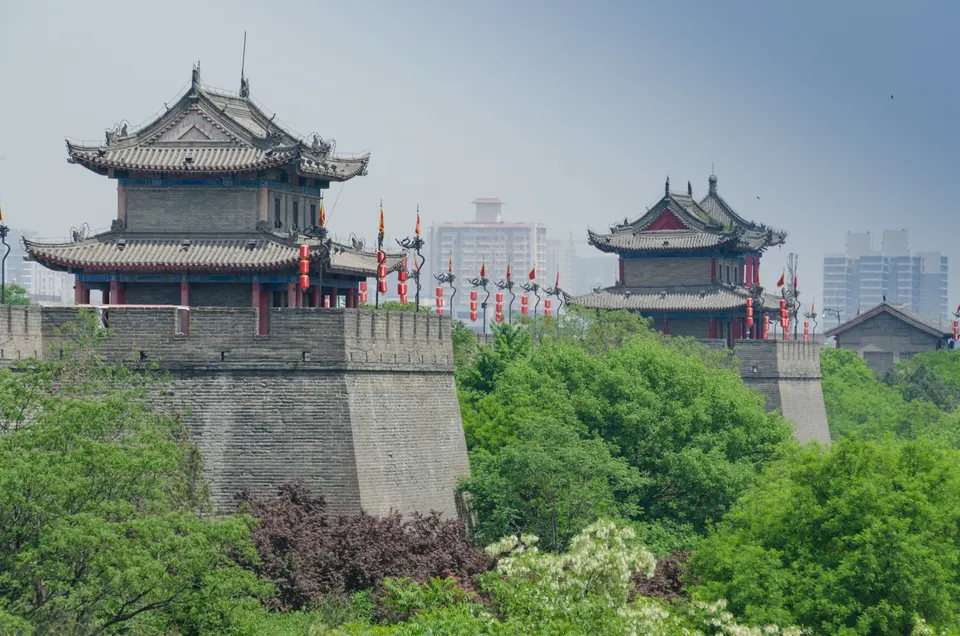
Ming city wall
Xi'an City Wall Audio Guide (Xi'an Chengqiang)
Almost fourteen kilometres of grey brick that wrap around Xi'an's old city and hold within them the walls of Tang Chang'an: a Ming war machine that survived sieges, bombings and a vote to tear it down, and is now an avenue for bikes, marathons and lanterns.
- 90 min of audio
- Ming dynasty
The wall around Xi'an's old city began to rise in 1374, by the most-cited date (other sources give 1370), when Zhu Yuanzhang, founder of the Ming, named his second son, Zhu Shuang, Prince of Qin with his seat in the city. Geng Bingwen and Pu Ying directed a project that did not start from scratch: it reused and extended to the west and south the walls of the Tang Chang'an Imperial City, built the east and north sections anew, and was practically finished in 1378. The result stands 12 metres high and up to 18 wide at the base, with 98 bastions projecting from the wall every 120 metres, the distance covered by arrows and firearms. In 1568 the rammed earth was faced with brick, and in 1781 Bi Yuan's renovation gave it the look it keeps today.
The contrast lies in its use. Built to shut the city in, the wall confined its residents during the siege of 1926, served them as an air-raid shelter under Japanese bombs, and in 1958 a municipal meeting voted by a majority to tear it down. It was saved by a letter to the State Council. Today its rampart hosts an international marathon every year, lights up with a lantern fair every Chinese New Year, and at its South Gate heads of state are received by a retinue dressed in the style of the Tang court.
Highlights
- South Gate, Yongningmen — Three gates and three towers in a row beyond a drawbridge over the moat
- Barbican and archers' tower — The 1636 trap courtyard and the tower destroyed in the siege of 1926
- South rampart — A brick avenue 12 to 14 metres wide with a bastion every 120 metres
- Hanguang Gate Museum — The gateway of the Tang Imperial City wrapped inside the Ming wall
- Southwest corner tower — The only round one of the four, a legacy of the Yuan wall
Around Xi’an’s old city runs, unbroken, the Xi’an City Wall (西安城墙, Xi’an Chengqiang), a Ming circuit of 13.74 kilometres with a moat, bastions, corner towers and 18 gates. It was ordered built by Zhu Yuanzhang, founder of the Ming dynasty, after he named his second son, Zhu Shuang, Prince of Qin with his seat in the city; the works, directed by Geng Bingwen and Pu Ying, began in 1374 according to some sources and in 1370 according to others (the Xi’an government’s own website gives both dates), and were practically finished in 1378. Beneath that grey brick lies something older: to the west and south, the Ming builders reused the walls of the Imperial City of Tang Chang’an, the capital of more than a thousand years ago.
The history of the Xi’an City Wall is that of a fortress strengthened with every new threat. In 1568 the governor of Shaanxi, Zhang Zhi, faced the rammed earth with brick; in 1636 Sun Chuanting added barbicans to the four gates to hold off the rebel Li Zicheng, who took the city anyway in 1643; and in 1781, under the Qianlong emperor, Governor Bi Yuan rebuilt walls and towers, added drains and crenellations, and fixed the look it has today. The twentieth century tested it in another way. Between 1937 and 1940, during the Japanese bombings, residents dug about a thousand air-raid shelters into its base, and several of those emergency exits are now gates such as Wumumen, Jianguomen, Chaoyangmen or Shangwumen. In 1952 the stretch in front of the railway station was knocked down to enlarge the square; it was not closed until 26 December 2004, when the wall became a continuous ring again.
Its architecture has its share of myth too. Popular memory attributes the hardness of the whole structure to a glutinous-rice mortar, but the construction account limits it to the lowest layer, of lime, earth and rice rammed together; above it come rammed yellow earth and the brick lining. Even the figures are not settled: the number of crenellations appears as 5,984 or 5,894 depending on the source, and the 13.74 km accepted today sits beside historical measurements of 14,088 and 13,766 metres. The East Gate, Changlemen, the “Gate of Eternal Joy”, carries its own legend: popular tradition says that Li Zicheng, on entering through it, read the sign and said that if the emperor was given eternal joy, the people would have eternal suffering, and that his men set fire to the tower, which was not rebuilt until the Qing. And at the foot of the wall, by Jianguomen, a group of fans of qinqiang, Shaanxi opera, gathers in its usual corner to sing against the bricks; among them is Shen Lianqiao, who at 78 has known arias since he was 12 and fears that no young person will take over.
To know what to see on the Xi’an City Wall without getting lost in its 13.74 kilometres, the audio guide walks the south and west stretch in five stops and ninety minutes of narration: from the South Gate, with its moat, barbican and archers’ tower, to the rampart as wide as an avenue and, to the west, as far as the Tang gateway buried in the wall and the only round corner tower. The thread is a single one: underfoot lies a war machine that encloses another, older wall and that came close to disappearing.
Right against its southern stretch, the Forest of Steles has kept the Confucian classics carved in stone since 1087. Beyond its gates wait the other layers of the city: the Tang Chang’an of the Big Wild Goose Pagoda, to the south, and the Qin empire of the Terracotta Army, in Lintong.
A drawbridge for receiving presidents
Yongning Gate (永宁门)
Summary of this stop
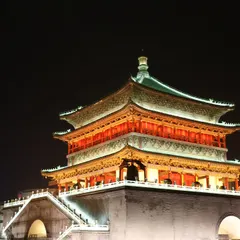
The route begins across the moat, before the South Gate, Yongningmen, which in Tang times was the Anshang gate of the Imperial City. What from afar looks like a single gate is in fact a “three gates, three towers” complex in a row: the drawbridge over the moat, the gate tower (zhalou), the archers’ tower (jianlou) and, at the back, the main tower (zhenglou). On each side, three arches opened in 1956 now carry cars and pedestrians, and the original tunnel no longer takes traffic.
That same bridge, designed to shut the city against the enemy, is now used to open it. Since 1996 a welcome ceremony inspired by the Tang court’s reception protocol has been staged before the South Gate: ancient music plays, palace ladies, civil and military officials and foreign envoys file out, cross the bridge to receive the guest, and singers and dancers welcome them. More than 200 dignitaries have received it. On 25 June 1998, at 8:55 p.m., US president Bill Clinton took the key to the city here and evoked Tang Chang’an as a centre of openness and culture of more than a thousand years ago. In front of the moat, the audio guide tells what this gate said about the city it protected and why its welcome ritual looks so far back in time.
The barbican: a stone trap and a besieged city
Yongningmen barbican and archers' tower
Summary of this stop
Behind the first gate opens a courtyard enclosed between the archers’ tower and the main tower: the barbican (wengcheng). Anyone who forced the outer entrance was trapped here, surrounded by walls. It was added in 1636, when Governor Sun Chuanting fitted all four gates with barbicans to hold off the rebel Li Zicheng; it did not help much, because in 1643 Li Zicheng entered Xi’an through the east gate, Changlemen, and burned it.
The archers’ tower that dominates the courtyard was built in 1378, but the one you see is new: its south façade, with four rows of twelve loopholes, was rebuilt in 2013 and 2014 and houses a museum. The original fell in 1926, during the siege by Liu Zhenhua’s Zhensong army, which surrounded Xi’an from April to November. The defence, led by Li Huchen and Yang Hucheng, went down in memory as “the two tigers defend Chang’an”, and hunger and fighting killed more than 40,000 soldiers and civilians inside the wall.
The chronicles of that siege are among the harshest in the city’s history. From September the grain ran out and residents ate bran, oil-press cake, distillery dregs and wild herbs; stored rice and wheat reached one hundred yuan a dou, and people scavenged for hides, roots and bark. The siege was lifted on 28 November. In 1927, under Yu Youren, the Revolution Park was created with two great mounds, known as the “tombs of the ten thousand”, the eastern one for men and the western one for women, and on 12 March the public funeral was held at which the fallen and 3,043 nameless bodies were buried. In the barbican courtyard, the narration reconstructs how a wall meant to save the city ended up being its prison too.
A brick avenue with bastions every 120 metres
South rampart bastions
Summary of this stop
On climbing to the south rampart, west of Yongningmen, the wall stops looking like a wall and becomes an avenue: 12 to 14 metres wide on top, 15 to 18 at the base and 12 high. Outwards, in a regular row, project the bastions (ditai), 98 around the whole circuit, jutting 12 metres from the wall every 120 metres, a spacing that fell within the range of arrows and firearms; each one is topped by a guard turret. The defensive logic can be read even at the edge: on the outer side, crenellations for shooting and watching; on the inner side, a smooth parapet with no crenellations, meant so that no one would fall.
That look is not the one of 1378. In 1568 Governor Zhang Zhi faced the rammed earth with grey brick, and in 1781 Bi Yuan directed the great renovation that added drains and crenellations. Since 7 November 1993, the same defensive machine has served as the track for the Xi’an City Wall International Marathon, and since 1984 it lights up every Chinese New Year with its Spring Lantern Fair, which in 2021 was already in its 33rd edition and opened on the night of the northern “little New Year”. On the rampart, the audio guide explains how each stretch was defended and how residents ended up making the wall their own.
The Tang gateway hidden inside the Ming wall
Hanguang Gate Ruins Museum (含光门遗址博物馆)
Summary of this stop
To the west, the Hanguang Gate Museum holds the proof that the Ming wall did not start from scratch. Before the 1950s a stretch collapsed beside Hanguangmen and exposed the Hanguang gate of the Tang Imperial City, wrapped inside the Ming wall. The fourteenth-century builders had reused and extended to the west and south the walls of Tang Chang’an, and only built the east and north sections anew.
The gateway was excavated in 1986, and since September 2008 a museum has displayed its remains alongside cuts through the wall in which, layer by layer, you can read the rammed earth of the Sui-Tang period and the later additions up to modern times. It is a cross-section of a thousand years of the city’s history seen in profile. Inside the museum, the narration tells how an entire city ended up inside the wall of the next.
The only round corner and the vote of 1958
Southwest corner tower
Summary of this stop
The route ends at the southwest corner tower, the only round one of the four: the other three are square. That curve gives away an even older wall, from the Yuan period, whose shape this corner preserved.
That the tower still stands was not written. On 17 June 1958, a municipal meeting on the wall’s future gave the majority to those in favour of demolishing it. Wu Bolun, deputy director of Culture of Shaanxi, then sent a letter to the State Council that received the backing of Xi Zhongxun, and in 1961 the wall entered the first list of nationally protected monuments. The credit is still disputed: Chinese accounts attribute it to Wu Bolun and Xi Zhongxun, and earlier to Zhao Shoushan, while other versions give it to the campaign of the architects Lin Huiyin and Liang Sicheng.
Saving it was not the same as preserving it. In the 1980s the wall had 14 breaches and its 98 bastions and four corner towers were completely ruined; in 1983 a large-scale restoration began that rebuilt towers, turned collapsed stretches into gates and recovered the moat. That is why, although it is usually presented as the most complete wall in China, much of what you see is reconstruction from 1983 to 2014 with modern materials and criteria. At the round corner, the last stop of the audio guide tells how close Xi’an came to being left without its wall.