Karst arch
Moon Hill Audio Guide (Yueliang Shan)
A limestone tower 380 metres above sea level pierced from side to side by the remnant of a cave that water emptied: an eye of about 50 metres that changes phase like the Moon as one walks through the valley, and under whose roof sport climbing began in China.
- 90 min of audio
- Natural karst arch
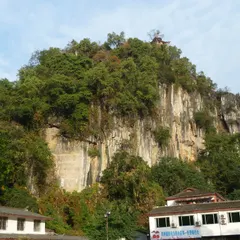
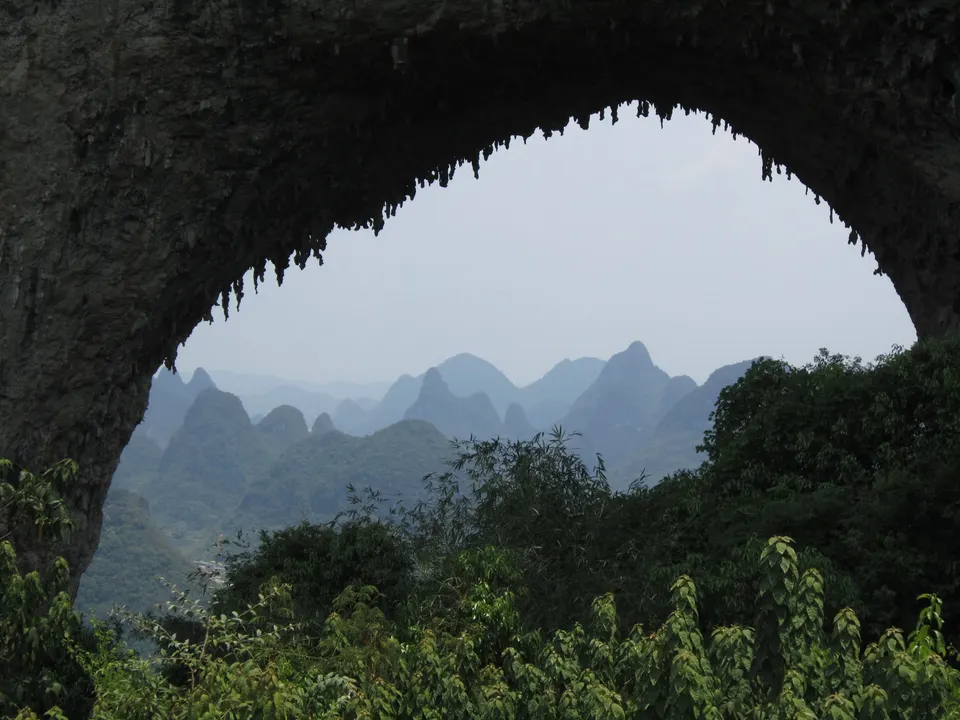
Moon Hill rises on the outskirts of Yangshuo above a plain of crops. Its formal name is Mingyue Feng, bright moon peak, for the great through-hole that opens below the summit: an arch about 50 metres high and as many wide, framed by a rock wall only a few metres thick. It is all that remains of an ancient limestone cave dug out below the groundwater level. Some 800 stone steps climb from the plain to the vault, whose roof is studded with stalactites.
Very different figures have turned around that stone moon. In the Qing era, Xu Tingzheng named it the moon hanging from the high peak; according to tradition, Richard Nixon climbed up here in the 1970s; in 1990 two American climbers bolted China’s first sport-climbing route under the arch; and a peasant woman who sold water on the stairs learned eight languages and ended up known as Mama Moon.
Highlights
- Eye of the moon — A gap of about 50 metres that pierces the limestone tower below the summit
- Moon-Viewing Path — The arch goes from full moon to half moon to eyebrow moon
- Stone stairway — About 800 steps from the plain to the vault, at some 300 metres above sea level
- Stalactite roof — Figures identified with Wu Gang and the Jade Rabbit of the lunar myth
- Moonwalker route — A 7c of about 20 metres along the underside of the arch, cradle of Chinese sport climbing
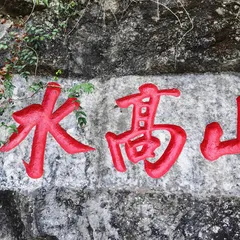
On the outskirts of Yangshuo, among rice paddies and limestone towers, Moon Hill (月亮山, Yuèliàng Shān) is recognised from afar by a semicircular gap that pierces it from side to side below the summit, through which the sky shows through the mountain. Yueliang Shan, “moon mountain”, is the popular name; the formal one is Mingyue Feng (明月峰), “bright moon peak”, because the hole looks like a high, luminous full moon. The summit reaches 380 metres above sea level.
The history of Moon Hill begins under water. The arch, about 50 metres high and as many wide, is all that remains of an ancient limestone cave dug out in the phreatic zone, below the groundwater level. The rock that surrounded it vanished and left that skeleton in view, framed by a wall only a few metres thick. In the Qing era (1644–1912), Xu Tingzheng named the view “the moon hanging from the high peak” and dedicated a poem to it.
Then came the visitors. According to tradition, Richard Nixon and his wife Pat climbed to the arch in the 1970s, though the date of that visit is disputed. In 1990, according to most sources, the Americans Todd Skinner and Sam Lightner Jr. bolted under the vault the first sport-climbing route in China, the start of Yangshuo as a climbing destination. And in the mid-1990s a peasant woman, Xu Xiuzhu, began selling drinks and fruit on the stairs, learned eight languages talking with foreigners and ended up known as “Mama Moon”.
To know what to see at Moon Hill, the audio guide walks the hill in four stops and 90 minutes: the esplanade at the foot, facing the arch; the stone stairway; the south mouth of the eye of the moon; and the lookout platform under the vault. The thread that joins them is a simple, strange idea: the moon of this mountain is the hollow of a cave that water emptied, and around it have turned poets, presidents, climbers and a water seller who learned the world on a staircase.
In the same karst countryside runs the Yulong River, descended on a bamboo raft between stone bridges; back in town, Yangshuo Park offers another climb, with a lookout over the old town.
A moon that pierces the mountain
Esplanade at the foot of the hill
Summary of this stop
The first stop is on the esplanade at the foot of the hill, beside the country restaurants from which the arch is seen head-on without any need to climb. From here the strangeness of the place is understood: a tower of solid rock with the sky showing through its interior, and two names, the popular and the formal, that read the same shape as a moon.
That moon is not fixed. North of the arch rises a rounded hill that serves as its backdrop, and whoever walks the Moon-Viewing Path (赏月路), on the south slope, sees the gap go from full moon to half moon to eyebrow moon depending on the angle. From a moving vehicle the effect is even quicker: the arch grows from crescent to full moon and wanes again.
The view also has a literary name. In the Qing era, Xu Tingzheng called it “the moon hanging from the high peak” and dedicated to it a poem according to which, since ancient times, a corner of the cliff collapsed and to this day its surviving soul lights a thousand autumns. In front of the arch, the audio guide teaches how to read that moon by its names and by the verse before the climb begins.
The stairs where a peasant woman learned eight languages
The 800-step stairway
Summary of this stop
The farmland plain lies about 120 metres above sea level and the arch about 300. A stone stairway of some 800 steps covers that drop of close to 180 metres; other sources count 804 or nearly a thousand. Above the arch, steeper, the stairs continue toward the summit and the Dressing Table lookout, a small railless promontory with a circular view over the karst.
It is rarely climbed alone. At the foot wait women with bottles of water and soft drinks who, if the visitor says no, accompany him step by step to the arch and then go back down for the next group, over and over through the day, a scene repeated since at least 2009. By these same stairs, according to tradition, Richard Nixon and his wife Pat passed in the 1970s; some sources say 1972, but that year Nixon toured only Beijing, Shanghai and Hangzhou, and the visit would fit better with his second trip, in 1976. No open primary source documents the climb.
The most famous story of the stairs is that of Xu Xiuzhu. With only three years of primary school, she began selling water by asking foreigners in Chinese whether they wanted a drink; when one answered “Wow, water”, she understood that “water” was what she was selling, and from then on she noted each new word in a little notebook that she reviewed before sleeping and on waking. She learned eight languages and in September 1998 obtained, by an exceptional route, her official guide licence. Her nickname was born in 2002, in that same notebook, from a Canadian student who felt dizzy during the climb. Halfway up the stairs, the audio guide tells what happened that day and why she refused to charge him.
The skeleton of a cave under water
Eye of the moon
Summary of this stop
At the south mouth of the arch, the visitor passes from light to shade. The eye of the moon is about 50 metres high and wide, but the rock wall that frames it is only a few metres thick: seen up close, the arch turns out much more fragile than it suggests from the plain.
Its origin explains its shape. This gap is the remnant of an ancient limestone cave that was dug out in the phreatic zone, below the groundwater level. The rest of the rock went away, and the cave remained open on both sides, turned into a window.
Under the vault, the two inner walls are smooth as walls, but the roof is studded with stalactites and flowstone. Two of them are identified with the woodcutter Wu Gang and the Jade Rabbit, dwellers of the lunar palace in Chinese myth; a third is sometimes sought, that of the goddess Chang’e. From here the audio guide points out where those figures hide on the roof.
The roof that opened Chinese climbing
Lookout platform under the arch
Summary of this stop
From the lookout platform under the arch, the roof reads like a wall turned upside down. Bolted lines run across it, such as Moonwalker, Over the Moon or Lunar Tick, and climbers are often hanging beneath the vault. Climbing on natural rock began here in China: in 1990, according to most sources, though others give 1991 or 1992, Todd Skinner and Sam Lightner Jr. bolted the country’s first sport route. The most famous is Moonwalker, a 7c of about 20 metres opened by Skinner that advances along the underside of the arch, hanging from flowstone and holes, to a third cave near the keystone.
The relationship between the mountain and its climbers has not been calm. When access became private and paid, in the early 2000s, many sneaked in without a ticket and climbing was banned for the first time; later, the park’s owners went as far as removing the first bolts from most routes. In the first half of 2017 the ban returned, after a fragment of rock nearly hit a guard on the head on this very platform, and during those years climbing happened only at the annual Yangshuo climbing festival, at the end of October. At the end of 2019, the new concessionaire lifted it after meeting the Yangshuo Climbers’ Association, in exchange for an annual inspection of the routes funded by the mandatory climbing insurance.
Under the roof a ritual also endures. Whoever sends Moonwalker finishes the route with the “Moon Swing”: an enormous pendulum that crosses the gap of the arch from side to side, like the clapper of a giant bell. At the last stop, the audio guide explains how that pendulum is prepared and why it is not an accident but a celebration.