Park among karst hills
Yangshuo Park Audio Guide (Yangshuo Gongyuan)
Opened in 1915 among karst hills, a few steps from West Street, the townspeople’s park holds a 10-metre rock shaped like a man who gazes west out of a Tang poem and, beneath its hills, the caves that Xu Xiake explored by torchlight in 1637.
- 40 min of audio
- Tang poetry and karst caves
Yangshuo Park opened in 1915 as Shouyang Park, after the mountain of that name, today’s Bilian Peak, and took its present name after its first enlargement, in 1934, because it lay in the middle of the built-up town. For decades it had a single gate, the north one; the south gate was not opened until 1980, and the park’s name over its two entrances bears the signature of the calligrapher Liu Haisu and the painter Lu Yanshao. Across some 23 hectares it gathers osmanthus, bamboo, the Shuangyue stream, the Chunlei garden, the Monument to the Revolutionary Martyrs and hills with names of their own such as the Xilang and the Zhongling.
Every morning locals come to exercise and play Chinese chess beside the stream, but the landscape around them has been read rock by rock for centuries. On the north face of the Xilang, a crag shaped like a boy with folded arms looks west, and on the wall is carved the poem that Cao Ye, a Tang poet born in Yangshuo, dedicated to it: Xilang wants to meet Donglang, the boy of the east, but the great river lies between them.
Highlights
- Xilang rock — A crag of about 10 metres shaped like a man with folded arms, turned west
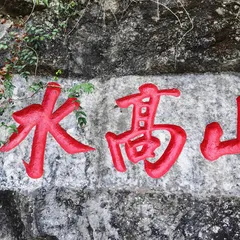
- Cao Ye’s poem — Tang verses carved on the wall of Xilang hill beside the characters 西郎
- Long, Bilian and Laixian caves — The ones Xu Xiake explored in 1637, now inside the park
- Woyun Pavilion — Lookout on the summit of the Xilang over the town of Yangshuo
- Calligraphed gates — The park’s name in the hand of Liu Haisu and Lu Yanshao
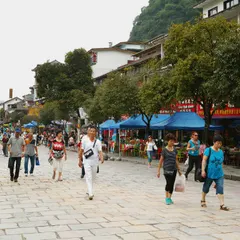
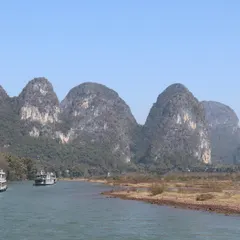
A few minutes’ walk from West Street, Yangshuo Park (阳朔公园) is the town’s everyday garden: osmanthus, bamboo, the Shuangyue stream, the Double Moon, and benches and tables where locals exercise and play Chinese chess from first thing in the morning. Karst hills with names, poems or legends of their own rise around it, and limestone caves open beneath them that already featured in the travel notebooks of Ming China.
The history of Yangshuo Park begins in 1915, when it opened as Shouyang Park, after the nearby Shouyang Mountain, today’s Bilian Peak that dominates the bank of the Li. After its first enlargement, in 1934, it was renamed Yangshuo Park for being in the centre of the built-up town. For decades it had a single entrance, the north gate, and the south one was not opened until 1980. Today it covers about 23 hectares; some English-language guides circulate the figure of 340 acres, which seems to stem from a mistranslation of 340 mu, the Chinese unit of area. Water is also part of its recent history: on 7 June 2020, 327.7 mm of rain fell on the county in a single day, a local record, and with releases from upstream reservoirs streets of the town were flooded, among them West Street and the park itself.
To know what to see in Yangshuo Park, it helps to read it as a landscape of names. On Xilang hill, about 100 metres high, a rock shaped like a man gives rise to a Tang poem; on Zhongling hill, also called Chenbo Shan, more than 20 interconnected limestone caves are strung together, with the Bilian cave and its lotus-shaped concretions, a paid visit with temporary closures. On its north skirt, the Chunlei garden gathers an old-style gateway, a pond, a small bridge, the hexagonal Baochun pavilion, orchids, bamboo and bonsai. To the east rises the Duxiu, a column about 100 metres high with a flat top and sheer walls, with the Fanghe pavilion, that of the released crane, halfway up: legend says that an immortal let loose there the crane that had brought him.
The park also has a civic calendar. Each 30 September, Martyrs’ Day, and around Qingming, the tomb-sweeping festival, Yangshuo holds its tribute ceremonies before the Monument to the Revolutionary Martyrs, with wreaths and baskets of flowers at the foot of the stele and the ritual of cleaning and remembering the fallen.
The audio guide walks the park in four stops and 40 minutes, from the main gate to the cave mouths of the Zhongling, the Xilang rock and the hilltop. The thread that joins them is the gaze: a park of neighbours and chess games that for centuries has been read rock by rock, and that by the end of the walk the visitor has learnt to read in the same way.
Outside the park, West Street is a few steps away and Bilian Peak closes the old town beside the river. About 6 km to the south, Moon Hill offers another way of reading limestone: an arch that changes phase like the Moon.
The gate signed by Liu Haisu
Main gate with Liu Haisu’s calligraphy
Summary of this stop
The main entrance shows the name 阳朔公园 written by the calligrapher Liu Haisu, one of the great brush masters of the 20th century. It is not the only illustrious signature: the small gate, raised in 1980 southwest of the Bilian cave, bears the park’s name in the hand of the painter Lu Yanshao. Two masters for the two entrances of a county park.
The name crowning the gate is not the original. The grounds were born in 1915 as Shouyang Park, taken from the mountain now known as Bilian Peak, and only after the 1934 enlargement was it renamed with the town’s name, for lying in the middle of the built-up area. For decades this was the only way in: the north gate concentrated all the comings and goings until the south one opened in 1980.
There is also an episode told by local tradition. On 29 November 1921, the flotilla of Sun Yat-sen, sailing up the Li toward Guilin to prepare the Northern Expedition, docked at Yangshuo; the magistrate and the guild representatives received him on the quay, and there he addressed the crowd and advised the county to improve its roads, open mines and plant forests and fruit trees. It is said that at the end of that November he also strolled through the park. At the main gate, the audio guide follows the steps of that visit on the way to war.
Xu Xiake’s torches and a dragon in chiselled stone
Cave mouths of Zhongling hill
Summary of this stop
At the foot of Zhongling hill, the gentle surface of the park, with its stream, its osmanthus and its chessboards, borders a hollow world. In 1637 the traveller Xu Xiake explored the Long, Bilian and Laixian caves, which now lie within the grounds. In the Laixian, west of Yangshuo’s old wall, he read at the entrance the inscription that gave it its name and mentioned Li Du of Fujian, copied the text of the “Laixian Dong Ji” and threw torches into an inner chasm without seeing the flames land at the bottom.
The Dragon Cave, the Long Dong, had its own founding myth. An old “Record of the Opening of the Cave”, the work of an ancestor of the local Mo family, called the northern cave the “palace where the hidden dragon hibernates” and the neighbouring Longyue shelter “where the divine dragon leapt”. When Xu Xiake went in with torches, on the back wall the white stone formations known as the dragon’s shadow and bed were still there, but they were already half smashed by hammer and chisel by those who came to take stone; only their trace was left of them.
Below were two pools, one square and one round, of water clear as a mirror that refilled however much was drawn off, and in front a circular elixir furnace with an opening like a door. Beside the cave mouths, the audio guide reconstructs what the most famous traveller of Ming China arrived in time to note down.
The stone boy who looks west
Xilang rock
Summary of this stop
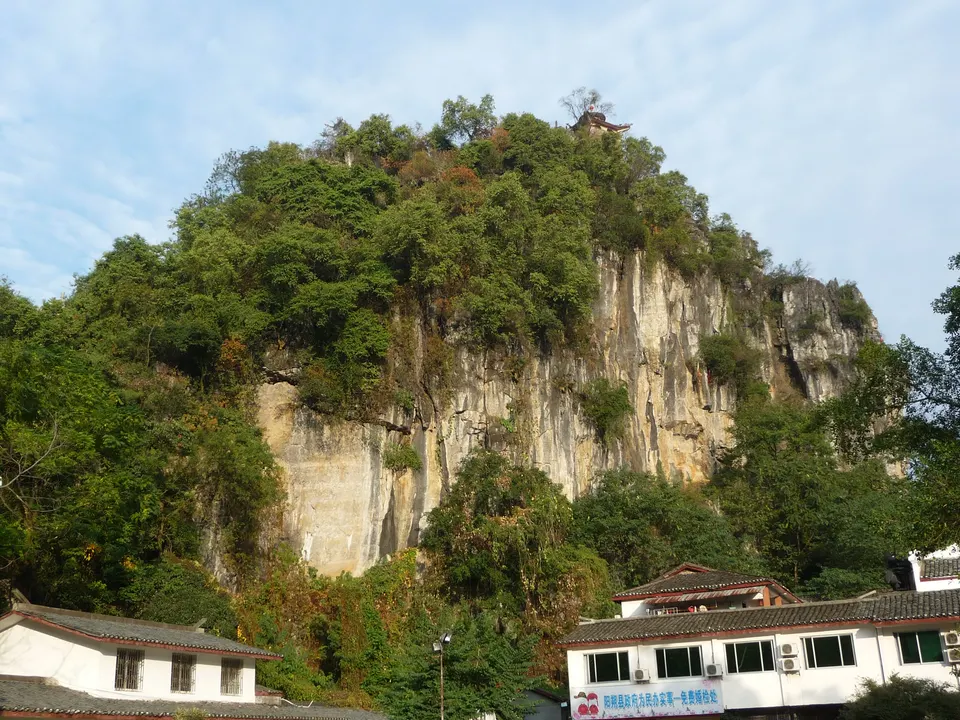
Xilang hill, in the south of the park and about 100 metres high, was formerly called Pingfeng Shan, Folding Screen Mountain, because it spreads wide like an open screen. Halfway up its north face a rock of about 10 metres juts out in the silhouette of a standing man, arms folded, turned toward the west: it is the Xilang, the boy of the west who gives the hill its name.
On the wall are carved the characters 西郎 and the poem “Xilang Shan” by Cao Ye, a Tang-dynasty poet born in Yangshuo. His verses ask why Xilang looks west: he wants to meet Donglang, the boy of the east, but the great river lies between them, and he still has not found him as he laments to the setting sun. The poem has a partner, “Donglang Shan”, which paints Donglang standing tall toward the east, waiting for the sun every morning. Its third line circulates in two versions: that of a Qing-era anthology speaks of how a wise sovereign and a loyal minister seldom coincide, and the current popular one of good friends; depending on which is read, Xilang’s wait is a political allegory or a story of friendship.
Opposite, beside Zhongling hill, a smaller peak, the Xiaogu Shan or Girl Mountain, faces it, and the scene is known as “Xilang bows to Gu”. Beneath the rock, the audio guide gives voice to the lament that Cao Ye wrote for his stone countryman.
Where the immortals came to look
Xilang hill
Summary of this stop
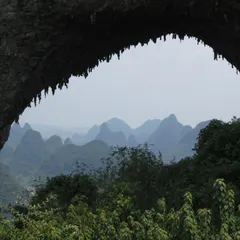
Beside the Xilang rock stands the Huixian Pavilion, hexagonal and of two storeys, dedicated to the immortals who, according to legend, came to contemplate the landscape with Xilang. North of the pavilion there is a natural stone basin with the inscription 天池, Celestial Pond, and to the east a tiger-shaped stone carved 醉霞, Drunken Glow. On the summit of the hill waits the Woyun Pavilion, the one that lies in the clouds, a lookout over the town of Yangshuo and the peaks that surround it; on the north slope remain the Wangxi terrace, the stream lookout, and the inscription celebrating the evening light on the western mountain, at its best in the late afternoon.
From here one understands what Cao Ye left behind. The poet lived ten years in Chang’an and failed the imperial examinations nine times, until his poems won him a patron and he obtained the jinshi degree in 850.
From the top a local habit can also be read: giving each mountain more than one name. The Duxiu, the sheer-walled column on the east side, is for some the Zhuyuan Shan, Bamboo Root Mountain, for its silhouette, and at the same time bears the title of Jade Pillar That Pierces the Sky. On the summit, the last stop of the audio guide occupies the immortals’ place and teaches how to look at the landscape with its two names.