Historic Li River town
Xingping Ancient Town Audio Guide (Xingping Guzhen)
For over three centuries it was the capital of Xiping County; when the seat moved to Yangshuo in 590, Xingping was left with the Li River, a market and a flagstone street that runs down to the old Rongtan landing.
- 90 min of audio
- Li River riverside town
Xingping Ancient Town was the seat of Xiping County from the year 265, in the days of the Wu kingdom, and became a market town when, according to local sources, the capital moved to Yangshuo in 590. Its old street, a paved lane of nearly a kilometre, descends between grey-brick houses and guild halls of merchants from other provinces to the bank of the Li, and along the way keeps the Guandi Temple, founded in 1739, with its Qing-era opera stage. Since 2007 it has been on China’s list of Famous Historic and Cultural Towns.
The river that made it prosperous is the same one that tests it. In the Ming and Qing eras, Xingping was the largest settlement on the banks of the Li and boats sailed to several cities from its landing; on 19 June 2024, the worst flood in Guilin since 1998 swamped that landing and the streets of the old town, and more than a thousand people had to be evacuated on rafts between West Street and Xingping.
Highlights
- “Ancient Xiping” plaque — The name of the county founded in 265, at the entrance to the street
- Old flagstone street — Nearly a kilometre between brick houses and guild halls down to the river
- Wannian stage — More than 20 opera notches on the pillars of the Guandi Temple of 1739
- Great banyan — A trunk that takes eight people with outstretched arms to circle
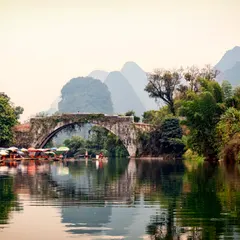
- Rongtan landing — Slabs carved with dragons and phoenixes beside the Li River
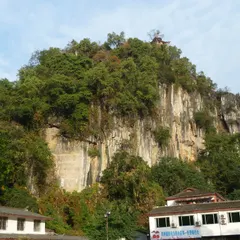
On the banks of the Li River, with Laozhai Peak keeping watch over the quay, Xingping Ancient Town (Xingping Guzhen) presents itself today as a street of souvenirs running down toward the water. Beneath that recent layer lie a county capital, a river port that was the largest on the Li and a temple whose stage still bears the marks of centuries of opera.
The history of Xingping begins in the year 265, the first year of the Ganlu era of the Wu kingdom, in the days of the Three Kingdoms, when the place became the seat of Xiping County. In 590, the tenth year of the Kaihuang era of the Sui, the seat moved to Yangshuo and Xingping was left as a simple market place; over time, the name Xiping drifted into Xingping through its similar sound. Sources do not tell that moment alike: local ones speak of the transfer of the seat, or of the abolition of Xiping to become Yangshuo County, while Chinese Wikipedia presents the creation of Yangshuo in 590 as a split from Shi’an County, without mentioning Xiping. The count of its age also wavers: the date of 265 gives it more than 1,700 years, though some tourist page speaks of more than 1,300; 265 is the one backed by local Chinese sources.
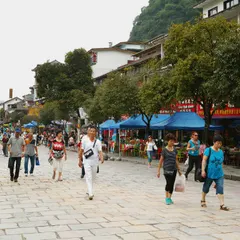
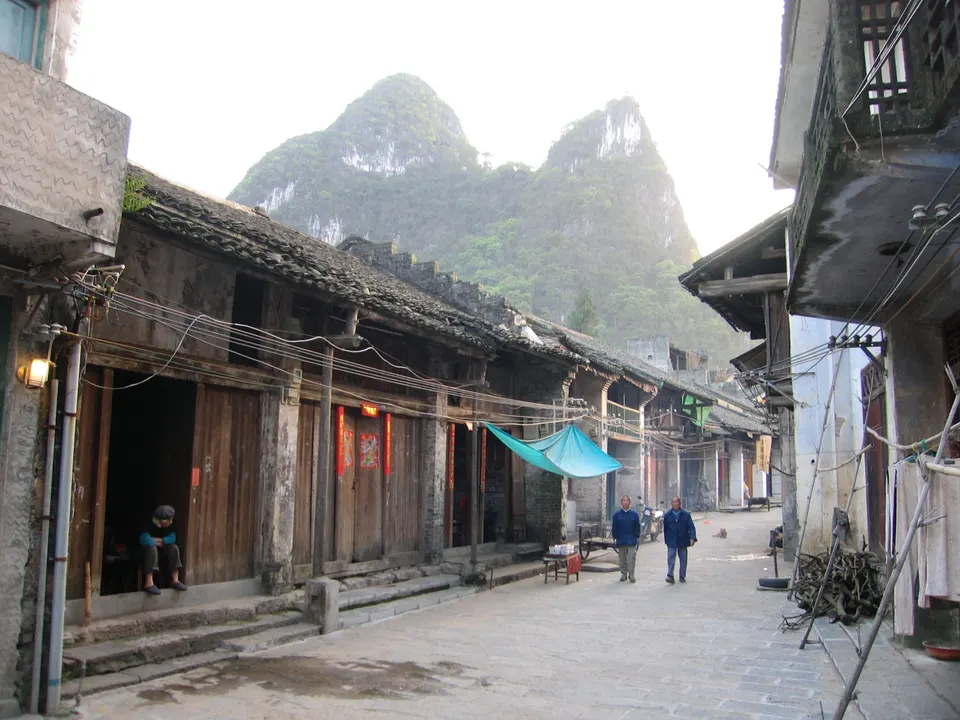
The architecture of Xingping is read along a single route: a paved street of about 1,000 metres that runs from the southeast of the town to the Banyan Spring and the landing, flanked by old houses of grey brick and wood, rows of terraced dwellings each with its own chimney and guild halls of merchants from several provinces in the Ming and Qing eras. At no. 23 Rongtan Street stands the Guandi Temple, founded in 1739, of which a side hall and the opera stage survive. At the end of the descent, at the old Rongtan landing, remain slabs carved with dragons and phoenixes, the site of the Hexi Pavilion and, up the steps, a three-storey octagonal pavilion. In 2006 the old town was restored and converted for tourism, and on 31 May 2007 Xingping entered the third list of Famous Historic and Cultural Towns of China.
The town has a flavour of its own too. As told in Xingping, songhua tang, fried glutinous-rice balls wrapped in sugar syrup with black sesame and cut into blocks, was invented by craftsmen from Fuzhou around the tenth year of the Kangxi reign; it reached Yulin in the early 1920s and a clerk from those shops brought the recipe back. Two versions circulate about the name: either it alludes to its grains, golden like pine pollen, or it is a corruption of “suhua”, the crisp sweet that melts in the mouth. It is still made by hand in the town.
To know what to see in Xingping, the audio guide walks the old street in five stops and 90 minutes, from the plaque at the entrance to the guild halls, the stage of the Guandi Temple, the great banyan and the Rongtan landing. A paradox joins them: a town that lost its status as capital and was left with only the river, and a river that gave it wealth and in 2024 flooded its streets.
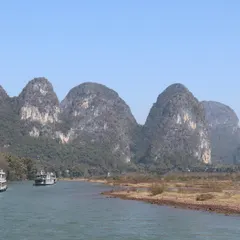
The best-known crossing of the Li River, the one past the 20-yuan note shoal, ends here. In Yangshuo, West Street tells the other side of the river: the street that grew up from the landing until it filled with backpackers.
A plaque with the name of the lost capital
“Ancient Xiping” plaque
Summary of this stop
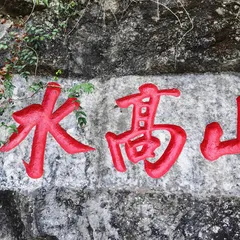
At the entrance to the paved street hangs a plaque inscribed “Ancient Xiping”. It does not say Xingping, the present name, but that of the county that had its seat here from the year 265. It is the town’s way of presenting itself: with the title of a capital that ceased to be in 590, when the seat moved to Yangshuo and Xingping was left with the market.
That capital has not entirely vanished. Southeast of the old street, at Shizidan, the ruins of the county town of Xiping survive: the outline of its wall is still legible and the ground is strewn with fragments of ancient brick, tile and pottery.
Centuries later, the town found a small revenge against the capital that took everything from it, at least in the phrases it repeats with pride. The painter Xu Beihong, who came to paint from life and carried Xingping’s sunset into his pictures, is credited with the saying “The most beautiful part of Yangshuo is in Xingping”; and Marshal Ye Jianying, after touring it in 1963, with the line that closes one of his poems: “Indeed, the best is in Xingping”. In front of the plaque, the narration tells how a lost name still gives its welcome.
Outside guilds and a chimney for every house
Guild halls and chimney houses
Summary of this stop
The central stretch of the old street shows what Xingping lived on once it stopped being a capital. It is a paved lane of nearly a kilometre, flanked by old brick houses and by guild halls of merchants from several provinces, buildings of the Ming and Qing eras that reveal that a good part of this street was built by outside merchants.
In the rows of terraced houses, each dwelling keeps its own chimney, a domestic detail repeated along the street that speaks of families who, wall to wall, each kept their own fire.
Today’s bustle is the most recent layer of that history. In 2006 the old town was restored and converted for tourism, and today the street is largely a souvenir market, though temples, opera stages and old bridges remain among the shops. A year later, in 2007, Xingping entered the list of Famous Historic and Cultural Towns of China. On this stretch, the audio guide separates what is scenery from what has stood for centuries.
Opera notches on Guan Yu’s stage
Wannian stage
Summary of this stop
Beside the old street, the Guandi Temple, dedicated to the general Guan Yu, was founded in 1739, the fourth year of the Qianlong reign. Its facade is weathered and of the complex a side hall and the opera stage, the Wannian stage, survive.
The wood keeps the physical memory of the performances. On the two pillars at the mouth of the stage remain more than 20 notches left by the plays, and along the edge of the platform run four wooden reliefs with scenes from four traditional operas; in one of them, Guan Yu beheads Cai Yang in “The Meeting at the Old City”.
On the left side of the stage stands a folding wooden screen of four leaves with bamboo in relief, signed below “gift of Banqiao, yichou year of Qianlong”, that is, 1745. The signature points to the celebrated painter and calligrapher Zheng Banqiao, but that attribution has not been verified by specialists. In front of the stage, the narration explains what the notches on the pillars tell and why the screen invites suspicion.
The banyan that swallowed the gods
Great banyan
Summary of this stop
Near the Banyan Spring and the end of the street, Xingping’s great banyan cuts the heat with an enormous shade. Its trunk takes the outstretched arms of eight people to circle, and its roots tangle as if they had been embracing everything in their path.
That is exactly what the legend tells. According to popular belief, the tree was planted when the county was founded, in the 3rd century, and over the centuries its roots wrapped what lay around them until they swallowed five bodhisattva images and a rock of some 20 tonnes, which would still be inside the trunk. No one can check without felling the tree.
Thus the banyan becomes a living thread between the lost capital and the town of today. Beneath its branches, the audio guide follows the trail of those sacred figures among the roots.
Dragon slabs where the river gave and took away
Old Rongtan landing
Summary of this stop
The whole town runs down toward this point. At the old Rongtan landing, large slabs carved with dragons and phoenixes still lie on their stone base; it is the site of the Hexi Pavilion, and up the steps remain a three-storey octagonal pavilion and the site of the Temple of the God of the North. From here sailed the boats that made Xingping the largest settlement on the banks of the Li: boats left its landing for several cities, and that river traffic brought it prosperity during the Ming and Qing dynasties.
The same river that made it rich reminded it in 2024. On 19 June, the worst flood in Guilin since 1998 swamped the landing and the streets of the old town, flooded the ground floors of many shops and forced the evacuation on rafts of more than a thousand people between West Street and Xingping; some residents took refuge on the second floors. The present quay, with its rafts and its ferry, is the lowest point of the town and was the first to go under water.
Above the quay rises Laozhai Peak, and its trail has a story of its own that local tradition keeps. The climb was so dangerous that accidents kept happening and a no-climbing sign was placed at the foot, until a Japanese traveller who introduced himself under the Chinese name Lin Kezhi reached the summit, was captivated by the landscape and paid out of his own pocket for a path of 1,149 stone steps, with railings on the steepest sections and two pavilions: Peace, in the lower part, and Friendship, at the top. He came back every year to spend seasons in the town and kept repairing the trail, which is free for everyone. Beside the water, the last stop of the audio guide closes the walk with that gift made step by step.