Bamboo raft descent
Yulong River Audio Guide (Yulong He)
A tributary of the Li without a single motor, which bamboo rafts descend by pole, hopping irrigation weirs and passing under dry-stone bridges: one from the Ming era and another from 1123, the oldest in Guangxi.
- 120 min of audio
- Song and Ming stone bridges
The Yulong River rises at Nanbianshan, in Lingui District, and delivers its waters to the Li on the outskirts of Yangshuo. It was formerly called Anle Shui, “water of peace and joy”, and took the name Yulong, “meeting the dragon”, from the stone bridge spanning its middle course. On its banks the Tang dynasty set up in 621 a county that lasted only six years, the Song dynasty built in 1123 the oldest surviving arch bridge in Guangxi and the Ming raised in 1412 an arch of ashlar without a drop of mortar.
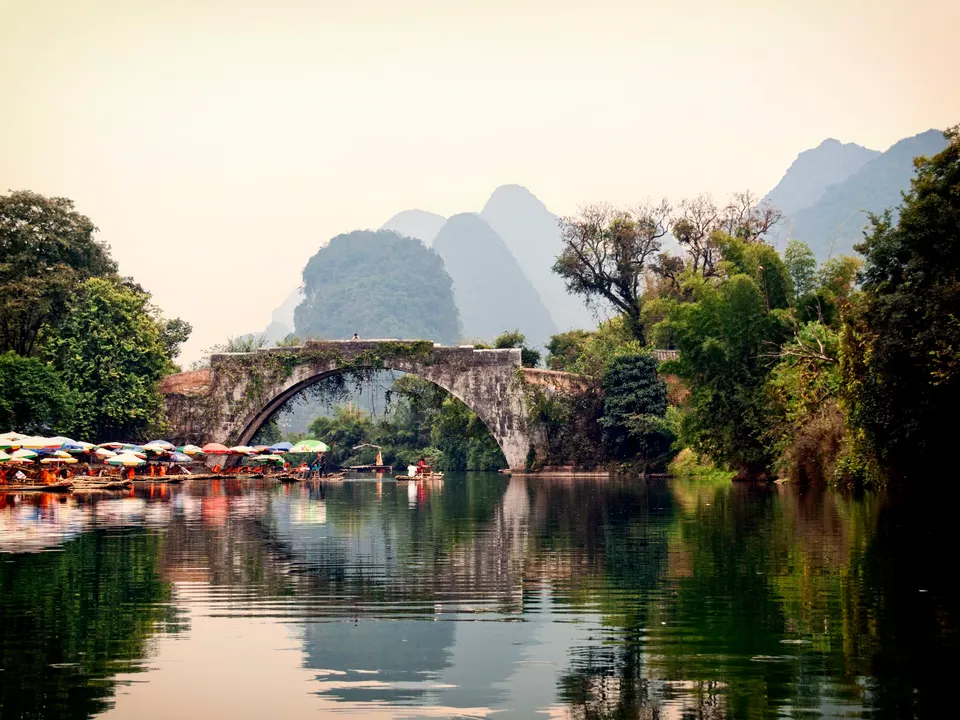
No boat can go down it. More than twenty irrigation weirs cross the channel from bank to bank, and each leaves a single gap through which the bamboo raft is launched, with two passengers and the raftsman standing at the stern. The trade was born in June 2001 from a favour to some photographers, and today the river sees a dragon of linked rafts parade at night, passing under the same Ming arch that is descended by day.
Highlights
- Yulong Bridge — A dry-laid ashlar arch of 1412, with parapets carved in 1870
- Xiangui Bridge — Nine rings of voussoirs and 281 stones: Guangxi’s oldest stone arch, of 1123
- Irrigation weirs — 28 dams with a single gap through which the bamboo raft hops
- Fuli Bridge — An arch and reflection that, in still water, draw a full moon
- Resistance stele — Thrown into the river in the Cultural Revolution and re-erected in 1987
The Yulong River (遇龙河) is the tributary of the Li that knows no engine. It rises in Nanbianshan township, in Lingui District, and flows into the right bank of the Li beside the Gongnong Bridge, at the foot of Shutong hill, on the outskirts of Yangshuo. Its main channel measures 54 km according to the most cited entry, though figures vary between sources and local guides depending on the stretch counted. What does not change is its character: more than twenty weirs raised to irrigate the rice paddies make it unnavigable for boats, and only bamboo rafts go down it, with two chairs, two passengers in life jackets and the raftsman standing at the stern with a long pole.
The history of the Yulong River begins with its name. It was anciently called Anle Shui, “water of peace and joy”, and the documentary explanation attributes the present name, Yulong, “meeting the dragon”, to the Yulong Bridge spanning its middle course. A local legend tells another story: a dragon from the East Sea stayed to live in the river and villagers saw it rise from the water. Another legend, tied to the bridge, makes the meeting a love story, between a young scholar who became zhuangyuan, the top scorer of the imperial examinations, and a dragon maiden. Long before all that, in the present village of Jiuxian, the Tang dynasty set up in 621 the county of Guiyi, split off from Yangshuo, and abolished it in 627.
The architecture of the Yulong River lies in its stone bridges. The Xiangui Bridge, of 1123, in the Song era, is the oldest surviving stone arch bridge in Guangxi. The Yulong Bridge, of 1412, in the Yongle reign of the Ming, is a single semicircular arch of dry-laid ashlar. And about 500 metres upstream, the Fuli Bridge, an ashlar arch 30 metres long and 10 high with an old tree at each end, is also attributed to the Yongle reign, though that date has not been verified. Higher still, in the village of Zhouzhai, the Wangfu Bridge, an arch over 200 years old, passes for the first old bridge of the Yulong; there, as the legend the elders told the washerwomen goes, beneath the Five Fingers Mountain lies the crushed Monkey King, Sun Wukong, waiting to be freed at 500 years. Downstream, among the karst outlines seen from the raft, are a Five Fingers peak and a crag called “Bajie gazing at the moon”, after the Monkey’s gluttonous companion.
To know what to see on the Yulong River, the audio guide accompanies the descent in four stops and 120 minutes, from the Jinlong Bridge landing to the confluence with the Li at the Gongnong Bridge. The thread that joins them is a river that farmers tamed to irrigate and their grandchildren turned into a road, and stone bridges in which each century left a different layer of its history.
At the end of the descent, the Yulong delivers its waters to the Li River, the one of the cruises among karst peaks. In the same countryside south of Yangshuo rises Moon Hill, with its arch that changes phase like the Moon.
Jinlong: boarding a river without boats
Jinlong Bridge
Summary of this stop
The descent starts at the Jinlong Bridge landing, the boarding point of the upper stretch, between Jinlong and Jiuxian. From here the bamboo rafts go down toward the Yulong Bridge, the very one that named a river formerly called Anle Shui, “water of peace and joy”, and which at this point is not yet in sight.
The trade of taking people down this river is recent and was born almost by chance. In June 2001, a fisherman from Yulong village took some photographers on his raft from the Yulong Bridge to the Great Banyan park. The photographers later mailed some photos of the river, and Zhu Dongfa, a villager, decided with a partner from the Yangshuo Longzhilü agency, “Dragon Journey”, to offer the ride to tourists.
What followed was very fast. By October 2001 villagers had already bought more than a hundred rafts, and in the Golden Week of that month every departure was booked; over the May Day holiday of 2002 tourists went down without a break from 6 in the morning to 8 at night. Beside the landing, the audio guide tells how a river without boats had a queue of passengers in under a year.
A Ming arch and a rescued stele
Yulong Bridge
Summary of this stop
The rafts pass under the great arch of the Yulong Bridge, built in 1412, the tenth year of the Yongle reign of the Ming dynasty: a single semicircular arch of ashlar locked with alternating joints and dry-laid, without mortar, about 9 metres high and today covered with creepers. Sources do not agree on its measurements or its exact date, and some speak only of “the Ming era”. From the deck, upstream, the Jinlong and Fuli bridges can be seen in line. In 1870, in the Qing era, stone parapets were added, carved with flowers, birds, fish, insects and the dragon-and-phoenix motif. The first sequence of the musical film “Liu Sanjie”, from the Changchun studio, was also shot here.
Above the bridge stands the Stele of Victory in the War of Resistance of Yulong village, which recalls how the villagers resisted the Japanese troops in 1944, entrenched at Zhujiazhai, also called Tianzuozhai, on the opposite bank; how long that resistance lasted is something sources tell very differently. During the Cultural Revolution the stele was smashed and thrown into the river. In 1987 its lower half was rescued from the water, the piece was completed and it was erected again in its original place.
The counterpoint comes at night. Since 2014, according to a documented tradition devised by villagers inspired by the river’s dragon legends, dozens of linked rafts, with LED lights, yellow parasols and thousands of lanterns, form a golden dragon guided by a steel head of about 4 metres. The procession slips under this arch, circles Panlong Island, “coiled dragon”, and ends with the meeting of a luminous phoenix amid fireworks. On the night of 18 June 2023 it was 55 rafts and 550 metres of dragon; since late 2024 the parade is repeated on Saturdays at dusk. Beneath the arch, the audio guide joins the stone dragon and phoenix with those of bamboo and light.
Hopping weirs beside a Tang county
Xiangui Bridge
Summary of this stop
On this stretch one understands why the Yulong has no boats. The weirs, low stone dams raised to irrigate the rice paddies, cross the river from bank to bank and leave a single gap through which the water runs. The bamboo raft is launched through it, two passengers at a time, to the next reach: the descent advances in hops, at the rhythm the dams set.
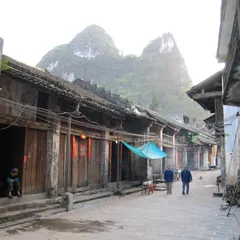
On the bank, the village of Jiuxian, “old county”, keeps grey-brick houses with black tile and stepped firewalls. Its name is no accident: here the Tang dynasty set up in 621 the county of Guiyi, split off from Yangshuo, and abolished it in 627. Of the enclosure, about 40,000 m², an ancient well remains.
Nearby spans the small arch of the Xiangui Bridge, also called the Jiuxian Bridge, built in 1123, the fifth Xuanhe year of the Song dynasty. Its technique is extremely rare: nine parallel rings of voussoirs and 281 stones. It is the oldest surviving stone arch bridge in Guangxi, and in front of it the audio guide explains how it holds up.
Gongnong: the Yulong gives itself to the Li
Gongnong Bridge
Summary of this stop
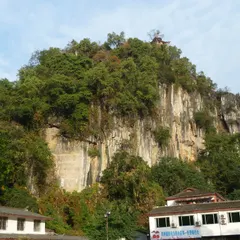
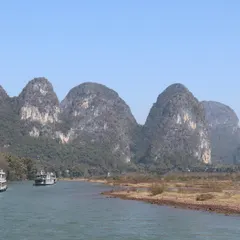
On the lower stretch, the karst crags flanking the route follow one another like named stations, according to a documented local custom. Downstream of the Yulong Bridge appear the Eight Immortals Rock, the Two Lions at Play and Lovers’ Hill; toward the Gongnong Bridge, the Tortoise Race, the Frog That Leaps the River, the Camel Crossing the River and the Rat Flying to Heaven. From the raft, the landscape turns into a stone zoo.
The journey ends at the Gongnong Bridge, a road bridge beside which the Yulong delivers its waters to the right bank of the Li River, at the foot of Shutong hill. Between the Yulong Bridge and this point the river runs 15.36 km, between 38 and 61 metres wide and between 0.5 and 2 metres deep, and is cut by 28 weirs.
It is the measure of the whole descent: kilometres of shallow water and dozens of irrigation dams that end up adding to the Li. At the confluence, the last stop of the audio guide names every crag along the way and closes the walk.