Royal monastery of 1630
Wat Chaiwatthanaram Audio Guide
A royal monastery of 1630 on the banks of the Chao Phraya, conceived as a map of the Buddhist cosmos and the setting for royal funerals, which survived the war of 1767, two centuries of jungle and the flood of 2011.
- 60 min of audio
- Royal temple ruins
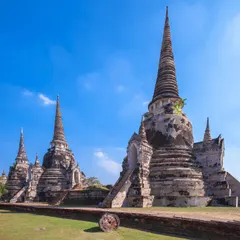
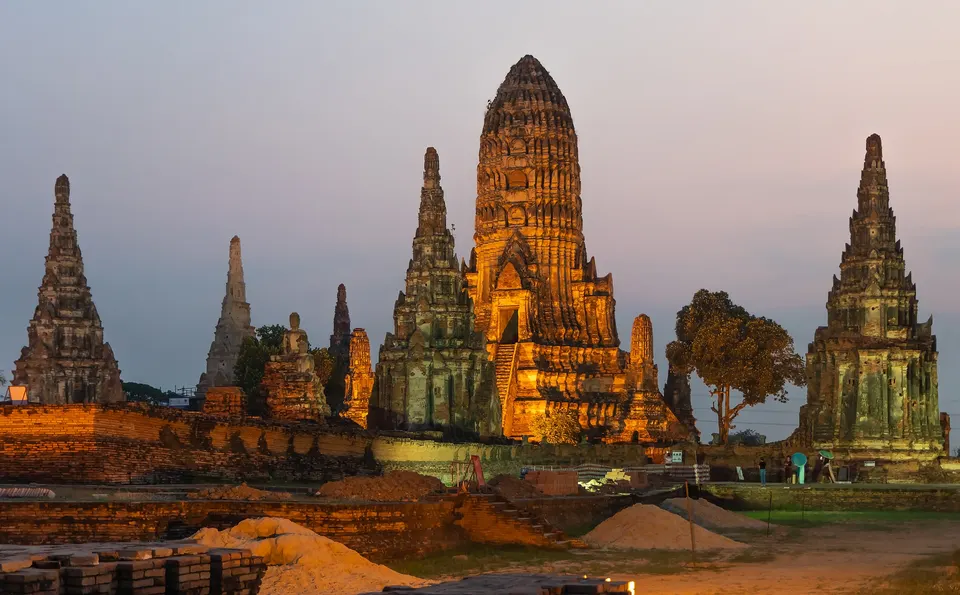
Wat Chaiwatthanaram is the royal monastery that King Prasat Thong ordered built in 1630 on the west bank of the Chao Phraya, on the plot where his adoptive mother had lived. Its plan is a map of the Buddhist cosmos of the Traiphum: a 35-metre central prang as Mount Meru, four corner towers as continents, a courtyard as the ocean and a gallery as the mountain ranges that close off the world. Eight seven-tiered pavilions copy the pyre of royal funerals, and in the compound princes and princesses of the royal house were cremated.
In 1655 the Dutchman Gijsbert Heeck described it gleaming with gold and precious stones, like a golden mountain, with so many gilded Buddhas that it was impossible to count them. Then came 1767: a fortified camp against the Burmese, a fall in nine days and some 220 years of jungle and looting, with the Buddhas beheaded and the bricks sold. Restored from 1987, opened to the public in 1992 and covered by about 2 metres of water in 2011, the temple emerged in 2024 from one last rescue.
Highlights
- Central prang — 35 m tower representing Mount Meru, with steep stairs on all four sides
- Eight meru — Pavilions of some 25 m and seven tiers that copy the pyre of royal funerals
- Gallery of Buddhas — Rows of seated stucco Buddhas, many headless after centuries of looting
- Funerary chedis of the north — Foundations of those of Chaofa Kung, Chaofa Sangwan and Chaofa Nim
- Twin chedis by the river — Twelve-cornered profile typical of the reign of Prasat Thong
On the west bank of the Chao Phraya stands Wat Chaiwatthanaram (วัดไชยวัฒนาราม), the royal monastery that King Prasat Thong (r. 1629-1656) ordered built in 1630, just after taking the throne. Its silhouette revives the model of the Khmer temple-mountain: a central prang of 35 metres ringed by four smaller towers, eight spire-roofed pavilions and a square gallery of Buddhas. What today looks like a brick ruin gilded by the sunset is what survived war, jungle, looting and water.
The history of Wat Chaiwatthanaram begins with a private gesture: the king chose the plot where his adoptive mother, wife of Okya Sri Thammathirat, had lived, to make merit in her name. Some sources speak of his mother rather than an adoptive mother, and the reason for the foundation is also debated: most tie it to that merit and the king’s Buddhist prestige, while Prince Damrong read it as the commemoration of an Ayutthaya victory over Longvek, in Cambodia, which the Thai sources present only as a possibility. The work was not quick. A gold sheet dated 1649 and Van Vliet’s mention, in 1637-1638, of a royal temple “under construction” point to some twenty years of works, and Piriya Krairiksh also proposes a renovation and enlargement between the 1730s and 1750s.
The architecture of Wat Chaiwatthanaram is a map of the cosmos of the Traiphum, the Siamese Buddhist cosmology of the 14th century: the central prang is Mount Meru, the four corner prangs are the continents, the courtyard the oceans and the gallery the mountain ranges that close off the world. From Prasat Thong on, all the kings of Ayutthaya made pilgrimage to this sanctuary and attended royal funerals here. Before the fall of the city in 1767 it became a fortified camp against the Burmese army; afterwards it lay some 220 years at the mercy of the jungle and looters, until the Fine Arts Department began restoring it in 1987 and opened it to the public in 1992. The flood of 2011 covered it with about 2 metres of water, and a project closed in November 2024 gave it drainage and defences against the next one.
The compound has also found a life that is anything but funerary. Since 2018, when the period series “Bupphesannivas” used it as a set, many Thais visit it dressed as its characters, and in March 2024 its prang served as the backdrop for two nights of khon, the masked dance of the Siamese court, with the “Satchapali” episode of the Ramayana. To know what to see at Wat Chaiwatthanaram, the audio guide walks it in five stops and 60 minutes, from the river to the centre, like a pilgrim crossing the Buddhist cosmos to its sacred mountain.
The same Prasat Thong rebuilt in 1633 the great prang of Wat Mahathat, in the centre of the island, where Wat Phra Si Sanphet, the private chapel of the kings, keeps royal ashes in three chedis.
The kings’ gate faces the river
Ubosot base and twin chedis
Summary of this stop
The temple’s main entrance did not face the city but the river: a royal landing led up to it, and that is why the route starts on the bank, beside the ubosot base, the ordination hall. Only its rectangular platform remains, some 45 by 19 metres, with its eight bai sema stones put back in place. To the north and south it is flanked by two twin chedis on square bases, with the indented twelve-cornered profile typical of the reign of Prasat Thong. What they hold is another matter: some sources claim the ashes of the king’s mother, or of his parents, rest there; others consider their content unknown.
In 1655, the Dutch traveller Gijsbert Heeck reached this entrance and found on each side an enormous, imposing stone guardian, with a tiger before it. He was told each giant had fought its tiger and defeated it. Beside the stairs there were also niches with gilded statues, and a gate that anciently opened only for kings. Today none of the giants or tigers remains; of the outer wall, some 194 by 117 metres, two of its eight arched gates are still standing.
Those walls had a last use that was anything but sacred. Before the fall of Ayutthaya in 1767, the temple was turned into a fortified camp against the Burmese army, which fell in nine days. In the compound, reinforced walls and remains of cannon and shot survive. Beside the river, the audio guide tells how a monastery raised to make merit ended up converted into a stronghold.
Two lovers of the court, a few metres apart
Foundations of the funerary chedis
Summary of this stop
On the north side, the foundations of three funerary chedis peep out at ground level. From Prasat Thong on, this was the temple of the court’s farewells: the kings of Ayutthaya attended royal funerals here, and in the compound princes and princesses of the royal house were cremated. Those three chedis have names: Chaofa Kung, Chaofa Sangwan and Chaofa Nim.
The first recalls Chaofa Thammathibet, called Chaofa Kung, eldest son and heir of King Borommakot (r. 1733-1758) and a poet, author of the Kap He Ruea boat songs. He entered the royal quarters with false keys, visited four royal concubines at night and planned to seize power. He died from his father’s punishments, was cremated here and his remains were placed in a chedi.
The other half of the story is hazier. According to the accounts, Chaofa Sangwan, wife of the king as queen of the left side, granddaughter of King Phetracha and mother of children of the monarch, was caught in 1755 as the lover of the heir, her stepson; she was punished with thirty lashes and died three days later. The king ordered both bodies taken to Wat Chaiwatthanaram, but what happened to them is unclear: some speak of burial and others of cremation with Buddhist rites. And the Chaofa Nim of the third chedi is, depending on the source, another concubine of the king or merely a second name for Sangwan herself. Before the foundations, the audio guide follows the trail of two lovers who ended up a few metres from each other.
One hundred and twenty gold Buddhas, now headless
Gallery of beheaded Buddhas
Summary of this stop
The gallery enclosing the courtyard forms a square of some 55 metres a side. What remains is the outer wall with false windows and the bases of the pillars, and along the wall, rows of seated Buddhas, many headless. There were 104 Buddhas of stucco lacquered in black and gold, in the posture of victory over Mara, plus another 16 flanking the meru: 120 in all according to most sources, although the 2024 press speaks of about 300 in the corridor. The inner wall was painted with the Vessantara Jataka.
Heeck, in 1655, saw something else: the “great Abbentak”, the temple of the kings, gleaming with gold and precious stones “like a golden mountain”, with a gallery so full of gilded Buddhas that it was impossible to count them. After the destruction of 1767 came some 220 years of abandonment: objects were stolen, bricks from the ruins were sold and the Buddha statues were beheaded. The Fine Arts Department restoration began in 1987, and the compound opened to the public in 1992.
Since 2018, the gallery has had other occupants. “Bupphesannivas” (“Love Destiny”), the Channel 3 period series, used these ruins as a set, and crowds of Thais came dressed as its characters, in costumes rented in the old town. In March 2018 park staff photographed new cracks in the red bricks and hung signs forbidding sitting, leaning or stepping on the ruins. The fashion survived lockdown and, in 2023, the park itself encouraged visitors to the night openings to come in period dress. In the corridor, the audio guide explains why the couples in period silks posing among headless Buddhas are not actors.
Eight royal pyres made of brick
Meru of the gallery
Summary of this stop
Eight meru rise above the gallery, at its cardinal and intercardinal points: spire-roofed pavilions of some 25 metres and seven diminishing tiers. Their silhouette copies the “Golden Meru”, the pyre of royal funerals, hence their name. They still show the square holes of the beams that held up their roofs, and on their outer porches, very blurred, remains survive of the twelve stucco panels with scenes from the life of the Buddha.
Inside they held twelve great seated Buddhas in royal dress and crown, in chambers open toward the gallery. Behind one of them a gold sheet had been buried with the date Maha Sakarat 572, that is, 1649: almost twenty years after the foundation, a clue to how long the work may have taken to complete.
Four of these pavilions have just emerged from their latest rescue. Between 2012 and 15 November 2024, Loy Krathong day, a project of the U.S. Ambassadors Fund, the Fine Arts Department and the World Monuments Fund, with 1.8 million dollars in five phases, installed drainage and flood defences and restored four meru with their cloisters, murals and Buddhas. Facing one of them, the audio guide deciphers what it means to ring a temple with eight brick pyres.
The Mount Meru that was covered in gold
Central prang
Summary of this stop
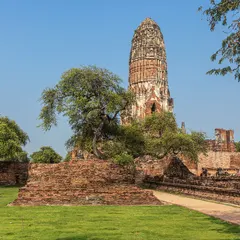
The route ends at the foot of the central prang, the 35-metre tower that presides over the courtyard from the raised platform it shares with four smaller prangs, one at each corner. On each cardinal side a steep stair climbs to a large niche; only the eastern one gave onto an inner chamber. Niches and chamber held Buddha images and are empty today.
That centre has a precise meaning. The complex reproduces the cosmos of the Traiphum: the prang is Mount Meru, the four corner towers are the continents, the courtyard the oceans and the gallery the mountain ranges that close off the world. In the stucco of the five towers nail holes can be seen that probably held sheets of gilded tin: everything points to all five gleaming with gold.
In 2011, the ocean of that cosmos filled for real. The Chao Phraya flood left the temple under about 2 metres of water and damaged brick, stucco, wood and murals centuries old. Before the east stairs, the audio guide’s last stop puts the pieces of the map together and explains what was left standing after war, jungle, looting and water.