Survivor of 1767
Wat Na Phra Men Audio Guide
Planted facing the Grand Palace, across the Khlong Sa Bua, the temple from which the Burmese cannon fired is now one of the few in Ayutthaya to keep its great ubosot standing, with a gilded Buddha dressed as a king and a green stone Buddha more than a thousand years old.
- 30 min of audio
- Buddhist temple in use
Its name is an address: Wat Na Phra Men means temple in front of the royal pyre, because between its walls and the Grand Palace the cremations of the kingdom's great were held. That position, only 378 metres from the palace wall, put it in the front row of Ayutthaya's history: the truce of 1563 with Bayinnaung was negotiated there, the Burmese placed their cannon there in 1760 and their army camped there in the siege of 1766-1767. In the fall of the city it was one of the few temples that were not burned, and that is why it keeps its Ayutthaya-period buildings.
The temple the enemy used as a camp ended up as a talisman against the enemy. It is said the Burmese spared it out of superstition, because here a cannon had burst beside their king Alaungpaya; the Thai version attributes that fear to the crowned Buddha of the ubosot. In March 2023, a Thai prime minister stepped off his official schedule to prostrate himself before that image, in a gesture read as a rite to keep adversaries away.
Highlights
- Crowned Buddha — Gilded metal image of 6 metres dressed as a king, with crown, earrings and necklace
- Gilded teak pediment — Vishnu on Garuda and the head of Rahu, among 26 celestial beings
- Phra Khanthararat — Green stone Buddha of the 7th-9th centuries seated European-style
- Wihan Noi — Chapel of 1838 with a 2.60-metre gilded door and murals from the reign of Rama III
- Luang Pho Khao — Silver-clad Buddha, the focus of the neighbours' devotion
Across the Khlong Sa Bua, facing what was the Grand Palace of Ayutthaya, Wat Na Phra Men (วัดหน้าพระเมรุราชิการาม) is still in use. It is a temple that was saved by being in the worst possible place: in the front row before the palace, and for that very reason in enemy hands every time the city was besieged. While much of Ayutthaya was left in ruins, here still stand a great Ayutthaya-period ubosot, a gilded Buddha dressed as a king and, in a tiny chapel, a green stone Buddha more than a thousand years old.
The history of Wat Na Phra Men begins with a date that is not certain. According to tradition, Prince In (Phra Ong In) founded it in 1503, in the reign of Ramathibodi II, under the name Wat Phra Meru Rachikaram, but there is no firm documentation and the founder and date remain unknown with certainty. Firmer is its role in the kingdom’s wars. A year after the first fall of Ayutthaya to the Burmese, in 1569, tradition records that the king of Lawaek, in Cambodia, thought he had found a defenceless capital and stationed at this monastery some thirty elephants and nearly four thousand men; the city held out and the Cambodians withdrew with heavy losses. In 1760 and in the siege of 1766-1767, the temple courtyard was a battery and camp for the Burmese armies.
After the sack of 1767, the temple spent more than half a century abandoned, until Phraya Chai Wichit (Phuek), governor of the city under Rama III, restored it between 1835 and 1838 without leaving the Ayutthaya style and gathered here antiquities scattered among the ruins. There were further repairs in 1914 and 1957. Not everything held: according to the recorded tradition, the brick-and-mortar prang rebuilt in 1835, on a square base about 9.5 metres on a side, was destroyed in 1939 and the relics it held were stolen. The temple that survived two Burmese armies lost its tower in peacetime.
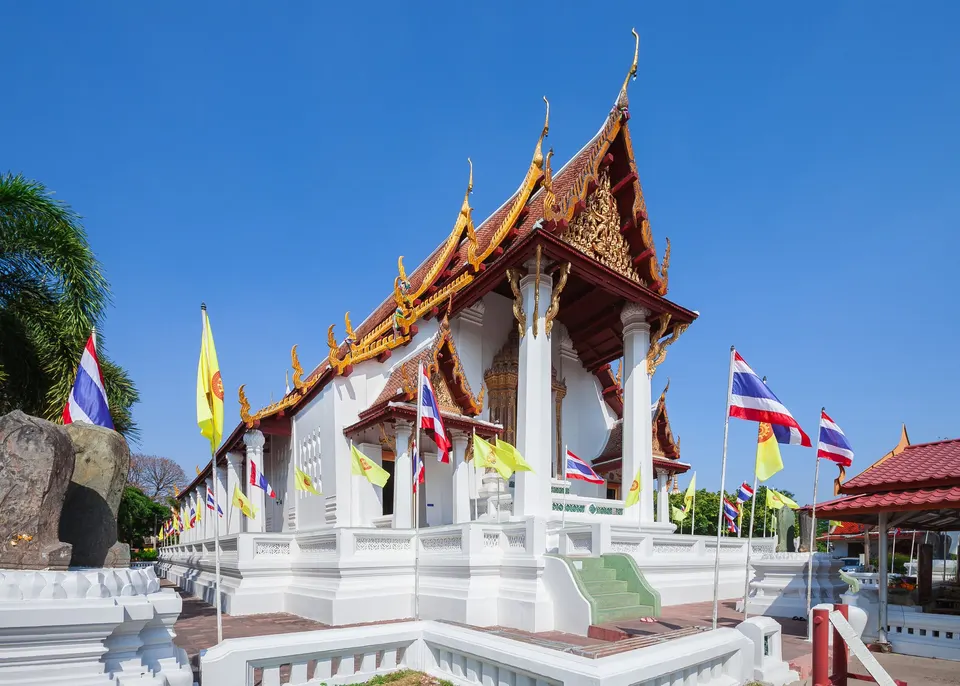
The architecture of Wat Na Phra Men is concentrated in a few weighty pieces: the ubosot with its gilded teak pediment, the nave of octagonal pillars with lotus-bud capitals, the small Wihan Noi of 1838 and a row of bell-shaped stupas behind the main hall. To know what to see at Wat Na Phra Men, the audio guide walks it in five stops and 30 minutes, from the canal bank to the vihara of the silver Buddha, with a single thread: how an enemy temple ended up working as an amulet against defeat.
Across the Khlong Sa Bua, on the site of the first palace, Wat Phra Si Sanphet shows what the sack left of the kings’ chapel, and somewhat to the southeast Wat Ratchaburana keeps standing the best preserved prang on the island.
The bank of the pyres and the truce
Khlong Sa Bua bank
Summary of this stop
The route begins beside the Khlong Sa Bua, the canal that separates the temple from the old palace compound. The open ground between the two explains the name: here stood the royal pyre, the crematorium of the kingdom’s great. In 1687-1688 the French envoy Simon de La Loubère described a singular custom: the king lit the pyre without leaving the palace, releasing a lit torch along a rope stretched from a window.
That same ground saw one of Ayutthaya’s costliest peaces. With Bayinnaung’s army before the capital, King Maha Chakkraphat negotiated in a pavilion raised between this temple and Wat Hatsadawat, with two thrones of equal height set four sok apart and, above both, a jewelled throne for the Three Jewels presiding over the meeting. The generally accepted date is 1563, consistent with Bayinnaung’s reign, although almost all versions of the Royal Chronicles place it in 1548 and others in 1549.
The price was high: four white elephants in place of the two asked at first, the handing over as hostages of Prince Ramesuan and the leaders of the war party, an annual tribute of 30 elephants and 300 catties of silver and the customs duties of the port of Mergui. From the bank, the audio guide reconstructs the scene of a court that paid for peace with its own heir.
Cannon at the foot of the gilded pediment
South facade and pediment of the ubosot
Summary of this stop
The south facade of the ubosot faces the palace, and that orientation was its fate. In 1760 the army of Alaungpaya placed its great cannon in front of the temple and bombarded the Grand Palace compound day and night until its spire fell; the next day the Burmese withdrew to the north. According to tradition, one of those cannon burst with the shot jammed in its mouth and gravely wounded the king, who lifted the siege and died on the retreat. The sources do not agree: the Thai ones speak of the explosion, and local tradition places it here although no version of the Royal Chronicles mentions the spot, while the Burmese ones attribute his death to illness.
Seven years later the scene was repeated on a larger scale. With only 378 metres between the temple and the palace wall, and the canal and moat between, Wat Na Phra Men was the main camp of the Burmese army during the siege of 1766-1767, from where the artillery battered the city.
Above that facade rises the gilded teak pediment: Vishnu (Phra Narai) on Garuda over the head of the demon Rahu, between two nagas, surrounded by 26 celestial beings on the front face and 22 on the back. Rahu is, for the Thais, the one who causes eclipses by seizing the sun and the moon, and the Pali canon holds an episode in which the Buddha orders him to release the moon god. Beneath the pediment, the audio guide tells why that demon obeyed.
A Buddha dressed as a king that nobody burned
Crowned Buddha Phra Buddha Nimit
Summary of this stop
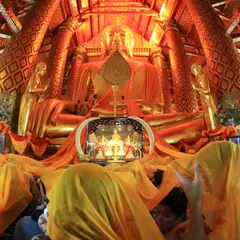
Inside the dimly lit ubosot survives an Ayutthaya-period interior that in other temples of the city can only be imagined. In the fall of 1767, the troops of Ava did not burn Wat Na Phra Men; popular memory presents it as the only temple the Burmese did not destroy, although it was one of several that were saved from the fire. The nave is presided over by the Phra Buddha Nimit Wichit Maramoli Si Sanphet Borommatrailokanat, a gilded metal image 6 metres high and some 4.5 across the lap, seated in the attitude of vanquishing Mara and dressed as a king, with crown, earrings, necklace and bracelets. It dates from late Ayutthaya, probably from the time of Prasat Thong, and its meaning is debated: some see in it Maitreya, the future Buddha; others, the scene in which the Buddha transforms himself into a great king to humble the proud King Jambupati.
Two explanations circulate about that survival. It is said the Burmese left the temple intact out of superstition, because here, seven years earlier, a cannon had burst beside their king. The Thai version turns the fear around: it is the crowned Buddha who inspires such dread in enemies that they do not dare enter.
The walls, by contrast, keep an absence. On the interior walls of the ubosot a scene of 80 Buddhist monks was painted; when the hall was restored, the painting was covered in white lime and vanished from sight. Before the Buddha, the audio guide sets the two legends against what lay beneath the whitewash.
The green Buddha who sits on a chair
Phra Khanthararat in the Wihan Noi
Summary of this stop
Beside the ubosot stands the Wihan Noi, the small vihara that Phraya Chai Wichit built in 1838 for a single image. It has a 2.60-metre gilded wooden door carved with celestial figures, Garuda, nagas and birds, stuccos with Chinese and European motifs and faded remains of murals from the reign of Rama III. In front of the chapel rises a 1.6-metre white stone lingam of Shiva.
Inside is the Phra Khanthararat, a green stone Buddha in the Dvaravati style, carved around the 7th-9th centuries, seated European-style, as on a chair, with feet resting on a lotus. It reached Wat Na Phra Men under Rama III, but its provenance is disputed: Phraya Chai Wichit’s inscription brings it from Wat Mahathat in Ayutthaya and says it came originally from Sri Lanka; a record from the reign of Rama V has it coming from Wat Phra Men in Nakhon Pathom, and the researcher Jean Boisselier ruled out that particular temple, though not the Nakhon Pathom area.
The head is authentic, with large curls that turn counter-clockwise against the canon; the forearms are later reconstructions, which is why both hands rest on the knees when the right one was once raised in a teaching gesture. The image also lacks its throne: the archaeologist Jean-Yves Claeys attributed to it a fragment of the same stone now in the Phra Pathom Chedi National Museum, though its findspot is not certain. Inside the chapel, the audio guide follows the trail of that missing piece.
Roots, silver and an amulet against defeat
Stupas and the vihara of Luang Pho Khao
Summary of this stop
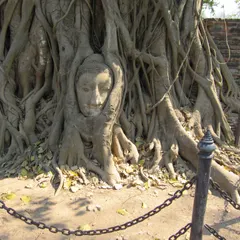
Behind the ubosot lines up a row of brick bell-shaped stupas with broken tops, one of them embraced by the roots of a banyan. A few steps away, a vihara holds Luang Pho Khao, the White Father, a Buddha in the attitude of vanquishing Mara clad entirely in silver, whose shine gives him his name and who today draws the incense, offerings and devotion of the neighbours.
That devotion is not only local. On 3 March 2023, the then prime minister Prayut Chan-o-cha, visiting Ayutthaya, left the ubosot of Wat Sala Pun and, off the agenda that was taking him to Wihan Phra Mongkhon Bophit and Wat Phra Si Sanphet, first detoured to Wat Na Phra Men to prostrate himself before the crowned Buddha. The gesture was understood as a khlet, a propitiatory act: worshipping at the temple the enemy did not destroy and whose Buddha, it is believed, keeps adversaries away. Among the brick the roots are swallowing and the silver polished by offerings, the audio guide’s last stop closes the story of a temple that still has work to do.