Royal temple of Ayutthaya
Wat Phra Si Sanphet Audio Guide
On the site of Ayutthaya's first palace, the kings reserved a chapel with no monks: three chedis hold their ashes in a row and, in front, an empty pedestal marks the spot of the 16-metre Buddha covered in gold that the sack of 1767 reduced to a lump of bronze.
- 60 min of audio
- Royal temple in ruins
In 1448 King Borommatrailokanat moved to a new palace farther north and turned the pavilions of the old one, which Prince U-Thong had finished in 1351, into sacred ground. That is how the court's private temple was born: no monk lived in it and religious figures were invited only for ceremonies such as the oath of loyalty of royal officials. Today the compound runs from east to west, from the pillars of the great royal chapel of 1499 to three identical bell-shaped chedis that, according to the chronicles, Ramathibodi II and his son Borommaracha IV raised for the ashes of three kings.
The largest thing the temple ever held is precisely what is missing. From 1500 the Phra Si Sanphetdayan was cast here, a 16-metre standing Buddha with a bronze core and a gold covering that the most widely cited figure puts at 343 kilos. In April 1767 the Burmese army melted it with fire to carry off the metal, and Rama I ended up burying its remains in a green mosaic chedi at Wat Pho, in Bangkok. Hardly anything wooden escaped the blaze: carved doors with threshold guardians, now in the Chao Sam Phraya National Museum, whose exact place within the temple is still debated.
Highlights
- Three chedis in a row — The ashes of three kings lined up from east to west on a single platform
- Pedestal of the Phra Si Sanphetdayan — The hollow left by a 16-metre standing Buddha covered in gold
- Wihan Luang of 1499 — Royal hall some 50 metres long with no windows, ventilated only by vertical slits
- Crypt of the eastern chedi — Eight stupas nested one inside another, found in 1932
- Crenellated wall — Small chedis and chapels with royal family ashes along its inner face
Within the old palace grounds of Ayutthaya stretches Wat Phra Si Sanphet (วัดพระศรีสรรเพชญ์), a brick plain that was the private heart of a kingdom. It was not a monastery in the usual sense: no monk lived in it. It was the chapel of the kings, the place where court officials swore loyalty and where the ashes of kings and members of the royal family were kept. A good part of its story is told through what is no longer there.
The history of Wat Phra Si Sanphet begins with a palace. Prince U-Thong, founder of Ayutthaya, finished his residence on this site in 1351; in 1448 King Borommatrailokanat moved to a new palace to the north and turned the old pavilions into sacred ground, the Putthawat. The date of origin has nuances: the chronicles mention offerings at the monastery of Phra Si Sanphet after the Angkor campaign of 1431, which suggests the temple already existed before that conversion. In 1638 the Dutch merchant Jeremias Van Vliet wrote that the books of law and religion composed by U-Thong himself were still kept in “the king’s most beautiful temple”, which he called Wat Siserpudt. No trace of that original library remains in the compound.
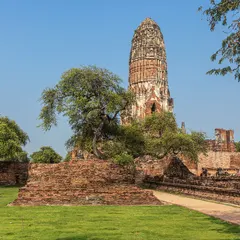
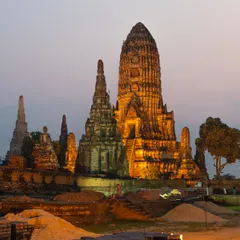
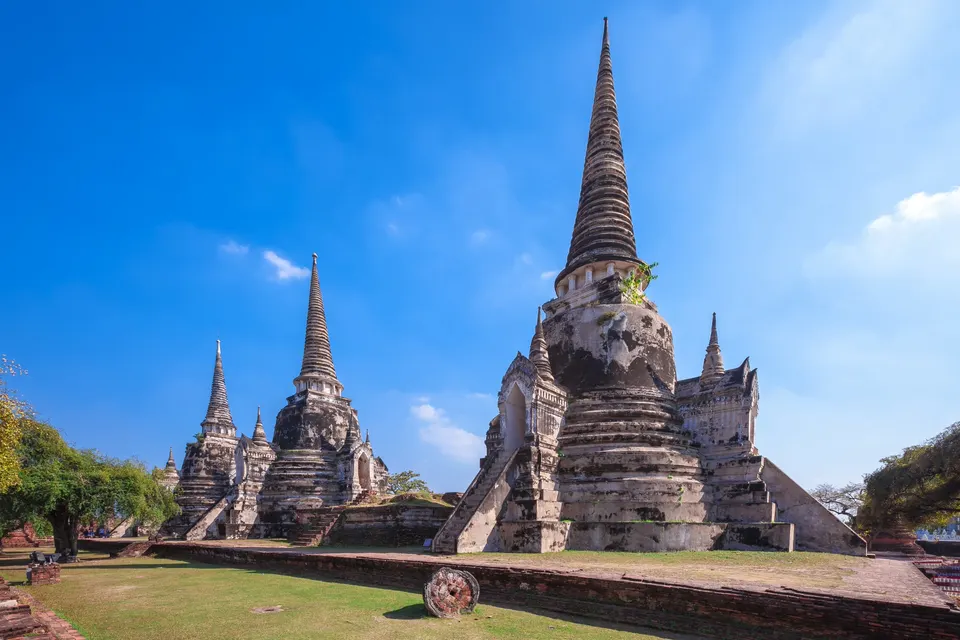
The architecture of Wat Phra Si Sanphet reads as a sequence. To the east, the ruin of the Wihan Luang, the royal chapel of 1499, with its rows of brick pillars, some with lotus-shaped capitals. Inside, the pedestal where the Phra Si Sanphetdayan stood, the 16-metre standing Buddha that took its name from the temple. Then, on a rectangular platform, the three bell-shaped chedis, each with four projecting porticoes crowned by a miniature replica of itself and a ring of small columns, the sao han, that holds up the spire: a feature typical of the Ayutthaya style. Between them peep the square bases of the mondop, and to the west the Greek-cross plan of the prasat added in the reign of Narai. A high crenellated brick wall closes it all in.
The catastrophe came in April 1767, when the Burmese army plundered and burned the temple. Only the eastern chedi was left standing; the other two were rebuilt, and in 1956 the Fine Arts Department restored all three. The two great chapels were never rebuilt.
To know what to see at Wat Phra Si Sanphet, the audio guide walks it from east to west in four stops and 60 minutes, from the head of the royal chapel to the wall that closed off the life of the court. A paradox joins them: the largest thing this compound ever held is precisely what is missing.
Across the Khlong Sa Bua, facing the old palace, Wat Na Phra Men keeps intact the interior of a temple of the period, and on the west bank of the Chao Phraya Wat Chaiwatthanaram was the setting for royal funerals.
A palace turned into a chapel for a single worshipper
Wihan Luang ruin
Summary of this stop
The route starts at the east end of the Wihan Luang, the great royal chapel. What remains is its elongated plan, with rows of brick pillars and walls pierced by vertical slits. Built in 1499 under Ramathibodi II, it measured some 50 metres divided into eleven bays of 4.6 metres, and had no windows: only those slits, which gave ventilation and a diffuse light to the interior.
Beneath these foundations stood the palace that U-Thong finished in 1351. When Borommatrailokanat moved in 1448 to a new palace to the north, the site became sacred and the temple became the private chapel of the kings within the palace compound. No monk lived here; religious figures came only by invitation, for ceremonies such as the oath of loyalty of royal officials.
That condition of a temple with no monastic community explains the scale and sobriety of the place: an immense hall designed for the court, not for the life of a monastery. From the head of the chapel, the audio guide reconstructs how this space was read when it still had a roof and who had the right to enter it.
The empty pedestal of the gold Buddha
Phra Si Sanphetdayan pedestal
Summary of this stop
Inside the royal chapel the pedestal survives where the Phra Si Sanphetdayan stood, with traces of stucco in which part of a lion’s paw can be made out. On top there is nothing. From 1500, Ramathibodi II had a standing Buddha 16 metres tall cast for this chapel on a pedestal 8 metres long, with a 2-metre head and a chest 5.5 metres wide. It had a bronze core of about 64 tonnes and a gold covering, and its making took more than three years.
The amount of gold depends on the source: 343 kilos in the most widely cited figure, 346.5 in the Muang Boran Museum and about 171 in the royal chronicle. Nor do the French travellers of the 17th century agree: Nicolas Gervaise described the image as seated with crossed legs and Guy Tachard as standing with its head touching the ceiling. Both report that it was cast right there and that the chapel was raised afterwards around it, a version that contradicts the chronicles.
In April 1767 the Burmese army melted with fire the gold that covered it and carried it all off; what remained of the image was a shapeless lump of bronze. King Rama I moved those unsalvageable remains to Bangkok and buried them in the Phra Chedi Si Sanphetdayan, a 45-metre chedi of green mosaic at Wat Pho, where they remain today. It was not the temple’s only giant: north of the royal chapel, the Wihan Phra Lokanat held a standing image of some 10 metres that Rama I also took to Bangkok, had repaired and installed in the same Wat Pho under the name Phra Buddha Lokanat. Before the pedestal, the audio guide follows the trail of the two colossi to their shared destination.
Three chedis, three kings and a looted crypt
The three chedis in a row
Summary of this stop
On a rectangular platform the three chedis line up from east to west, identical, with their porticoes crowned by miniature chedis and the ring of small columns that holds up each spire. The row works as a family tree in brick. According to the chronicles, in 1492 Ramathibodi II raised the eastern one for the ashes of his father, Borommatrailokanat, and the central one for those of his elder brother, Borommaracha III. The western one was built by Borommaracha IV, who reigned from 1529 to 1533, for the ashes of Ramathibodi II himself, the king who had raised the other two.
That dating is not settled. The art historian Piriya Krairiksh points out that 17th-century plans and views, such as those of Vingboons and Kaempfer, do not show these bell-shaped chedis, and attributes them to the complete renovation that King Borommakot undertook from 1742. What is certain is that after 1767 only the eastern chedi remained standing, that the other two were rebuilt and that the Fine Arts Department restored all three in 1956.
Beneath them there was a silent race. During the reign of Rama V the chambers of the chedis were dug out and Buddha images and a great quantity of gold objects came out, and treasure hunters kept prowling the compound. When the Fine Arts Department began to excavate in 1932, it did so to protect what was still buried. In the crypt of the eastern chedi it found a stupa made of eight stupas nested one inside another; the outer one was in pieces and the other seven are on display in the Chao Sam Phraya National Museum. Facing the row of chedis, the audio guide tells who reached those royal tombs first.
A crenellated wall and the secrets of the court
Perimeter wall and funerary chapels
Summary of this stop
The route ends beside the west wall of the compound, a high crenellated brick enclosure. Along its inner face come one after another small bell-shaped chedis and chapels where the ashes of members of the royal family were kept. The gates had proper names: the southern one was the Pratu Bowon Nimit, the “Gate of the Excellent Omen”, and the western one, the Pratu Chong Kut, opened onto the Tamnak Suan Kratai, the “Royal Pavilion of the Rabbit Garden”.
Court scenes with consequences played out between these walls. In 1611, during a revolt of Japanese merchants who entered the palace, King Song Tham was listening to the monks in the Chom Thong pavilion of the temple, and eight monks from Wat Pradu Song Tham led him out of there in front of the Japanese. Years later, in the reign of Prasat Thong (1629-1656), Prince Athittayawong, son of Song Tham, sat on the wall beside the great chapel and did not come down as the king passed: he was stripped of his rank and sent to live in a bamboo house beside Wat Tha Sai.
The temple also has a living continuation. Wat Phra Si Sanphet served as the model for the Temple of the Emerald Buddha (Wat Phra Si Rattana Satsadaram) in the Grand Palace of Bangkok, another palace temple with no resident monks. Beside the wall, the last stop of the audio guide builds the bridge between this chapel in ruins and its standing copy.