Crypt of the royal gold
Wat Ratchaburana Audio Guide
A royal temple born in 1424 from a double death, that of two princes felled in a duel on elephant back, whose prang hid a painted crypt with more than 100 kilos of gold that looters broke open in 1957.
- 45 min of audio
- Royal temple of Ayutthaya
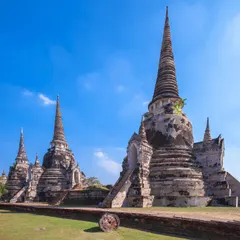
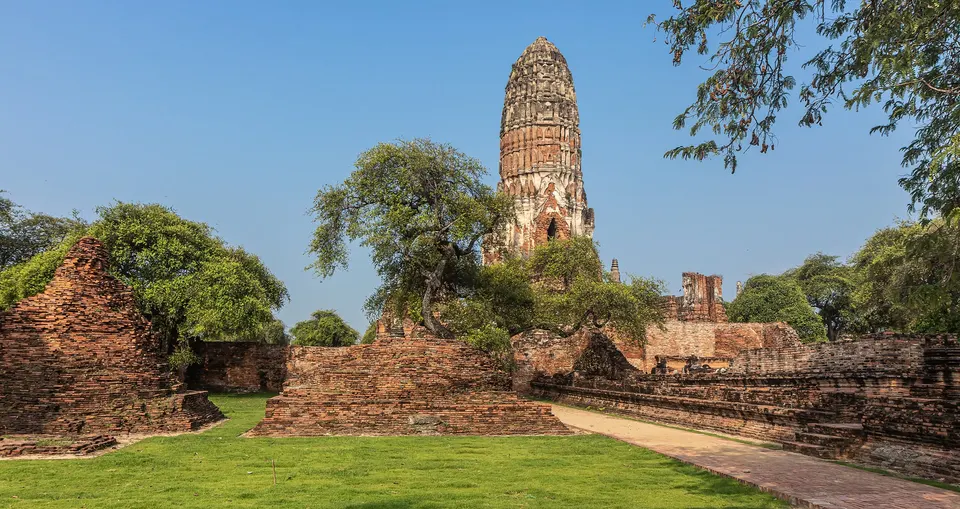
Wat Ratchaburana was founded in 1424 as a royal temple: according to official historiography, King Borommarachathirat II, also called Chao Sam Phraya, founded it to hold the ashes of his two elder brothers, killed in a duel on elephant back, although other versions of the chronicles change the date or the founder. Its corncob-shaped prang, the best preserved on the island, rises among four corner chedis that represent Mount Meru, with original stucco reliefs of garudas over nagas, between the royal vihara in ruins to the east and the ubosot to the west.
Beneath the tower lay a crypt of three stacked chambers. In 1957 a band of looters, with policemen who guarded the temple among them according to the account of the scandal, reached the upper chamber before the archaeologists, and part of the gold was sold and never reappeared. Even so, the official excavation of 1958 brought out more than 100 kilos of gold, some 2,000 offerings, more than 100,000 votive tablets and the royal sword of victory, now on display in the Chao Sam Phraya National Museum.
Highlights
- Central prang — The best preserved tower on the island, with four chedis tracing Mount Meru
- Three-chamber crypt — Murals with figures and Chinese characters almost faded away
- Stucco garudas — Original reliefs of mythical birds swooping on nagas
- Treasure of 1958 — More than 100 kilos of gold and the royal sword Phra Saeng Khan Chai Si
- Chedi Ai and Chedi Yi — Two chedis on the site of the elephant-back duel of 1424
In the centre of the old island of Ayutthaya stands Wat Ratchaburana (วัดราชบูรณะ), a royal temple whose prang, the corncob-shaped tower, is the best preserved on the island. From outside it looks like one more ruin, of brick and headless Buddhas; inside it was a strongbox. Beneath the tower lay a crypt of three stacked chambers that held gold, relics of the Buddha and more than a hundred thousand votive tablets, until in 1957 a band of looters got there before the archaeologists.
The history of Wat Ratchaburana begins with a duel. In 1424, on the death of King Intharacha, his sons Chao Ai Phraya and Chao Yi Phraya faced each other on elephant back beside the Pa Than bridge, and both died in the fight. The younger brother, Chao Sam Phraya, by then King Borommarachathirat II, had two chedis raised on the site of the duel and founded the temple to hold his brothers’ ashes. That is how official historiography, based on Damrong Rajanubhab, sets it down; the Luang Prasoet version of the chronicles dates the duel to year 786 of the Chula Sakarat era, and other versions attribute the foundation to Ekathotsarot. Nor is there agreement on whom the monument was dedicated to: the two brothers, the cremation of their father Intharacha or, as the Chao Sam Phraya National Museum maintains after studying the gold, the relics of the Buddha found in the lowest chamber.
The architecture of Wat Ratchaburana is arranged on an east-west axis: to the east, the great royal vihara, now only walls and foundations; in the centre, the prang with its four corner chedis, an image of Mount Meru; to the west, standing apart, the ubosot with its raised porch; and all around, the bases of the cloister that enclosed the tower. The temple has been through fire and water. According to documented tradition, on a Friday night in December 1766 a great fire broke out at Tha Sai, the sand landing, advanced toward Wat Ratchaburana and Wat Mahathat and destroyed more than ten thousand monastic buildings and houses; that same night the future King Taksin fled his camp and saw the city lit by flames from afar. In the autumn of 2011, floods severely damaged the temple.
To know what to see at Wat Ratchaburana, the audio guide walks it in four stops and 45 minutes, from the royal vihara to the crypt and back to the cloister. The treasure is no longer here: the gold, the royal sword and the tablets are on display in the Chao Sam Phraya National Museum, a few minutes’ walk away, which also keeps a life-size, true-colour reproduction of the murals of the crypt’s second level, in ceramic tiles printed in Shiga (Japan), because the crypt is expected to close to the public owing to its progressive deterioration. What remains in the temple is the tower, empty like an open strongbox, and the story the audio guide tells inside it.
Opposite, Wat Mahathat hid beneath its prang another crypt, opened in 1956. Another elephant-back duel, Naresuan’s in 1592, is associated with the great chedi of Wat Yai Chai Mongkhon, and to the north, past the Khlong Sa Bua, Wat Na Phra Men is one of the few temples that saved its interior in 1767.
A royal hall for two dead brothers
Royal vihara
Summary of this stop
The route begins at the east end, in the royal vihara, the temple’s great assembly hall. Today only its walls and foundations remain: the multi-tiered wooden roof is gone, and vertical ventilation slits open in the windowless walls. To the west, at the far end, the prang rises.
Everything seen from this hall exists because of a duel. In 1424, on the death of King Intharacha, his elder sons, Chao Ai Phraya and Chao Yi Phraya, faced each other on elephant back beside the Pa Than bridge. Both fell gravely wounded, their throats cut in the same instant, and died in the fight. The younger brother, Chao Sam Phraya, by then King Borommarachathirat II, founded the temple to hold their ashes.
Opposite the temple, at the crossing of Naresuan Road and Chikun Road, beside the Pa Than bridge, the Chedi Ai and Chedi Yi still stand, two brick chedis on octagonal bases that the king had raised on the site of the combat. From the vihara, the audio guide reads the whole temple as a memorial and reconstructs what happened at that crossing.
A crow on the tip of Mount Meru
Central prang and corner chedis
Summary of this stop
The central prang rises on a plinth with projections to the north and south in the form of wings. It is the best preserved part of the temple, and its cella is reached by steep stairs on the east, north and south sides. At its four corners, four tapering chedis, all surviving, complete with the tower a representation of Mount Meru, the centre of the Buddhist cosmos.
On the first tier of the tower, original stucco reliefs survive: garudas swooping on nagas, other mythical creatures and lotus flowers. Several garudas at the base have lost their heads. That the rest is still there is partly due to a recent restoration: after the floods of autumn 2011, the Fine Arts Department and the German project GRASP, with the Cologne University of Applied Sciences, consolidated the stuccos and the temple’s foundations between December 2011 and 2013.
According to tradition, the crown of this tower was the setting of an omen. Shortly before Ayutthaya fell to the Burmese in 1767, a crow came flying and impaled itself on the tip of the prang, and the city took the scene as a warning of its own end. At the foot of the east stairs, the audio guide raises the gaze from the garudas to that crown.
The chamber broken open in 1957
Crypt of the prang
Summary of this stop
From the cella of the prang a narrow stair descends that the Fine Arts Department built in 1958. It leads to the crypt: three large chambers stacked vertically, the lowest at ground level. The upper one, about 3 metres on a side, keeps almost faded murals of Chinese figures, with some Chinese characters still legible. Lower down, in a cell where only one person fits, the paintings show the Buddha with his disciples, trees and birds, with gilded parts.
A band of looters reached that upper chamber on 23 September 1957, while the Fine Arts Department delayed the planned excavation. The chronology varies by source: some place the plunder in 1956 and others speak of three nights of digging, from 25 to 27 September 1957. The account of the scandal adds a twist: among the looters were policemen who guarded the temple, and one of them, an officer, wanted to keep the most valuable pieces in the share-out. Drunk, he turned up at his station boasting, his commander arrested him and the arrest dragged down the whole band.
The police recovered part of the haul, around a fifth of what was stolen or less, according to that same account. An unknown amount of gold never reappeared, because it was sold at once to dealers and collectors. When the crypt is open, the audio guide tells the night of the heist in the exact place where it happened.
The sword and the gold that left
Cloister remains and beheaded Buddhas
Summary of this stop
Around the prang and its chedis remain the bases of the cloister, the gallery that ringed them, with broken, headless Buddha images. The crypt is empty, and at this last stop what counts is what came out of it. The official excavation of the Fine Arts Department, begun in 1958, brought out some 2,000 offerings and more than 100 kilos of gold, among them two pieces from Kashmir and three Buddhas from Sri Lanka. The chambers were filled with more than 100,000 votive tablets neatly stacked, with Buddha images from Thailand, India, Burma, Indonesia and Nepal.
The finest piece is the Phra Saeng Khan Chai Si, the royal sword of victory, and most of the gold consists of the monarch’s regalia. The third chamber, the lowest, held relics of the Buddha, which identifies the prang as a royal reliquary in the centre of the city. Part of the tablets was sold to fund the Chao Sam Phraya National Museum, named after the founding king and opened on 26 December 1961 to display the treasure. In 2005 news also spread of a gold helmet or crown found in a museum in the United States; its authenticity and its possible origin in this crypt remain unresolved.
Popular belief holds that the looting awakened the curse of the spirit guarding the treasure: the royal sword gave off a dazzling light, the sky turned uncanny, several looters lost their minds, the shops that bought the pieces closed and everyone involved met a tragic end. The story is associated with Pu Som Fao Sap, the ghost who guards buried treasure, and some claim to have seen the guardian chained to the model of the gold stupa in the museum hall where the treasure is shown. The locals themselves, asked in 2013, admitted the tales were greatly exaggerated, and the most famous scene, that of a maddened looter who danced in the Hua Ro market with the royal sword, clashes with the account of the arrest: the sword turned up leaning against the wall of the house where the band was dividing the loot, and that dance came years later, with a prop sword from a likay theatre. Among the headless Buddhas, the audio guide closes the route before a tower that lost its treasure and kept its story.