Great Temple of Victory
Wat Yai Chai Mongkhon Audio Guide
A living monastery of Ayutthaya, born according to the chronicles on the pyre of two princes, where the tallest chedi in the province recalls a duel on elephant back and lives spared at the request of a monk.
- 45 min of audio
- Active Buddhist monastery
Its story begins, according to chronicle tradition, in 1357, when King U-Thong founded the monastery of Wat Pa Kaeo on the spot where he had two princes dead of cholera burned, and gave it to monks ordained in Sri Lanka. The present name, “Great Temple of Auspicious Victory”, goes with the great chedi that tradition attributes to King Naresuan after his victory of 1592. Today the compound gathers that bell-shaped chedi on a terrace 15 metres high, a gallery of seated Buddhas, more than twenty satellite chedis, a reclining Buddha of some 17 metres and an ubosot of 1979.
After the fall of Ayutthaya in 1767 the monastery was abandoned; a group of Chinese dug through its ruins and found a great quantity of gold, and treasure hunters wrecked the reclining Buddha, which was not remade until 1965. In 1957 it became officially a temple with resident monks again, and on 27 October 2026, the day after the end of the rains retreat, 33 of them came down in procession from the great chedi to receive the offerings of nuns and worshippers dressed in white.
Highlights
- Great Chai Mongkhon chedi — The tallest in the province, on a square terrace 32.40 metres on a side
- East stairs — Climb to the 15-metre terrace and enter the relic chamber
- Reclining Buddha — About 17 metres in the open air, remade in 1965 after the looting
- Gallery of seated Buddhas — Rows of images with saffron cloth around the chedi
- Ubosot of 1979 — Holds the Phra Phuttha Chai Mongkhon, the main sandstone image
On the southeast of Ayutthaya island, Wat Yai Chai Mongkhon (วัดใหญ่ชัยมงคล) is not one more ruin of the old kingdom of Siam: it is a living monastery, with resident monks, grown around the tallest chedi in Phra Nakhon Si Ayutthaya province. Its name means “Great Temple of Auspicious Victory”, and the victory it alludes to is that of 1592, when King Naresuan defeated the Burmese army at Nong Sarai by killing the Burmese crown prince in single combat on elephant back.
The history of Wat Yai Chai Mongkhon begins, according to chronicle tradition, with a pyre. In 1357, year 1900 of the Buddhist era, King U-Thong, Ramathibodi I, had the bodies of Princes Chao Kaeo and Chao Thai, dead of cholera, exhumed and burned, and founded on the site of the cremation a monastery called Wat Pa Kaeo. It was occupied by a community of monks ordained in Sri Lanka in the school of the master Ratana Mahathera; U-Thong named their superior Somdet Phra Wanrat and declared the temple a royal monastery of the forest order. That origin is not settled: provincial tourism only places the foundation as a hypothesis in the first phase of Ayutthaya, and it has been proposed that the site earlier housed a Khmer complex.
That forest monastery was never outside politics. In 1548 a group of conspirators met in its preaching hall and lit candles as an oracle to decide whether to overthrow the usurper Khun Worawongsa; after the coup, Prince Thianracha rose to the throne as King Maha Chakkraphat. At the end of 1766, with the Burmese besieging the capital, the Ayutthaya fleet gathered at Wat Pa Kaeo and from here set out the vanguard of Phraya Phet Buri, who ended up captured and put to death. According to a documented tradition, among the commanders of that fleet was Phraya Tak, the future King Taksin, who fell back to Wat Phichai and Wat Kruai months before the final fall. There is even a European echo: the Dutchman Jeremias van Vliet recounts in his diary that the head of the trading post asked the abbot of a temple called Thimphiathey, a friend of his and very powerful, to intercede with the king for some Dutchmen who had got drunk and caused an uproar. Dutch maps label this monastery “Tianpiatay”, although the identification is not certain.
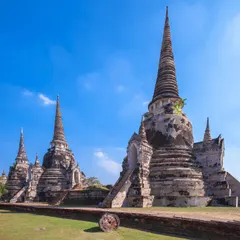
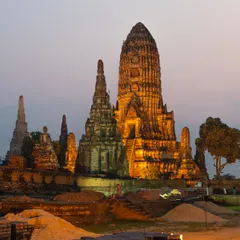
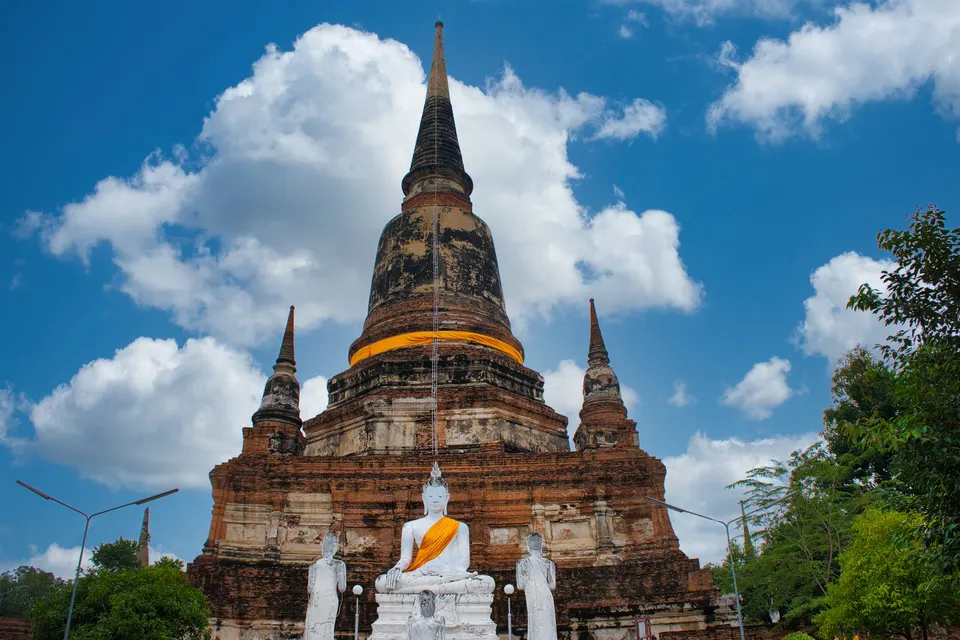
The architecture of Wat Yai Chai Mongkhon is arranged around the great bell-shaped chedi, raised on a square terrace with smaller chedis at the corners and ringed by a gallery of seated Buddhas and by more than twenty satellite chedis. Beside the entrance lies a reclining Buddha in the open air; opposite rises the ubosot rebuilt in 1979, and within the compound, a shrine to Naresuan completed in 2001. To know what to see at Wat Yai Chai Mongkhon, the audio guide walks it in four stops and 45 minutes, from the reclining Buddha to the terrace of the great chedi and the ubosot. A single thread joins them: the tallest tower of Ayutthaya celebrates not only a victory, but also lives spared.
Another elephant duel, the one in which two princes died, lies at the origin of Wat Ratchaburana, the royal temple of 1424 in the centre of the island. About 1.6 km away, beside the river, Wat Phanan Choeng is the other living temple of the southeast, with a 19-metre seated Buddha.
A white Buddha on a royal pyre
Reclining Buddha
Summary of this stop
The route starts beside the entrance, before a whitewashed reclining Buddha of some 17 metres resting in the open air among the remains of its vihan. It lies north to south, head to the south and face to the east, and its serenity deceives: it is a reconstruction of 1965.
The original figure dates from the time of Naresuan. It was left exposed when the vihan that covered it collapsed and ended up wrecked by treasure hunters. The monastery had been abandoned since the second fall of Ayutthaya, in 1767, and at some later point a group of Chinese dug through its ruins and found a great quantity of gold.
Beneath that story of looting lies an older one, that of the foundation: according to the chronicles, this ground was the pyre on which King U-Thong had Princes Chao Kaeo and Chao Thai, dead of cholera, burned in 1357. Before the white figure, the audio guide joins the cremation, the unearthed gold and the reconstruction in a single story.
The monk who asked Naresuan for lives
Gallery of seated Buddhas
Summary of this stop
The second stop walks the gallery ringing the great chedi. Along its inner wall line up rows of seated Buddhas in the gesture of calling the earth to witness, of recent make, many with a saffron-coloured cloth draped over the shoulder. Of the old covered gallery only the starts of the pillars remain in view, an absence that outlines the roof that once was. Outside, more than twenty satellite chedis of various sizes hold the ashes of the temple’s former patrons.
Above the wall the great chedi peeps out, and its origin has to do with a pardon. After the victory of 1592 at Nong Sarai, in which Naresuan killed the Maha Uparacha, the Burmese crown prince, in single combat on elephant back, the king wanted to execute the commanders who had failed to follow him into battle. The monastery’s patriarch, Somdet Phra Wanrat, came with 25 monks to ask him to pardon those soldiers and advised him to raise a great chedi in their place.
The office did not always fare so well. According to a documented tradition, in 1561 the patriarch of Pa Kaeo set the auspicious moment for Prince Si Sin, youngest son of King Chairacha and Queen Si Suda Chan, to rise against King Maha Chakkraphat. The rebellion failed, Si Sin died in the royal palace and, the cleric’s role having been proved, the king had him executed. Among the Buddhas of the gallery, the audio guide sets the two patriarchs face to face: the one who read the stars for a coup and the one who asked a king for lives.
Inside the tower of victory
Terrace of the great chedi
Summary of this stop
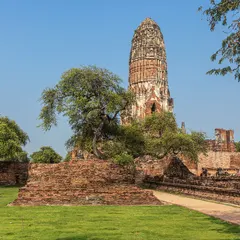
The great Chai Mongkhon chedi is a bell-shaped chedi resting on a square terrace 32.40 metres on a side and 15 metres high. A steep stair on the east side climbs to that first terrace, with a view over the compound and the plain, and enters the dome, where the chamber that held the relics can be seen. It remains the tallest chedi in Phra Nakhon Si Ayutthaya province.
What is less clear is who raised it and how tall it is. Tradition and provincial tourism attribute it to Naresuan, who would have had it built as a memorial of his victory over the Maha Uparacha, the moment when the monastery went from being called Wat Pa Kaeo to Wat Yai Chai Mongkhon. But the Royal Chronicles of Ayutthaya do not record its construction, and that Naresuan restored and enlarged it is an assumption. The height is much the same: the figure of 1 sen and 1 wa, some 42 metres, coexists with others published of about 60 and even about 92 metres.
In the 17th century, Jeremias van Vliet noted what he was told in Ayutthaya about the pointed tower of Thimphiathey, one of the kingdom’s four main temples: there, they said, a ruby of almost incalculable value was buried, guarded by the dead, faithful slaves sacrificed so that their spirits would watch over their master’s treasure forever. Whether Thimphiathey is this monastery is a disputed identification. At the top of the terrace, the audio guide tests that legend against the empty relic chamber.
Monks who returned to the ruin
Ubosot
Summary of this stop
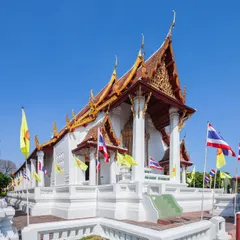
The last stop halts before the ubosot, the ordination hall. It was raised in 1979 by the abbot Phra Phawanarangsi with the Fine Arts Department: it measures 16 by 44 metres, keeps ancient remains in view and houses the Phra Phuttha Chai Mongkhon, the main image, of sandstone and partly covered in gold leaf.
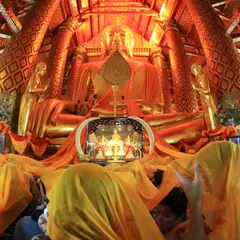
Before that building there was a return. A group of monks, novices and nuns led by Phra Chaluai Sutthamo settled in the ruins to meditate, and in 1957, year 2500 of the Buddhist era, the temple officially went from abandoned to a temple with resident monks. That community still uses the great chedi: on 27 October 2026, the day after the end of the rains retreat, 33 monks came down in procession from it in the Tak Bat Thewo rite and walked more than 300 metres to receive the offerings of nuns and worshippers dressed in white.
In the shrine of King Naresuan, within the compound, fighting cocks of ceramic and plaster pile up, offerings that Thais from all over the country bring to the warrior king. Legend has it that, as a young man, Naresuan bet a Burmese prince that Ayutthaya would be free if his cock won the fight, and the cock won; the most devout are those born in the year of the rooster, who bring ever more ornate figures in search of luck. Before the ubosot, the audio guide closes the route with the return of the monks to the house their predecessors had left in ruins.