City wall gate
North Gate Tower Audio Guide (Beimen Chenglou)
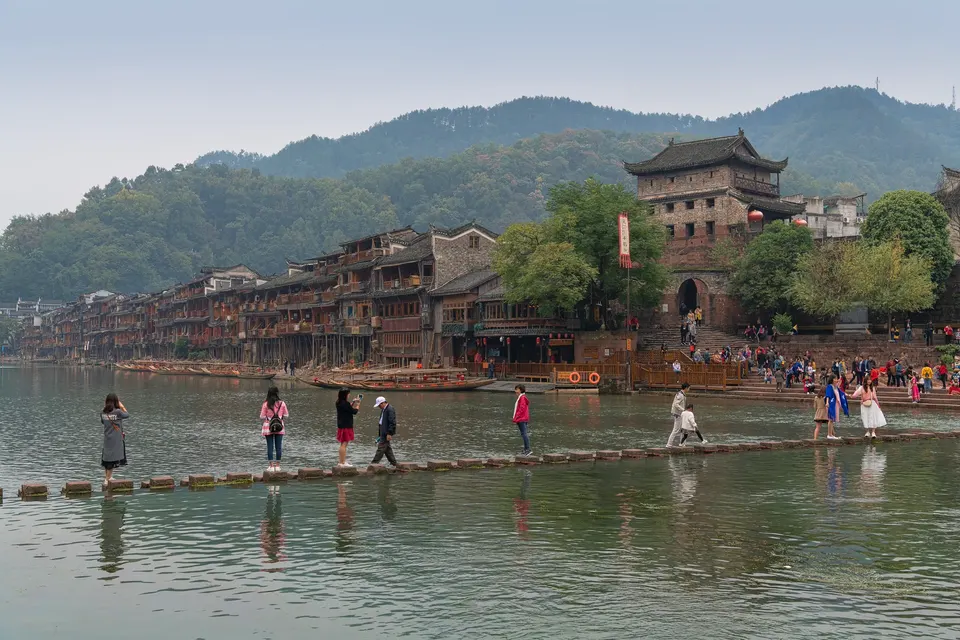
The red sandstone gate through which a frontier fortress looked out on the Tuo River: eight loopholes over the water, stepping stones to cross it that were an entrance and an assault route, and dozens of wars without the gate falling.
- 30 min of audio
- Ming and Qing wall
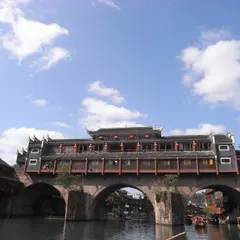
The North Gate is one of the four original main gates of the Fenghuang city wall. Its history begins in 1556, the 35th year of the Jiajing era, when the arrival of the garrison of the Zhenzhan commander from Mayang led to replacing the earth wall with a brick one with four great gates crowned by towers. In 1715, the 54th year of Kangxi, the brick was rebuilt in stone and the gate received its official name, Bihui men. Above the arch of red blocks, with its leaves lined with iron and studded with nails, rises a grey brick tower with a double eave, with fish and mythical beasts carved on the eaves.
Behind its postcard image lies a garrison city: at the start of the Qing, Fenghuang had six thousand inhabitants and eight thousand soldiers. The river that is now crossed by hopping the Tiaoyan stepping stones was one of the entrances to the city and the main route of attack in every uprising and every war; its beach, in the winter of 1911, was for almost a month the place of executions. And in the 2014 flood the entire wall lay under water, to reappear weeks later.
Highlights
- Red sandstone arch — Leaves lined with iron sheet and studded with nails under a double-eaved tower
- Loopholes on the outer face — Two rows of four embrasures to cover 180 degrees in front of the gate
- Tiaoyan stepping stones — Two rows of stone piers to hop across the Tuo, the old entrance to the city
- Wall stretch over the Tuo — A section of red-purple sandstone with a walkable parapet beside the river
- North Gate wharf — The landing stage of the wooden boats that go down the Tuo
On the south bank of the Tuo River, where Fenghuang’s red-purple sandstone wall comes closest to the water, opens the North Gate Tower (北门城楼, Beimen Chenglou). It is one of the four original main gates of the enclosure and, of them all, the one that faces the river: an arch of red blocks, two leaves of studded iron and, above, a grey brick tower with a double eave. Today it is one of the most photographed views of the old city; for centuries it was the mouth of a frontier fortress.
The history of the North Gate is written in military dates. In 1556, the 35th year of the Ming Jiajing era, the garrison of the Zhenzhan commander moved here from Mayang and the earth wall was replaced by a brick one with four great gates, each crowned by a tower. In 1715, the 54th year of Kangxi, the brick was rebuilt in stone and the gate received the official name Bihui men, which sources write in two ways, “shining wall” or “shining jade”, with the same pronunciation. Under Kangxi the city became the seat of Zhenzhan, one of the empire’s 62 regional military commands, and the military intendant of Chen-Yuan-Yong-Jing, who governed more than half of Xiangxi, moved here. At the start of the Qing, six thousand inhabitants and eight thousand soldiers lived inside the walls. Chronologies do not always agree: some sources date the city’s founding to 1704, while the wall’s history takes the North Gate back to Ming times.
Its architecture is that of a gate designed to resist. Before the round arch one crosses a curved barbican, the wengcheng; on the face toward the river, the tower opens two rows of loopholes to sweep the whole front with fire. According to the wall’s history, it has come through dozens of wars without falling. In 2023 the tower kept its worn flagstone floor and its flaking timber doors and windows, although the shops and guesthouses around it almost block the view it once had over the Tuo to the north and the city to the south.
To know what to see at the North Gate Tower of Fenghuang, the audio guide covers it in four stops and 30 minutes: from the arch, seen from the city, to the bank facing the embrasures, the Tiaoyan stone stepping stones and the wharf where the boats depart. A river crossed by hopping was an entry road, an assault route and a place of execution, and the red stone still stands after every war and every flood.
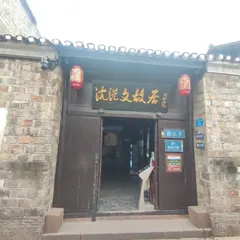
Beside the wall are the Yang Family Ancestral Hall and, barely a hundred metres away, Xiong Xiling’s Former Residence; following the bank one reaches the Hong Bridge.
Iron leaves of a garrison city
North Gate of Fenghuang
Summary of this stop
From the city side, the North Gate presents itself as what it was: a piece of a frontier fortress. The blocks are of local red sandstone; the opening, a round arch closed by two leaves lined with iron sheet and studded with large round-headed nails. Above, the grey brick tower with a double eave shows carvings of fish and mythical beasts on its eaves.
That solidity has a date. In 1556, when the garrison of the Zhenzhan commander arrived from Mayang, the city left behind its earth wall and raised a brick one with four great gates, each with its tower. It was not a city with soldiers, but almost a city of soldiers: at the start of the Qing, the eight thousand men at arms outnumbered the six thousand inhabitants.
In front of the arch, the audio guide’s first stop reads the gate as its contemporaries read it, and reveals what that studded iron said about the city.
Loopholes over the 1911 beach
Loopholes on the outer face
Summary of this stop
On the bank, facing the tower, the outer face shows its function with full clarity: two rows of embrasures, four loopholes in each, designed to cover with fire an arc of 180 degrees in front of the gate. It was no ornament. The river crossing in front of the North Gate was the main route of attack against the city in the Miao uprising of the Qianlong and Jiaqing eras, in the Fenghuang rising of the 1911 revolution and in the civil war. The gate, raised in the Jiajing era, came through dozens of wars without falling.
This bank also holds its darkest episode. According to documented tradition, in the winter of 1911, with the rising failed, the garrison went out to the villages to seize people, mostly peasants from the Miao hamlets of the northwest, and the executions, which were usually carried out outside the West Gate, were moved to the beach before the North Gate, because the “rebels” had come from the north. It is said the killing lasted nearly a month and that, when the prisoners became too many, each one’s fate was left to two bamboo slips thrown before the altar of the Tianwang temple.
From the top of this wall a boy of eight or nine watched it, who would later be the city’s great writer, Shen Congwen. Beside the loopholes, the narration tells how those slips fell and what he learned of revolution on this beach.
Rocks for hopping the Tuo
Tiaoyan stepping stones
Summary of this stop
Right in front of the gate, two rows of square stone piers cross the Tuo: these are the Tiaoyan stepping stones, whose name, “rocks for hopping”, comes from crossing the river by leaping from stone to stone. In Qing times they were one of the entrances to the city. Their origin is disputed: some trace it to the Tang with a renovation in 1704, and others give them directly as built in 1704.
A short distance away runs a narrow wooden bridge on stone piers, and sources often mix up the two structures. To that plank crossing belongs the story of the first crossing: more than forty rectangular red stone pillars that floods swept away every year, the planks that in the Republican era county chief Li Zongqi had laid, and that floods kept carrying off, and the 1950 reform, which joined the pillars two by two into 15 piers along 100 metres, with thick planks fastened with iron chains.
Today the stepping stones stage another rite: the portrait dressed as a Miao, with embroidered costume, basket on the back and silver ornaments. It seems one more souvenir, but the weight of that silver holds, according to Miao makeup artists, an explanation tied to survival in mountains full of bandits. On the stones, the audio guide reveals what a necklace has to do with an escape.
The wall that rose from the water
Landing stage of the Tuo boats
Summary of this stop
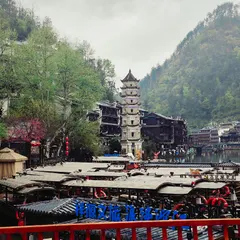
The route ends at the North Gate wharf, the Beimen matou, a few steps downstream from the tower: it is the boarding point of the wooden boats that go down the Tuo toward the southeast. From here one sees the stretch of wall that runs along the south bank, the same that in 1715 was rebuilt in stone.
That stone met its most recent test in the flood of 15 July 2014, when the wall was entirely under water. By the end of July the stepping stones were back as before, and by mid-August the last scaffolding was removed from the tower.
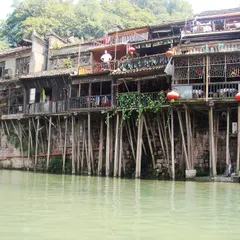
Facing the wharf cluster the stilt houses, with galleries cantilevered over the river and a continuous bench-railing with a gallant name: meirenkao, “the beauties’ backrest”. In Fenghuang they say the name hides a wait, that of the women of a city of soldiers. Beside the boats, the audio guide’s last stop explains whose wait it was and how it ended in the autumn of 1937.