
Qing clan temple
Yang Family Ancestral Hall Audio Guide (Yangjia Citang)
A clan temple of 1836 tucked against the Fenghuang wall, with its door turned toward the Tuo River so the clan's fortune would never stop flowing, and an opera stage planted before the ancestors' altar.
- 30 min of audio
- Qing dynasty
The hall was built in 1836, the 16th year of the Daoguang reign, with the money of Yang Fang, junior tutor to the crown prince, Marquis Guoyong and commander of the Zhengan garrison. Fenghuang was then a frontier garrison town known as the city of "six thousand inhabitants and eight thousand soldiers", and of its first clan temples only the Yangs' was built inside the wall, a reflection of its founder's military weight. It is a closed two-storey timber courtyard of some 770 square metres: gateway, stage, passage pavilion, side galleries and main hall.
Here the clan prayed to its dead and, a few steps away, watched opera. Every year, on fixed dates, the Yangs gathered before the tablets with the three sacrificial animals, the three bows of the rite, the bangs of the "iron cannons" and ceremonial music. The same stage hosted storytellers, shows for the people of Fenghuang and, at festivals, the ritual nuo opera to please the gods and drive off evil spirits. Today it is still in use: at fixed times a Miao wedding is staged on it.
Highlights
- Oblique door — Opened sideways and diagonally toward the Tuo River, with faded Cultural Revolution slogans beside the opening
- Opera stage — 7 by 8 metres on four columns carved with dragons and phoenixes
- Actors' doors — Lettered "Exit general" and "Enter minister", on both sides of Mother Yang educating her son
- Two-storey galleries — Boxes of the notables and the Miao "dripping water" wedding bed
- Ancestors' altar — Yang tablets behind thirteen steps, with three auspicious murals
In the stretch of wall linking Fenghuang’s East Gate and North Gate hides a timber courtyard that was at once altar, theatre and statement of power: the Yang Family Ancestral Hall (杨家祠堂, Yangjia Citang). It was built in 1836, the 16th year of the Daoguang reign, and paid for by General Yang Fang, Marquis Guoyong, in a garrison city famous for its “six thousand inhabitants and eight thousand soldiers”. Of Fenghuang’s first clan temples, it was the only one raised inside the wall. On who paid for it there are, however, two versions: some sources speak of the general’s personal donation; others, of a collection by the city’s Yang clan, which made it the place where the lineage head settled affairs and disputes.
The history of the Yang Family Ancestral Hall is that of a building that changed lives several times. It was an ancestors’ temple, with annual rites amid incense smoke, iron bangs and ceremonial music; it was also a public venue for hearing storytellers and watching opera, including the ritual nuo opera of festivals. When it lost its clan function it became a factory, offices and housing, until in March 2001 the county government allotted 500,000 yuan to restore it and that same year it opened to the public. Beside the door, the 1836 façade still keeps faded Cultural Revolution slogans.
Its architecture follows a closed two-storey rectangle of some 770 square metres, although one passage in the sources raises the figure to 800: gateway, stage, passage pavilion, side galleries and main hall. The oddity is in the entrance. Unlike the usual clan halls, its door opens sideways and diagonally, oriented toward the Tuo River so that the clan’s fortune would flow endlessly, like its water. Inside, an opera stage looks straight at the ancestors’ altar.
Behind it all is a man whose biography weighs more than timber. Yang Fang captured the rebel Jahangir Khoja alive in Kashgar, was banished for cowardice and rehabilitated, and in his last years dragged along an anecdote that circulates to this day: that of the chamber pots he supposedly set out before the British ships at Canton during the First Opium War. It is recorded by an anonymous Qing-era chronicle, but his own memorial to the throne speaks of tung oil barrels on rafts for a fire attack, and the British account of the campaign mentions nothing of the kind. To know what to see at the Yang Family Ancestral Hall, the audio guide covers it in four stops and 30 minutes, from the crooked door to the altar at the back.
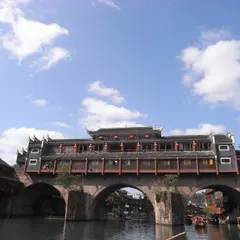
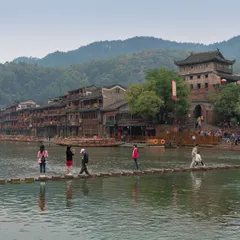
A few steps away the North Gate Tower opens in the wall, over the Tuo, and some 150 metres away the Hong Bridge crosses the river.
A crooked door toward the Tuo
Yang Family Ancestral Hall
Summary of this stop
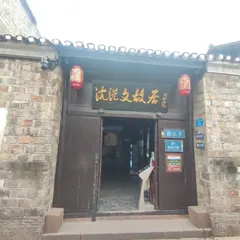
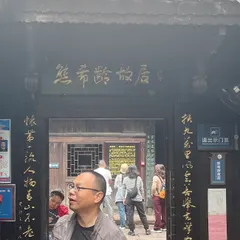
From the street, the gateway disconcerts: it does not follow the building’s axis, but opens sideways and diagonally, seeking the Tuo River. It is a licence that ordinary clan halls do not allow themselves, and the reason given is that the Yangs’ good fortune should run without running out, like water. Beside the opening, the 1836 façade keeps a layer from another era, the faded remains of slogans painted during the Cultural Revolution.
The location says as much as the door. Fenghuang was a garrison town on the frontier, the city of “six thousand inhabitants and eight thousand soldiers”, and the Yang hall was the only one of its first clan temples built inside the wall, pressed against it. Its founder, according to the most cited version, was Yang Fang, junior tutor to the crown prince, Marquis Guoyong and commander of the Zhengan garrison.
Behind the first door appears the second, with a carved ox head to ward off evil and bats that bring good luck. Before the gateway, the narration explains why the temple of a general born in Guizhou ended up inside the walls of this garrison city.
An opera stage facing the dead
Opera stage
Summary of this stop
In the middle of the courtyard, the stage dominates: 7 metres wide by 8 deep, a single-eaved hipped roof with gables and raised tips, and four columns carved with dragons and phoenixes. At the back appears a painting of “Mother Yang Educates Her Son” under the inscription “Her fame shakes the Three Passes” (威震三关). The two doors through which the actors entered and left are lettered “Exit general” and “Enter minister”: quite a programme for a clan of soldiers.
This stage was a public venue in Fenghuang for storytellers and opera, and at festivals it hosted the ritual nuo opera, meant to please the gods and expel evil spirits. Today it keeps the custom in its own way: folk shows are scheduled daily and, at fixed times, a Miao wedding is staged before the Yang altar.
Local legend has it that the Yangs of Fenghuang descend from the Yang generals of the Song dynasty, the same ones who people Chinese opera, and even names the chain: Yang Ye, Yang Yanzhao, Yang Wenguang, Yang Banghuai… and a Yang Shenglong who, with his two brothers, supposedly arrived here in command of troops to put down a Miao uprising. No open source documents that genealogy. Facing the stage, the audio guide reads each inscription as a message from the clan.
Timber boxes that were a factory
Galleries and Miao exhibition
Summary of this stop
Facing the stage opens a courtyard of some 40 square metres paved with red sandstone, surrounded by two-storey galleries with windows and doors of openwork lattice. From up there, the families of the notables followed the performances. Among the audience below was a boy who would become one of Fenghuang’s great names: the painter Huang Yongyu came as a child, with other future figures of the town, to watch opera on this stage while the clan elders looked on from the upper floor.
Those same boxes knew a far less ceremonial life. When the hall stopped being a clan temple, it served as a factory, offices and housing. The restoration came in March 2001, with 500,000 yuan from the county government, and that year the building opened to the public.
Today the side galleries hold a small exhibition of everyday objects and Miao crafts. The most striking piece is a wedding bed called the “dripping water bed” (dishui chuang), with an eave that imitates that of stilt houses. In the galleries, the narration reveals what that name has to do with Miao brides.
Thirteen steps to Marquis Yang Fang
Altar of the Yang ancestors
Summary of this stop
Thirteen steps and a pebble courtyard separate the courtyard from the main hall, with its frame of stacked beams. In the centre are the tablets of the Yang ancestors; in front, three auspicious murals: lions playing with a silk ball, the carp leaping the Dragon Gate and the qilin that brings sons. At the sides, the clan’s maxim: “the ancestors’ virtue is distant; may the sons never cease to follow it”.
The name that presides over this place is that of Yang Fang (1770-1846), born in Songtao, in Guizhou. In 1828, in the Kashgar campaign, he captured the rebel Jahangir Khoja alive and earned for it the hereditary title of Marquis Guoyong. He had retired through illness in 1835, but in 1836, the same year the hall was founded, he was called back with the rank of brigadier general to quell a mutiny of soldiers in Fenghuang.
It was not his first mutiny. According to documented tradition, thirty years earlier, in 1806, the Ningshan garrison in Shaanxi rose against the officer who replaced him, and the rebels put Yang Fang’s young wife in safety. The court accused him of negligence and cowardice and banished him to Ili, and that loyalty ended up costing his soldiers dearly. Before the altar, the audio guide tells how the story ended and why, after hearing it, the clan’s maxim sounds different.