The writer's birthplace
Shen Congwen's Former Residence Audio Guide (Shen Congwen Guju)
The timber courtyard house a general grandfather built in 1866 in a Fenghuang alley, where Shen Congwen, author of "Border Town", was born: the family sold it in 1919 and it did not open to the public until 1988, the year of his death.
- 40 min of audio
- 1866 courtyard house
The house was built in 1866, the fifth year of the Tongzhi era, when Shen Hongfu, the writer's grandfather and a former military commander of Guizhou, bought an old dwelling, tore it down and raised his own on some 600 square metres. It is a siheyuan with two successive courtyards, a chuandou timber frame, fired-brick enclosure and, in the centre, a skylit courtyard paved with red stone blocks: 11 rooms in all. A Hunan provincial monument since 1991, in 2006 it entered the sixth batch of nationally protected monuments.
The man whose name is on the plaque at the entrance never slept here again. When he returned to Fenghuang in 1982, at almost 80, the house was no longer the family's, and he stayed as a guest in someone else's little timber house on the south bank of the Tuo River, with a notice chalked on the door about a fierce dog. He came back for good only in 1988: that year he died in Beijing, part of his ashes returned to the river and the house opened its doors.
Highlights
- Red stone skylit courtyard — The open-sky tianjing where Shen Congwen played as a child, among 11 timber rooms
- Display cases of his books — Border Town, The Long River and the 32 volumes of the Complete Works
- Photo of the Jinbianxi stream — Zhang Zhaohe fixes his shirt collar on his last journey home
- Furniture from Beijing — Pieces of flaking paint from his Beijing home, in the half-light of the back courtyard
- Shen Hong's calligraphy — The scroll his granddaughter wrote with a brush in 1991, hung on the plank wall
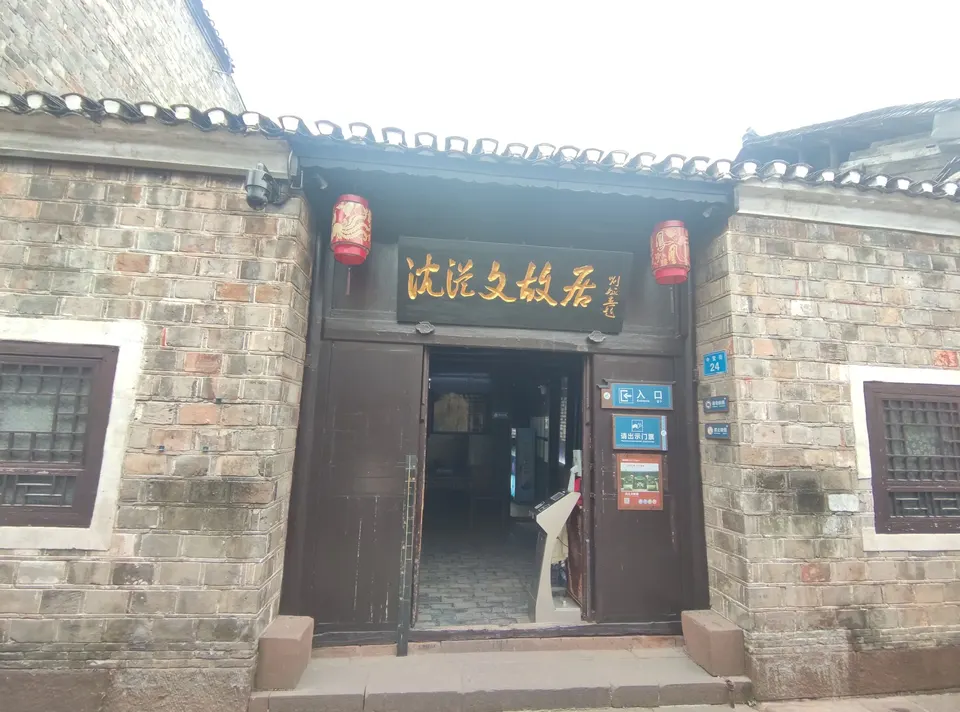
Turning a grey corner of Zhongying Street, in Fenghuang’s old town, a west-facing gateway appears with five characters over the lintel: 沈从文故居 (Shen Congwen Guju). This is Shen Congwen’s Former Residence, the timber courtyard house where on 28 December 1902 Shen Yuehuan was born, the boy who jumped the school wall to go and watch the boats on the Tuo River and who, as Shen Congwen, would write “Border Town”. At the time the city was not even called Fenghuang, but Zhen’gan.
The history of Shen Congwen’s Former Residence begins with a soldier. His grandfather, Shen Hongfu, was a local hero who rose to decorated general and acting commander-in-chief of Guizhou province at only 25. In 1866, the fifth year of the Tongzhi era, he bought an old dwelling, tore it down and raised this one. The date has its small tangle: a recent report places it in 1856, but the Tongzhi year, the heritage record and the rest of the sources hold to 1866, thirty-six years before the writer’s birth. Tourist listings do not agree either on the street number; all of them, though, place it on Zhongying.
The architecture of Shen Congwen’s Former Residence is that of a siheyuan with two successive courtyards, front and rear, with a chuandou timber frame, fired-brick enclosure and firewalls ending in stepped profiles with raised corners. In the centre opens a skylit courtyard paved with square blocks of red stone, flanked by side wings with carved lattices that filter the light: 11 rooms over some 600 square metres. It was declared a protected monument of Hunan in 1991 and, on 25 May 2006, the State Council included it among the nationally protected monuments.
To know what to see at Shen Congwen’s Former Residence, the audio guide covers it in four stops and 40 minutes: the alley gateway, the red stone courtyard, the study with the cases of his books and the rear courtyard hall, with its portrait, the family photos and the furniture that came from Beijing. The thread is a single one: a house of soldiers raised a writer who lost it as a child, came back to his city as a guest and only returned for good when he was no longer there.
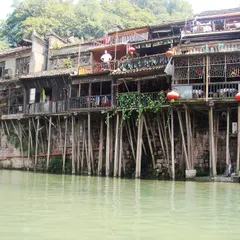
The “skinny legs” he described still hold up the Huilongge Stilt Houses, and some 300 metres away stands Xiong Xiling’s Former Residence, the cradle of Fenghuang’s other illustrious son, who became prime minister.
A general’s house in a crooked alley
Shen Congwen's Former Residence
Summary of this stop
Nothing on the gateway announces a house of power. It is a discreet door in a crooked alley, with the name plaque over the lintel and, above the roofs, the brick walls that close the complex and step up toward the sky with raised heads at the corners. From the street one cannot guess that behind it lie two courtyards and eleven rooms.
The one who had it built was Shen Hongfu, the writer’s grandfather. A local hero, he rose to decorated general and was named acting commander-in-chief of Guizhou province at only 25. In 1866 he did not look for an empty plot: he bought an old dwelling, tore it down and built his own in its place, on some 600 square metres, in the heart of the old town.
That is the paradox with which the visit begins: a general’s house ended up remembered by a grandson who put down arms to write. In front of the gateway, the narration tells how this house of soldiers was raised and what remained of it when the boy who would give it its name was born.
Red stone: the writer’s first school
Red stone skylit courtyard
Summary of this stop
Past the street range, turned into an exhibition room with yellowed photographs and manuscripts on all four walls, the skylit courtyard opens: an open-sky square paved with red stone blocks, with the side wings on both sides. It is the heart of the siheyuan, the patch of sky around which the whole house is ordered, and the very floor that Shen Yuehuan walked as a child, born here in 1902.
According to documented tradition, in this courtyard the boy chased butterflies, caught dragonflies and listened to the elders tell stories of sorcerers, spirits and demons of nuo, the ritual theatre of the mountains of western Hunan, and of the pirates who raided the river. Outside, in the nearby lanes, he planted himself before the wooden puppet theatre and before the Miao who turned somersaults and walked on their hands, scenes he himself left written in “My Primary Education”.
The other school, the official one, bored him: he slipped out of the private school over its back wall to go to the bank of the Tuo, to watch the coming and going of boats and the women who beat clothes as they washed them. In the centre of the courtyard, the audio guide reconstructs how the Fenghuang that would later fill his novels began to be told here.
An old table and a sold house
Study with the young writer's photo
Summary of this stop
To the left of the courtyard lies the study, an austere room: an old wooden table, a few chairs, a bookcase and, on the wall, a photo of the young writer, thin-faced and stubborn-eyed. Beside it, in the side wing and under the light of the lattices, the display cases gather his books, “Border Town”, “Notes from a Trip to Hunan”, “Autobiography of Congwen”, “The Long River”, and the 32 volumes of his Complete Works, lined up one after another.
The general’s house did not last another generation. After the founding of the Republic of China in 1912, his father, Shen Zongsi, joined a failed plot to assassinate President Yuan Shikai and had to hide in Inner Mongolia; from then on the family fortune dwindled. In 1917, with most of the land already sold, Shen Congwen finished primary school and left the house: at about 14 he joined a local militia and later served as a clerk in a regiment in Chenzhou. When he returned in 1919, with his father missing, he and his mother agreed to sell the house and leave for Zhijiang, under the wing of an uncle who was the local police chief.
Behind the family photos there is also a shadow, that of his younger brother Shen Quan, nicknamed Balu, a well-known marksman who in 1937 led a regiment against the Japanese and came out of the battle with little more than a hundred men. His end, in 1951, is a story told by hearsay and sometimes misdated, and in the study the narration relates it with the caution it deserves, beside the volumes his brother came to write.
Coming home as a guest
Portrait and bust in the main hall
Summary of this stop
The route ends in the main hall of the rear courtyard, presided over by a portrait of the bespectacled writer and, beneath it, a bust with a smiling face. In the surrounding rooms, in half-light, wait old pieces of furniture with flaking paint: much of it comes from his Beijing home, the city he reached in 1923 and where he died, and was brought to Fenghuang. On the plank wall hangs the scroll in regular script that his granddaughter, Shen Hong, wrote with a brush and in tears on visiting the house in February 1991.
Among the photos from different periods there is one he preferred to all those of his old age: the one taken at the Jinbianxi stream in Zhangjiajie, at about 80, in which his wife, Zhang Zhaohe, fixes his shirt collar. It is from the last journey home, that of 1982, before which he changed his official ethnicity to Miao. The son of a father of Han and Miao descent and a Tujia mother, he had kept secret until the 1980s the origin of his mother and paternal grandmother, and even so he considered himself Miao.
On that return he did not sleep in the house where he was born, but in someone else’s, and wept in silence on hearing the drums and gongs of a nuo performance. He returned for good in 1988: he died in Beijing, part of his ashes was scattered in the Tuo and the rest rests at the foot of Mount Tingtao, beside a five-coloured stone he chose himself. That same year the house opened to the public. In the hall at the back, the audio guide’s last stop tells how that journey back went and what made the writer weep.