Qing guild hall
Wanshou Palace Audio Guide
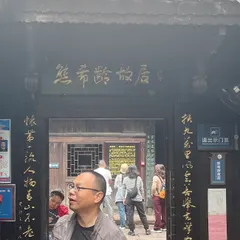
The guild hall the Jiangxi merchants raised beside the Tuo River with its three doors lined up with the three arches of the Hong Bridge, so that wealth would enter with the water, and which survived being a banknote printing house, barracks and school.
- 40 min of audio
- Qing dynasty
It was built in 1755, the 20th year of the Qianlong emperor, by the merchants from Jiangxi province who did business in Fenghuang, and for almost 200 years it was their guild hall, dedicated to their patron Xu Zhenjun. In 1854 Yang Si added the Xichang Pavilion and in 1928 the Yang Tower was raised beside the gateway. The 20th century turned it into a banknote printing house, barracks, textile factory, school and granary, and of the whole complex only the great gateway and the main hall survived. Today it is the Fenghuang Art Museum and, outside Jiangxi, one of the two best-preserved Wanshou in China.
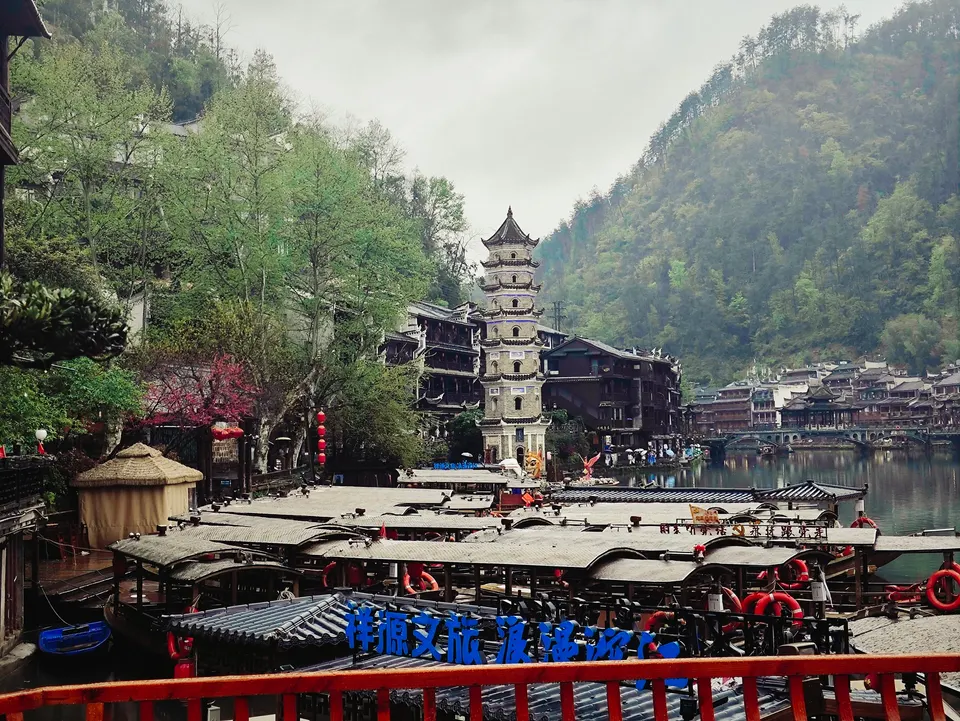
Beside it rises the Wanming Pagoda, the Pagoda of Ten Thousand Names. It stands on the site of a tower kiln where written paper was respectfully burned, demolished during the Cultural Revolution, and it was raised between 1985 and 1988 by the people of Fenghuang on the initiative of the painter Huang Yongyu. And legend has it that, on the hillside opposite, the locals answered the rich outsiders with a silent duel of temples, windows and spires.
Highlights
- Great gateway with three doors — Lined up with the three arches of the Hong Bridge, some 100 m upstream
- Two-storey opera stage — Dances and folklore every day before the main hall
- Main hall — 22 columns, the image of Xu Zhenjun and the Iron Pillar tablet
- Porcelain ridge — A glazed gourd between two dragons made of coloured fragments
- Wanming Pagoda — 7 hexagonal storeys raised by a whole town over the ruins of a paper kiln
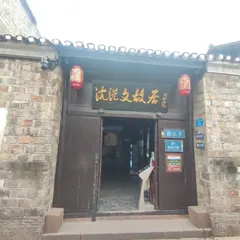
On the banks of the Tuo River, a hundred metres downstream from the Hong Bridge, stands the Wanshou Palace (万寿宫), also called the Jiangxi Guild Hall. It was not built by a Fenghuang clan or an imperial official, but by outsiders: the merchants from Jiangxi province who did business in the city and who needed, far from home, a place of their own to meet, pray to their patron and sleep among fellow countrymen. Most sources date its construction to 1755, the 20th year of the Qianlong emperor; another moves it back to 1747, and a third places its origin in the late Ming or early Qing, with 1755 as the year of the great work.
The history of the Wanshou Palace was written in layers. In 1854, the 4th year of Xianfeng, Yang Si added the Xichang Pavilion on the west side; in 1928, the 17th year of the Republic, the Yang Tower was raised beside the north side of the main gate. Then came uses no merchant would have imagined: during the Republic and the early years of the People’s Republic, the compound was a banknote printing house, barracks for suppressing banditry in the counties of Feng, Ma and Lu, a textile factory, a primary school and a grain store. Most of the halls were remodelled or demolished. Only the great gateway and the main hall were left standing, and even so it is, along with the one in Huize, Yunnan, one of the two best-preserved Wanshou outside Jiangxi.
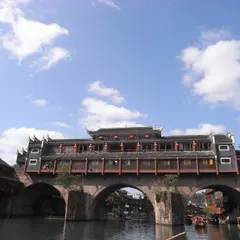
Its architecture is understood from the river. The gateway’s three doors face the three arches of the Hong Bridge head on; behind them, nine steps flanked by stone lions climb to the courtyard, where a two-storey opera stage faces the main hall, held up by 22 columns. On top, the small-tile ridge unfolds clouds, flowers and animals, with chiwen finials at the ends and, in the centre, a glazed gourd between two dragons made of fragments of red, orange, yellow, blue and purple porcelain. Today the former guild houses the Fenghuang Art Museum, with a room devoted to the painter Huang Yongyu, and beside it rises the Wanming Pagoda.
To know what to see at the Wanshou Palace, the audio guide covers it in four stops and 40 minutes: from the gateway facing the bridge to the stage courtyard, from the patron’s hall to the foot of the pagoda, by the water. The thread is a single one: the home away from home of some outsiders who opened their doors to the river so that fortune would enter with it.
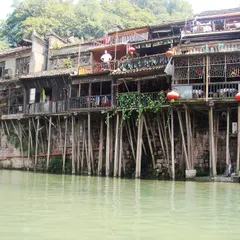
Its doors face the Hong Bridge, a hundred metres upstream, and downstream stretch the Huilongge Stilt Houses, hanging over the same river.
Three doors pointing at the Hong Bridge
Wanshou Palace
Summary of this stop
The route begins before the great gateway, one of the two parts of the complex that withstood the 20th century. It is tall and opens in three doors, and its orientation is no accident: all three face the three arches of the Hong Bridge head on, visible some 100 metres upstream. The idea was that wealth would enter the palace just as the Tuo’s water reaches the city, pushed by the current and through the bridge.
Those who designed it this way were the Jiangxi merchants settled in Fenghuang, who in 1755 raised their guild hall here. Pressed against the north side of the gateway peeks out the Yang Tower, added in 1928, when the building had already stood for more than a century and a half. Outside their home province, only the Wanshou in Huize, Yunnan, is as well preserved as this one.
That axis between doors and arches is the first key to reading the building, and it does not end at the threshold. In front of the gateway, the narration tells how far that line drawn from the river reaches.
From merchants’ refuge to barracks
Two-storey opera stage
Summary of this stop
Past the door, a staircase of nine steps with a pair of carved stone lions raises the entrance hall above the courtyard. Facing the main hall, to the right of the entrance, stands an old two-storey opera stage that has not lost its function: dances and folklore shows are performed on it every day, every half hour from 8:30 to 12:00.
For almost 200 years, the compound was the home of the Jiangxi merchants in Fenghuang. It is said that any merchant from that province doing business far from home could stay free of charge in a Wanshou, under the protection of their patron: it was a hospitality network among fellow countrymen, long before inns with booking existed. A merchant who poled up the river to this city knew he had a roof here.
The 20th century broke that custom without ceremony. Banknote printing house, barracks against banditry in three counties, textile factory, primary school and granary: each use left its mark, and most of the halls disappeared or were remodelled. In the courtyard, the audio guide reconstructs that path from refuge to barracks before the stage that sounds once more today.
The Iron Pillar and the ray of sun
Image of Xu Zhenjun
Summary of this stop
The main hall rests on 22 columns joined by beams and lintels that form a wide-span timber frame. Inside it keeps the image of Xu Zhenjun, the Lord of Jingyang, the name by which Xu Xun is known, the protective patron to whom Jiangxi emigrants dedicated their Wanshou all over China. Above the hall, a horizontal tablet bears four characters, 铁柱功崇, “Tiezhu gong chong”: “Exalted is the merit of the Iron Pillar”.
Those four characters point to a founding legend born in Nanchang, gathered by tradition. More than 1,600 years ago, a jiao dragon stirred up storms at the Zhang River wharf and ravaged the city. Xu Xun, who had left his post as magistrate of Jingyang, fought it with his magic sword, cast an iron pillar and left it chained in a deep well beside the Guangrun gate. When he ascended to heaven, the townspeople raised a shrine to him there, the Iron Pillar Wanshou, the mother house of all those the Jiangxi merchants went on building across the country.
A local tradition adds a detail that closes the axis as seen from outside: on clear summer and autumn days, the setting sun is reflected in the Tuo, crosses the central arch of the Hong Bridge and enters through the middle door of the palace. Where that light comes to rest is told in the narration, before the patron’s image.
Ten thousand names for a fallen tower
Wanming Pagoda
Summary of this stop
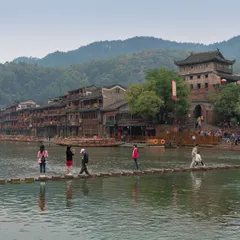
To the west of the complex lies the Xichang Pavilion, the 1854 addition, and beyond it, on the north bank of Shawan, the Wanming Pagoda. It occupies the site of the Zizhilu tower, a kiln where written paper was respectfully burned: a hexagonal brick tower of three storeys and 11 metres, which most sources date to the Jiaqing era (1796-1820) and another to 1776. The Cultural Revolution reduced it to ruins. In 1985, the painter Huang Yongyu, a native of Fenghuang whose work now has its own room in the former guild’s museum, drove with the townspeople and the local government a new pagoda, finished in 1988. It was named Wanming, “of the Ten Thousand Names”, for the collective effort that paid for it.
It has seven hexagonal storeys of grey brick, mortar and reinforced concrete, with a base diameter of 4.5 metres that shrinks by 0.3 metres on each floor, and copper bells on the eaves; its height is 22.98 metres, although one source gives 21. Above the door facing the river appear the characters 万名塔, and on the first floor, six couplets about illustrious figures. It cannot be climbed, but its walls keep adding names: visitors leave signatures and inscriptions, some more than two metres high. From its foot, looking west, one sees the Hong Bridge with its pavilion, the same axis to which the palace’s three doors point.
Legend has it that between the people of Fenghuang and the Jiangxi merchants there was a silent duel of temples: huge round windows on the hillside opposite, a small white pagoda in Shawan, different from this one, and a disquieting figure in a Buddhist temple. At the foot of the pagoda, by the water, the audio guide closes the route by revealing who was looking at whom in that duel fought on both sides of the Tuo.